- Plants
- ›Vascular Plants
- ›flowering plants
- ›monocots
- ›Agaves, Orchids, Irises, and Allies
- ›amaryllis, onions, and allies
- ›amaryllis subfamily
- ›Haemantheae
- ›Scadoxus
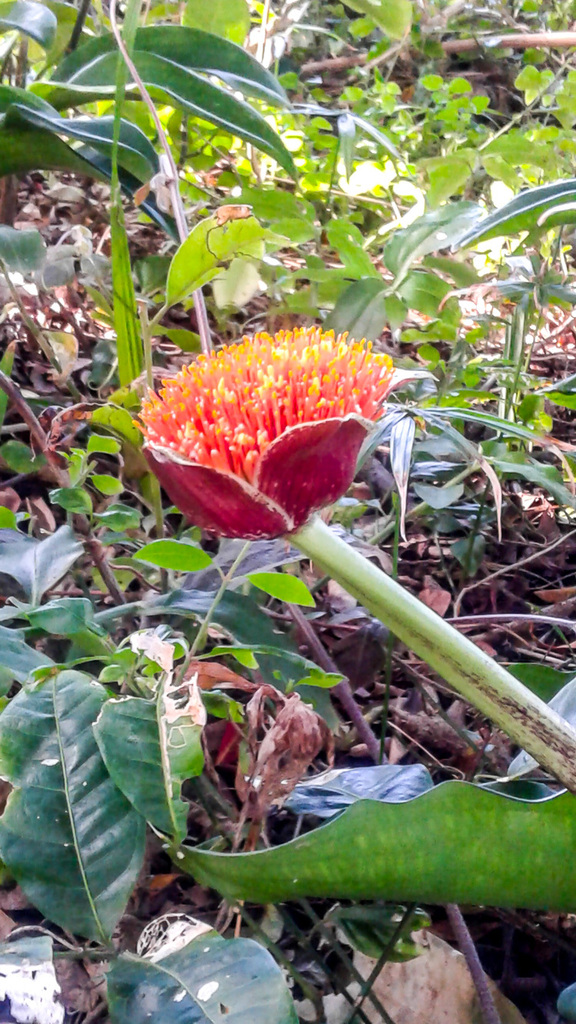
Dwarf Paintbrush Lily
Scadoxus membranaceus
Scadoxus membranaceus is a flowering plant in the Amaryllidaceae family. It is a bulbous plant from South Africa (east Cape Province, KwaZulu-Natal). The smallest of the species of Scadoxus, it is sometimes cultivated as an ornamental plant where a minimum temperature of 5 °C (41 °F) can be maintained.
From the article Scadoxus membranaceus on Wikipedia (CC BY-SA), quoted section by section
Description
Scadoxus membranaceus is the smallest of the species in the genus Scadoxus. It grows from a bulb from which three or four thin leaves appear. The leaf stalk (petiole) is 3–6 in (8–15 cm) long and the leaf blade 4–6 in (10–15 cm) long. The flowers are borne in an umbel about 1.5 in (3.8 cm) across on the end of a leafless stem (scape). Bracts underneath the umbel (usually four) enclose it, more or less to the same height as the tips of the flowers. The bracts, which are usually coloured, persist throughout flowering and fruiting. Individual flowers are described as being green, pink or pale red in colour. The tepals are fused at the base forming a tube about a third of the length of the flower. The stamens and style are slightly longer than the flowers and so protrude. The ripe berries have been described as "especially showy".
Range & habitat
Scadoxus membranaceus is native to the east coast of South Africa, from the east of Cape Province in the south to KwaZulu-Natal in the north. It grows in areas of coastal sand, and on rocks as a lithophyte where there is sufficient accumulated material to form an open rooting medium.
Wikipedia: “Distribution and habitat”
Toxicity
The genus Scadoxus is known to have some strongly toxic species, containing poisonous alkaloids. These are lethal to animals, such as sheep and goats, that graze on the plants. Other species of Scadoxus have been used in parts of tropical Africa as components of arrow poisons and fishing poisons.
== References ==
How it is grown
Scadoxus membranaceus is not common in cultivation, but can be grown with a minimum temperature of 5 °C (41 °F), such as provided by a heated greenhouse in less favourable climates. An open growing medium is required, such as that used for orchids. Propagation is by seed. Pests are those of Scadoxus generally.
Wikipedia: “Cultivation”
Where it lives
Recorded sightings
—
geo-referenced records in GBIF, from museums, herbaria and field observers.
Drag the globe to turn it. Dots are where records exist, not a range map; darker means more records.
In the stacks
Searching the stacks…
Every page naming Scadoxus membranaceus in the Biodiversity Heritage Library →
This page is assembled live from iNaturalist, GBIF, Wikipedia, the Source Library and the Internet Archive. It is not yet part of the hand-edited codex. iNaturalist taxon 593764.