- Plants
- ›Vascular Plants
- ›flowering plants
- ›Dicots
- ›proteas, lotuses, planes, and allies
- ›Protea family
- ›Singlet Proteas
- ›Hairiseed Proteoid Clade
- ›Protea
- ›Pinifoliae
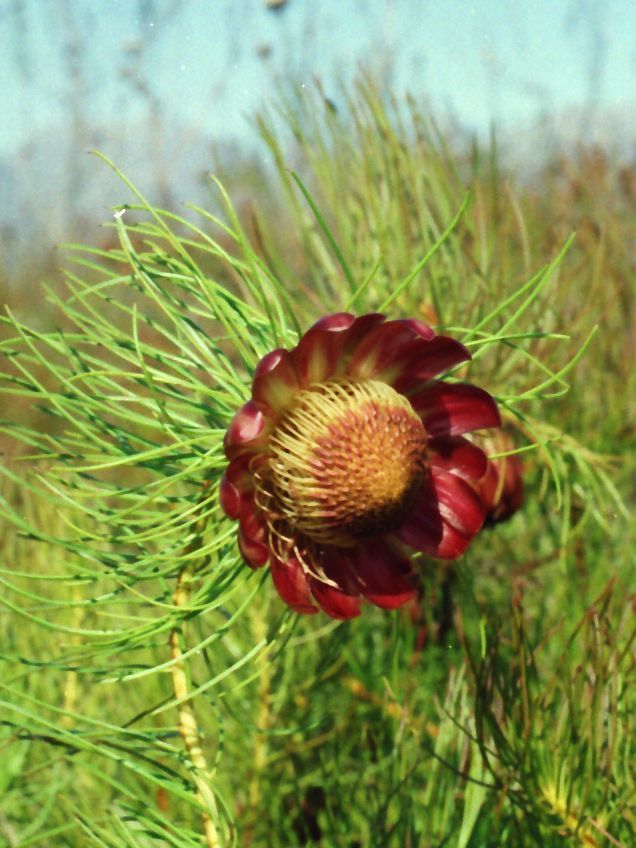
Ceres Sugarbush
Protea pityphylla
Protea pityphylla, also known as Ceres sugarbush or mountain rose (along with a number of similar species), is a flowering shrub of the genus Protea, in the family Proteaceae. The plant is endemic to the southwestern Cape Region of South Africa.
From the article Protea pityphylla on Wikipedia (CC BY-SA), quoted section by section
Description
This plant is a shrub which can grow to become up to 1 metre (3.3 ft) in height, which can grow with either somewhat erect branches or branches which have a more sprawling form. The stems are glabrous. Plants can flower from about five years of age. The leaves are linear and needle-like, ending in a piercingly sharp point. They point upwards (are ascending) and/or secund. The leaves are 1mm wide and 4–9 centimetres (1.6–3.5 in) in length, glabrous, slightly grooved or channelled, and bright green in colour. The top side of the leaf is minutely, but prominently, ribbed (costate). It blooms in the early winter, with the peak in May to July, but potentially from May to September. The inflorescences are specialised structures called pseudanthia, also known simply as flower heads, containing hundred of reduced flowers, called florets. The flower heads are sessile. The flower heads are cup-shaped, dropping and pendulous, coloured red, 1.5–1.75 inches (3.8–4.4 cm) in length, and 5–8 centimetres (2.0–3.1 in) in diameter. The flower heads are surrounded by a series of seven rows of petal or scale-like 'involucral bracts'. These bracts are all glabrous. The lowest outer bracts grow into long, leafy structures resembling the leaves. The outer bracts are ovate, acuminate, 15 to 20mm long and can end either in a sharp point or with a rounded tip. …
Range & habitat
This species has a very restricted range, occurring in an area of occupancy of only 88 km2 (34 sq mi), and it is known from only five localities. It is endemic to the Western Cape province of South Africa. Protea pityphylla is found on the mountains surrounding the Ceres valley: the Skurweberg Mountains, Hex River Mountains, and Olifants River Mountains. In the Hex River Mountains it can be found from Ceres to the Sanddrift Peaks. It occurs on Michell's Pass in the Skurweberge. There is an outlying population on the Dasklip Pass. In the few locations where it does occur, it can grow relatively densely in small isolated stands.
Wikipedia: “Distribution”
What it does
Protea pityphylla grows in mountainous areas in between large rocks and boulders, at altitudes of 500 to 1,500 metres (1,600 to 4,900 ft). The species is restricted to a single habitat which the same source describes as fynbos on sandstone-derived soils and later as high-altitude fynbos on shale-derived soils. The periodic wildfires which burn through this habitat destroy the adult plants, but the seeds can survive such an event. The old, dry, woody, fire-resistant infructescences are persistently retained on the plant for a few years, with the ripe seeds stored inside. When finally released after fires kill the mother plant and open her infructescence, the seeds are dispersed by means of the wind. They germinate during the autumn rains. In 1998 it was as yet unknown which creature may be responsible for pollination of the flowers, strangely, it produces very little nectar, and yet it has the yeasty scent typical of a protea trying to attract rodents or other small mammals as pollinators. One source states it is probably pollinated by birds. According to SANBI in 2019 birds and insects are thought to provide pollination.
Wikipedia: “Ecology”
Where it lives
Recorded sightings
—
geo-referenced records in GBIF, from museums, herbaria and field observers.
Drag the globe to turn it. Dots are where records exist, not a range map; darker means more records.
In the stacks
Searching the stacks…
Every page naming Protea pityphylla in the Biodiversity Heritage Library →
This page is assembled live from iNaturalist, GBIF, Wikipedia, the Source Library and the Internet Archive. It is not yet part of the hand-edited codex. iNaturalist taxon 592532.