- Plants
- ›Vascular Plants
- ›flowering plants
- ›Dicots
- ›proteas, lotuses, planes, and allies
- ›Protea family
- ›Singlet Proteas
- ›Hairiseed Proteoid Clade
- ›Protea
- ›Leiocephalae
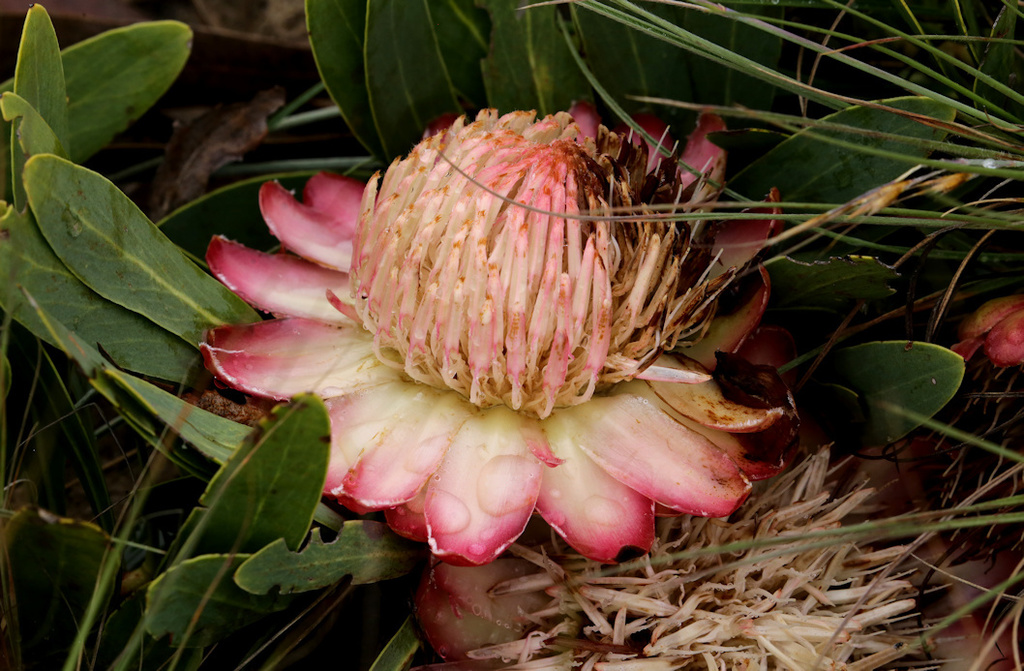
Dainty Sugarbush
Protea parvula
Protea parvula, also known as the dainty sugarbush, or kleinsuikerbos in Afrikaans, is a small flowering shrub belonging to the genus Protea.
From the article Protea parvula on Wikipedia (CC BY-SA), quoted section by section
Description
It is a low-growing, creeping, shrubby groundcover, growing only up to 16cm in height. Sources differ on the ability of this species to survive wildfires. According to one source it is long-lived, with plants surviving over a century, and can regrow after fire from an underground bole or rootstock, another source states the plant is killed by fire. The seeds are released by the plant as soon as the woody fruit is ripe, from April to July, and are dispersed by the wind. The seeds are fire-proof, and simply lie on the ground until germination. Protea parvula flowers in the summer, from December to March. The plant is monoecious with both sexes in each flower. The flowers are pollinated by birds.
Range & habitat
Protea parvula is found on the slopes of the Drakensberg Mountains, from Mariepskop, through Mpumalanga and eSwatini, to Vryheid in central northern KwaZulu-Natal. It grows in rocky, exposed grassland on acid soils, at elevations of 1,300 to 2,150 meters.
Wikipedia: “Distribution”
Where it lives
Recorded sightings
—
geo-referenced records in GBIF, from museums, herbaria and field observers.
Drag the globe to turn it. Dots are where records exist, not a range map; darker means more records.
In the stacks
Searching the stacks…
Every page naming Protea parvula in the Biodiversity Heritage Library →
This page is assembled live from iNaturalist, GBIF, Wikipedia, the Source Library and the Internet Archive. It is not yet part of the hand-edited codex. iNaturalist taxon 592529.