- Animals
- ›Arthropods
- ›Hexapods
- ›Insects
- ›Winged and Once-winged Insects
- ›Butterflies and Moths
- ›Butterflies
- ›Brush-footed Butterflies
- ›Satyrs, Morphos, and Allies
- ›Alpines, Arctics, Nymphs and Satyrs
- ›Coenonymphina
- ›Coenonympha
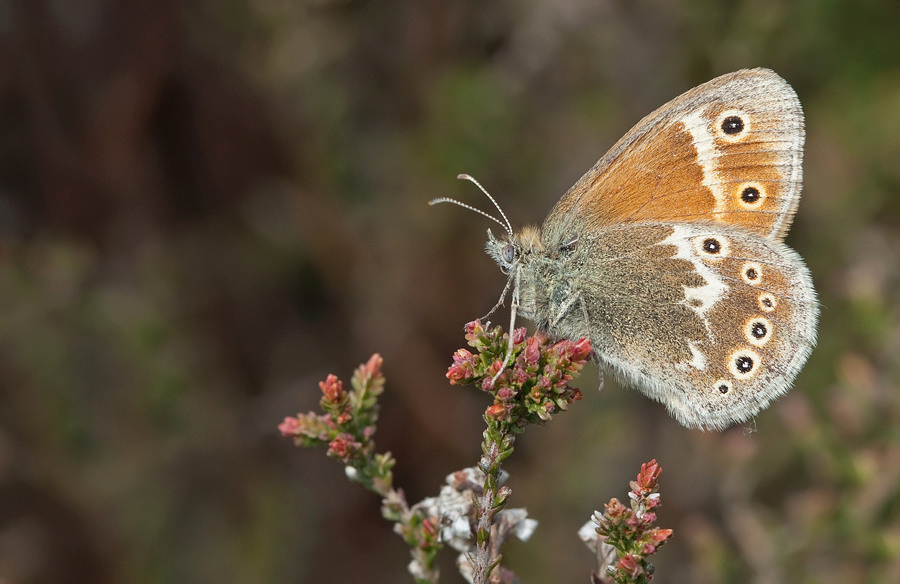
Large Heath
Coenonympha tullia
Coenonympha tullia, the large heath or common ringlet, is a butterfly in the family Nymphalidae. It flies in a variety of grassy habitats, including roadsides, woodland edges and clearings, prairies, bogs, and arctic and alpine taiga and tundra. It is a poor flyer, but can sometimes be found along ditches seeking new grounds. It is a holarctic species found in northern Europe, east across the Palearctic and across North America. The species was first described by Otto Friedrich Müller in 1764.
Successful reintroductions of the species to North West England took place in 2020, 2022 and 2023.
From the article Coenonympha tullia on Wikipedia (CC BY-SA), quoted section by section
Description
C. tiphon Rott. (— davus F., tullia Hbn.) (48h). Upperside sandy yellow, similar to Coenonympha symphita, rather duller; male without markings, female with the ocelli shining through. On the underside of the hindwing whitish smears are joined forming a more or less incomplete median band, beyond which there are some ocelli in the male and often a complete row in the female. In Central Europe, especially in the Alps, Central and Southern Germany and the Danube countries. — philoxenus Esp. (= rothliebi Stgr.) (48 h) is a rather large northern form, dulled with grey above and strongly ocellated below, from the continental shores of the North Sea and Great Britain, (said to have occurred also at Lemberg). — ab. laidion Bkh. is a slight deviation from the type, which is a little paler ochre-yellow on the upperside; it is probably found every-where exceptionally among the nymotypical form. -— isis Tnbg. (= demophile Fr.) (48h) has instead of a brown underside a grey one with fewer and smaller ocelli, and its upperside, which is absolutely without markings, is also of a greyish colour. Scandinavia, North Russia, as far as Central Asia. — viluiensis Mén. …
Wikipedia: “Description in Seitz”
In human culture
Named in the Classical tradition. The Specific epithet tullia is related to Tullia, daughter of Servius Tullius, sixth Roman king, or daughter of Marcus Tullius Cicero, orator, writer and jurist.
Wikipedia: “Etymology”
Listen
Looking for field recordings…
Where it lives
Recorded sightings
—
geo-referenced records in GBIF, from museums, herbaria and field observers.
Drag the globe to turn it. Dots are where records exist, not a range map; darker means more records.
In the stacks
Searching the stacks…
Every page naming Coenonympha tullia in the Biodiversity Heritage Library →
This page is assembled live from iNaturalist, GBIF, Wikipedia, the Source Library and the Internet Archive. It is not yet part of the hand-edited codex. iNaturalist taxon 59185.