- Plants
- ›Vascular Plants
- ›flowering plants
- ›Dicots
- ›proteas, lotuses, planes, and allies
- ›Protea family
- ›Singlet Proteas
- ›Nutseed Proteoid Clade
- ›Cape Nutseed Proteoids
- ›Paranomus
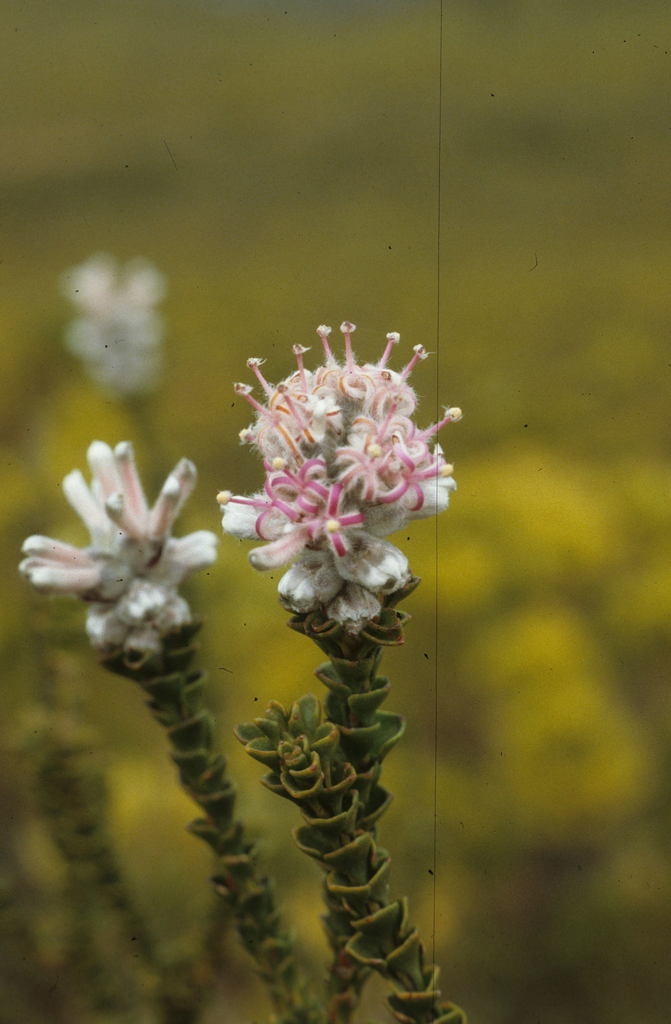
Hairystyle Sceptre
Paranomus adiantifolius
Paranomus adiantifolius, the hairy-style sceptre, is a flower-bearing shrub that belongs to the genus Paranomus and forms part of the fynbos. The plant is native to the Western Cape, South Africa.
From the article Paranomus adiantifolius on Wikipedia (CC BY-SA), quoted section by section
Description
The shrub grows 1.7 m (5.6 ft) tall and flowers mainly from September to November. Fire destroys the plant but the seeds survive. The plant is bisexual and pollinated by insects. The fruit ripens two months after flowering, and the seeds fall to the ground where they are spread by ants. In Afrikaans, it is known as harigestylsepter.
Range & habitat
The plant occurs at Wolfieskop in the Riviersonderend Mountains, Groenlandberg, and Houhoek. It grows in sandstone soil at altitudes of 500–1,000 m (1,600–3,300 ft).
Wikipedia: “Distribution and habitat”
Where it lives
Recorded sightings
—
geo-referenced records in GBIF, from museums, herbaria and field observers.
Drag the globe to turn it. Dots are where records exist, not a range map; darker means more records.
In the stacks
Searching the stacks…
Every page naming Paranomus adiantifolius in the Biodiversity Heritage Library →
This page is assembled live from iNaturalist, GBIF, Wikipedia, the Source Library and the Internet Archive. It is not yet part of the hand-edited codex. iNaturalist taxon 591393.