- Plants
- ›Vascular Plants
- ›flowering plants
- ›monocots
- ›grasses, sedges, cattails, and allies
- ›Sedges
- ›Cyperoideae
- ›Cypereae
- ›Cyperus
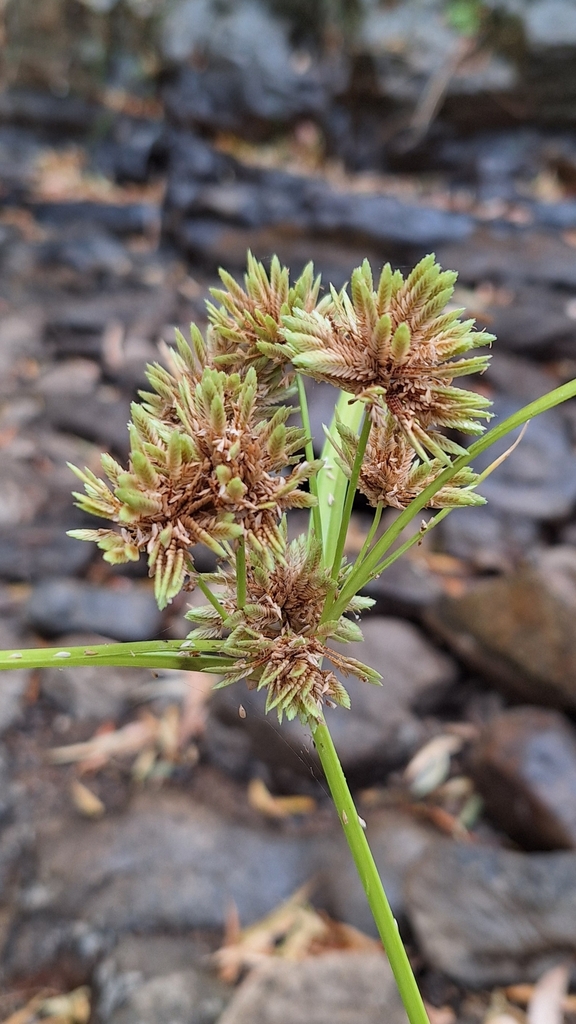
tall flatsedge
Cyperus eragrostis
Cyperus eragrostis is a species of sedge known by several common names, including tall flatsedge, nutgrass, tall nutgrass, umbrella sedge, chufa, Earth almond, zula nuts, edible galingale and pale galingale. In New Zealand, it is also known by the Māori name Puketangata. This species is associated with disturbed wet environments.
From the article Cyperus eragrostis on Wikipedia (CC BY-SA), quoted section by section
Description
Cyperus eragrostis is a tufted herbaceous plant in the sedge family that is commonly mistaken for a type of grass. However, it can be differentiated from grasses by many features. Firstly, the plant has a short, thick, woody rhizome. These stems are crucial for helping Cyperus eragrostis survive changes in seasons. These stems are trigonous, solid, leafy, and a bit thicker at the base, growing 25-90 cm tall. The leaves of the plant grow from the base and are slender, flat and linear with finely serrated margins. They are usually flat but can also be slightly folded, forming a slight V-shape, often making them blend in with different species of grass. The leaf size ranges from a width of 4-8 mm and is typically bright green, while the protective sheaths of the plant are a dark purple-brown colour. The inflorescence of Cyperus eragrostis is another one of its most defining features and is the reason for one of its common names of “umbrella sedge”. At the top of the stem, a compound umbel can be found. This compound umbel consists of up to twelve 3-10 cm rays which all have globose heads at the end of them. These globose heads (the rounded head at the end of a ray) have a diameter of 10-20 mm and are not a single flower. They are a cluster of small spikelets which 20-40 smaller flowers grow out of. …
Range & habitat
Cyperus eragrostis is native to subtropical and tropical regions of South America, including Argentina, Bolivia, Brazil, Chile, and Peru. It has also been introduced to parts of Canada, Mexico, and parts of the United States including California, Mississippi, Louisiana, New Jersey, South Carolina, Texas, Oregon, Pennsylvania, and Washington. Other than its native range, Cyperus eragrostis has spread to many different places around the world by being naturalized or introduced. It has been recorded as an invasive species in many European countries such as France, Switzerland, Germany, Spain, Hungary, Netherlands, Portugal, England, Italy, Montenegro, Czech Republic, Slovenia, Bulgaria, and Turkey. This species is found scattered throughout the North and South Islands of New Zealand where it is also considered an invasive pest on the New Zealand weed list.
Wikipedia: “Natural global range”
What it does
Cyperus eragrostis is great at establishing itself quickly because it has two main ways of reproduction; one through the sexual reproduction of seeds and one from spreading vegetatively through its rhizomes. The vegetative growth stage starts in spring from either seed germination or resprouting from a rhizome. Given the right conditions, during the end of spring and throughout summer, flowers and a small hard achene fruit will start to be produced on the compound umbels of spikelets. In late summer, the fruiting process will begin to end, with seeds waiting to be dispersed. These fruits/seeds have a high germination rate so when it was introduced to many countries for decorative and recreational uses it spread quickly. The species has also managed to reproduce in large numbers through their rhizomes, therefore aiding its numbers in moist disturbed environments.
Wikipedia: “Life cycle and phenology”
At the table
In some regions, the small nut-like tubers of Cyperus eragrostis are eaten by people either raw or cooked. This is not a common practice because it is considered an invasive weed in most countries where it is found but, when cooked, it tastes like coconuts and raisins. The base of the stem (rhizomes) are also edible. The leaf of Cyperus eragrostis was used by Native Americans to weave baskets and other objects. One possible reason for introducing this species is that it is good at controlling erosion. The rhizome of the plant enables it to form dense clumps in soil that helps to stabilize and restore degraded areas. However, once Cyperus eragrostis is introduced, it has a habit of overtaking and out-competing other species.
Wikipedia: “Cultural uses”
Where it lives
Recorded sightings
—
geo-referenced records in GBIF, from museums, herbaria and field observers.
Drag the globe to turn it. Dots are where records exist, not a range map; darker means more records.
In the stacks
Searching the stacks…
Every page naming Cyperus eragrostis in the Biodiversity Heritage Library →
This page is assembled live from iNaturalist, GBIF, Wikipedia, the Source Library and the Internet Archive. It is not yet part of the hand-edited codex. iNaturalist taxon 59055.