- Plants
- ›Vascular Plants
- ›flowering plants
- ›monocots
- ›grasses, sedges, cattails, and allies
- ›Sedges
- ›Cyperoideae
- ›Cariceae
- ›Carex
- ›Carex
- ›Phacocystis
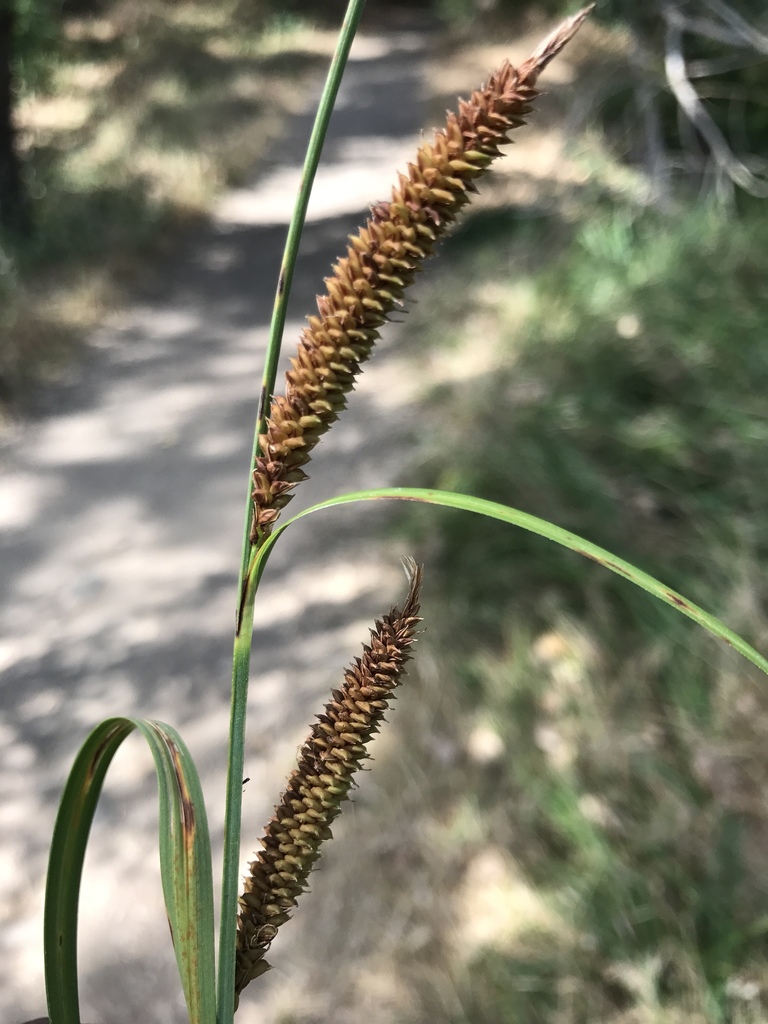
Santa Barbara sedge
Carex barbarae
Carex barbarae is a species of sedge known by the common name Santa Barbara sedge. It is native to California and Oregon, where it grows in wet and seasonally wet habitat, such as meadows and riverbanks. This sedge produces angled, hairless stems up to one meter tall or slightly taller, but not in clumps. The tough leaves are narrow with shredding, red-spotted or purple basal sheaths. The inflorescence produces erect and drooping spikes up to about...
From the article Carex barbarae on Wikipedia (CC BY-SA), quoted section by section
Description
This sedge produces angled, hairless stems up to one meter tall or slightly taller, but not in clumps. The tough leaves are narrow with shredding, red-spotted or purple basal sheaths. The inflorescence produces erect and drooping spikes up to about 8 centimeters long with an associated long bract which exceeds the length of the spikes. The fruits are covered in a sac called a perigynium which is light to dark brown and sometimes red-spotted, leathery and tough, and sometimes with a toothed, hairy tip. The plant rarely matures into a fruiting stage, however, with most individuals remaining sterile.
Range & habitat
Santa Barbara sedge is native to the western United States, in California and Oregon. It grows in wet and seasonally wet habitat, such as meadows and riverbanks.
Wikipedia: “Distribution and habitat”
At the table
Parts of this sedge were used in basketry and as sewing fiber by California Native American groups such as the Maidu and Pomo.
Wikipedia: “Uses”
Where it lives
Recorded sightings
—
geo-referenced records in GBIF, from museums, herbaria and field observers.
Drag the globe to turn it. Dots are where records exist, not a range map; darker means more records.
In the stacks
Searching the stacks…
Every page naming Carex barbarae in the Biodiversity Heritage Library →
This page is assembled live from iNaturalist, GBIF, Wikipedia, the Source Library and the Internet Archive. It is not yet part of the hand-edited codex. iNaturalist taxon 59045.