- Plants
- ›Vascular Plants
- ›flowering plants
- ›Dicots
- ›proteas, lotuses, planes, and allies
- ›Protea family
- ›Singlet Proteas
- ›Nutseed Proteoid Clade
- ›Cape Nutseed Proteoids
- ›Mimetes
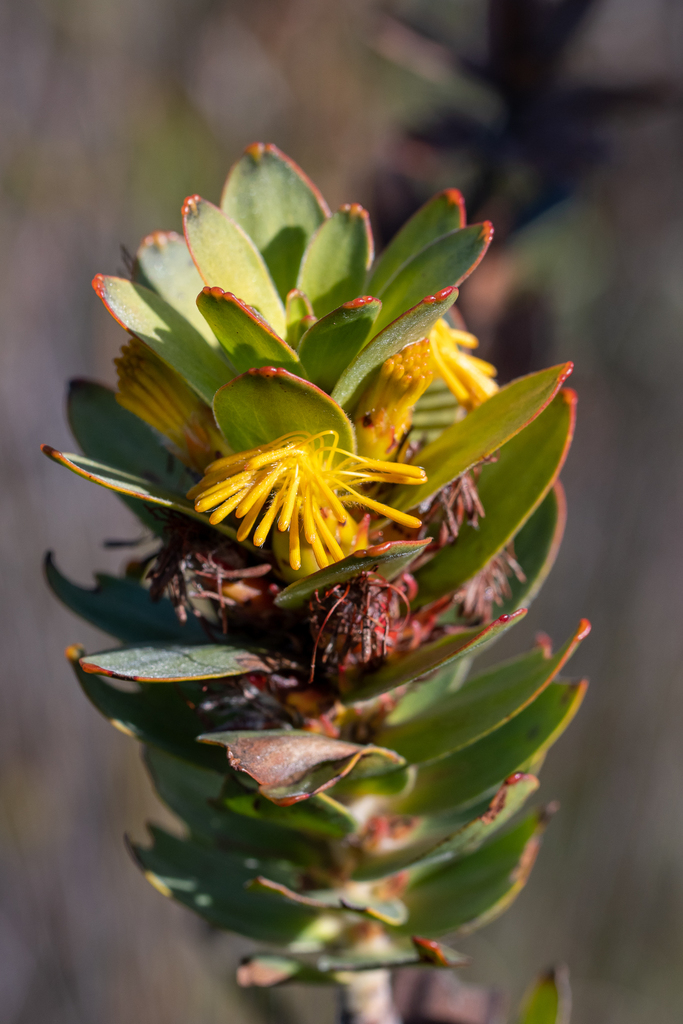
Limestone Pagoda
Mimetes saxatilis
Mimetes saxatilis or limestone pagoda is an evergreen, upright, rarely branching shrub of 1–2¼ m (3⅓–7¼ ft) high, assigned to the family Proteaceae. The approximately oval leaves are 3½–5 cm (1.4–2.0 in) long and 1½–3 cm (0.6–1.2 in) wide with a blunt, thickened, reddish tip or with three crowded teeth. It has cylinder-shaped inflorescences topped by a crest of green leaves, further consisting of heads with 12–22 individual bright yellow flowers, each in the axil of a flat, green leaf. It is an endemic species that is restricted to limestone outcrops in the Agulhas plains in the very south of the Western Cape province of South Africa. It is considered an endangered species. Flowering may occur between July and December, but is unreliable in its timing, dependent on sufficient moisture availability.
From the article Mimetes saxatilis on Wikipedia (CC BY-SA), quoted section by section
Description
Mimetes saxatilis is an evergreen, upright, rarely branching shrub of 1–2¼ m (3⅓–7¼ ft) high. Its branches are ½–1 cm (0.2–0.4 in) thick, initially densely felty, later becoming hairless. After the leaves are shed, conspicuous marks remain. The leathery leaves are alternately set, at a slight upward angle and somewhat overlapping and lack both stipules and leaf stalks. The leaves are elliptic to broadly oval, 3½–5 cm (1.4–2.0 in) long and 1½–3 cm (0.6–1.2 in) wide with an entire margin and a blunt thickened tip or with three crowded teeth, with a row of hairs along the rim and an initially felty, later hairless surface. The inflorescences at the top of the shoots are cylinder-shaped, 5–10 cm (2–4 in) long and 5–6 cm (2.0–2.4 in) in diameter below a crest of green, oval or elliptic, more or less upright leaves. The flower heads consist of fourteen to twenty two individual flowers and are subtended by an ordinary, flat, green leaf. The outer whorl of bracts that encircle the flower heads are loosely arranged, oval to broadly lance-shaped with a pointy tip, 1–2½ cm (0.4–1.0 in) long and 6–8 mm (¼–⅓ in) wide, with a hairless surface except for a row of hairs along the edge. …
Range & habitat
Mimetes saxatilis can be found in an approximately 100 km (63 mi) long, narrow strip along the south coast of about 3 km (2 mi) wide between Franskraal in the west and Struisbay, several km east of Cape Agulhas, and from there in a narrow strip inland to around Bredasdorp. It occurs from sea level to at most 180 m (590 ft). It only grows on limestone of the Alexandria Formation and derived alkaline soils. It seems to do best in sinkholes and crevices where the rock is bare. It grows together with other Proteacea that prefer limestone, including Leucospermum patersonii, Protea obtusifolia and Leucadendron meridianum. Flowers may open anywhere between July and December, but this seems to depend on the availability of sufficient moisture. Over most of its distribution, the average annual precipitation is about 400 mm (16 in). The fruits are ripe about 9 months after flowering.
Wikipedia: “Distribution and habitat”
Where it lives
Recorded sightings
—
geo-referenced records in GBIF, from museums, herbaria and field observers.
Drag the globe to turn it. Dots are where records exist, not a range map; darker means more records.
In the stacks
Searching the stacks…
Every page naming Mimetes saxatilis in the Biodiversity Heritage Library →
This page is assembled live from iNaturalist, GBIF, Wikipedia, the Source Library and the Internet Archive. It is not yet part of the hand-edited codex. iNaturalist taxon 590023.