- Plants
- ›Vascular Plants
- ›flowering plants
- ›Dicots
- ›proteas, lotuses, planes, and allies
- ›Protea family
- ›Singlet Proteas
- ›Nutseed Proteoid Clade
- ›Cape Nutseed Proteoids
- ›Mimetes
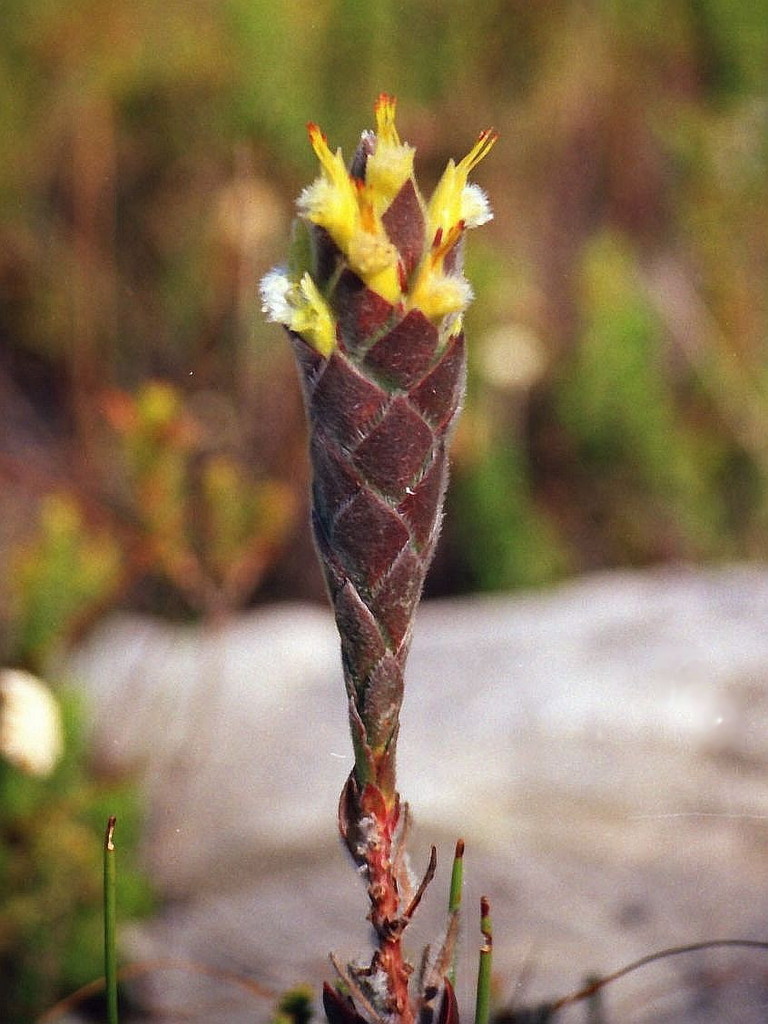
Cryptic Pagoda
Mimetes palustris
Mimetes palustris or cryptic pagoda is an evergreen shrub, assigned to the family Proteaceae. It has horizontal sprawling shoots as well as upright, unbranched shoots usually about ½ m (1½ in) high. The leaves are entire and stand out on the lower parts of the shoots, but are overlapping and pressed tightly against each other near the inflorescence, almost like a snakeskin. The inflorescence consists of several flowerheads, each containing three clear yellow flowers that are longer than the subtending leaves. It is the smallest species of Mimetes and is an endemic species that grows on well-drained, but permanently moist sandy and peaty slopes in the mountains near Hermanus, Western Cape province of South Africa. It is considered critically endangered. Flowering occurs all year round, but peaks in August and September.
From the article Mimetes palustris on Wikipedia (CC BY-SA), quoted section by section
Description
Mimetes palustris is an evergreen shrub, of mostly about ½ m (1½ ft), seldom 1 m high, and up to ¾ m (2½ ft) in diameter, that develops from an upright main stem of up to ½ cm (0.2 in) thick, which is covered by brown bark. At 5–10 cm (2–4 in) above the ground, several vigorous, upright, unbranched shoots emerge, as well as many lax horizontal runners that occasionally fork. Both types of shoot are 1½–3 mm (0.06–0.12 in) thick, initially covert in rusty-coloured felty hairs, but becoming hairless with age. The leathery leaves are alternately set and lack both stipules and a leaf stalk, are lance-shaped, elliptic to very broadly oval near the inflorescences, 1½–2 cm (0.6–0.8 in) long and ½–1 cm (0.2–0.4 in) wide, and have a pointy, thickened tip. The leaves are initially densely covered in rusty-coloured felty hairs and have a fringe of felty hair, but become hairless with age. Near the foot of the shoots the leaves stand out horizontally, but near the inflorescences the leaves are overlapping and tightly clasp the stem. On some of the runners, inflorescences develop that consist of one to three flower heads at its tip. The erect shoots have inflorescences of five to twelve heads and are narrowly cylinder-shaped. The flower heads are 3½ cm (1.4 in) long and consist of three to six flowers, and are subtended by an ordinary green leaf. …
Range & habitat
Mimetes palustris is an endemic species restricted to the Kleinrivier Mountains, Western Cape province of South Africa, where it can be found between the Platberg in the Fernkloof Nature Reserve near Hermanus in the west and slightly east of the Rocklands Peak. Here it grows in a vegetation type called Overberg Sandstone Fynbos, at an altitude of 600–900 m (2000–3000 ft). Mimetes palustris can only be found on south-facing slopes in part-shade in locations where an updraught from the sea create cool and moist air during summer. At the edge of seepage zones it can be found in combination with Brunia alopecuroides, Erica hispidula, Roridula gorgonias, and Villarsia ovata. Flower heads may occur at any time during the year. It is assumed that like other Mimetes species, the cryptic pagoda is pollinated by birds and the seeds are distributed by ants.
Wikipedia: “Distribution and habitat”
Where it lives
Recorded sightings
—
geo-referenced records in GBIF, from museums, herbaria and field observers.
Drag the globe to turn it. Dots are where records exist, not a range map; darker means more records.
In the stacks
Searching the stacks…
Every page naming Mimetes palustris in the Biodiversity Heritage Library →
This page is assembled live from iNaturalist, GBIF, Wikipedia, the Source Library and the Internet Archive. It is not yet part of the hand-edited codex. iNaturalist taxon 590022.