- Plants
- ›Vascular Plants
- ›flowering plants
- ›Dicots
- ›myrtles, evening primroses, and allies
- ›myrtle family
- ›Myrtoideae
- ›Melaleuceae
- ›Melaleuca
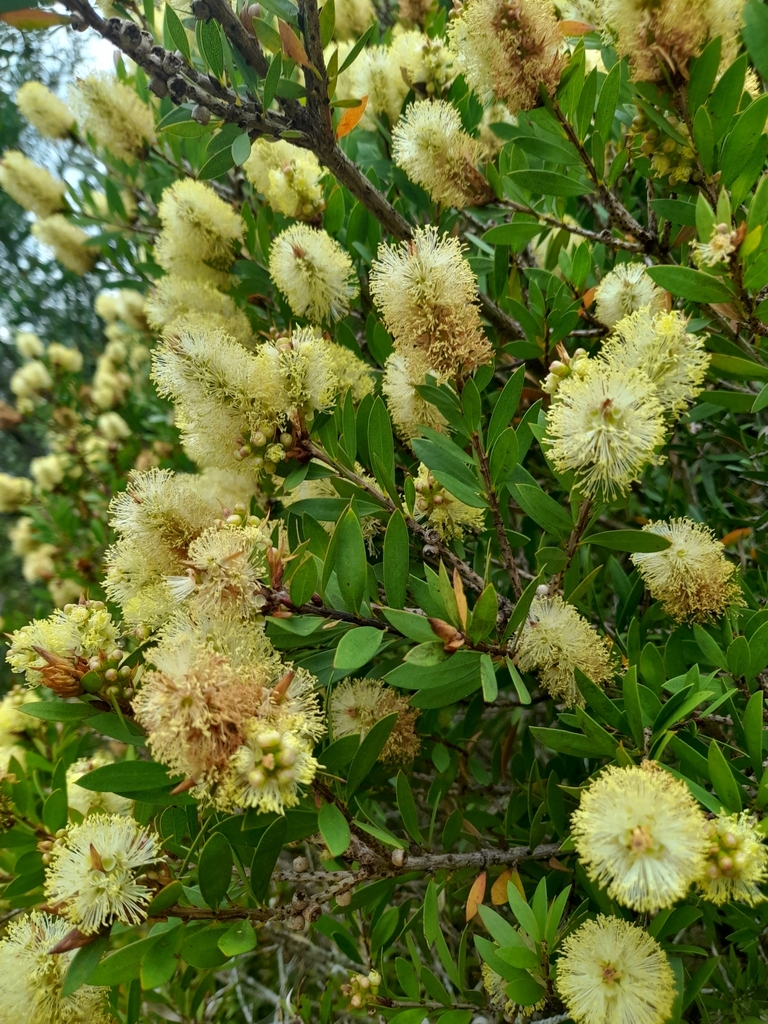
Lemon Bottlebrush
Melaleuca pallida
Melaleuca pallida, commonly known as lemon bottlebrush, is a plant in the myrtle family, Myrtaceae and is endemic to eastern Australia. (Some Australian state herbaria use the name Callistemon pallidus.) It is an upright shrub with thin, spreading branches, silvery new growth and pale yellow, sometimes pinkish bottlebrush flowers.
From the article Melaleuca pallida on Wikipedia (CC BY-SA), quoted section by section
Description
Melaleuca pallida is a shrub or tree growing to 8 m (30 ft) tall, with fibrous or papery bark. Its leaves are arranged alternately and are 20–79 mm (0.8–3 in) long, 4–17 mm (0.2–0.7 in) wide, flat or broadly v-shaped, narrow elliptic to egg-shaped with the narrow end towards the base and with a small point at the end. There is a distinct mid-vein, 6-16 indistinct side veins and many distinct oil glands.
The flowers are a shade of cream to yellow, occasionally pinkish-red and are arranged in spikes on the ends of branches that continue to grow after flowering and sometimes also on the sides of the branches. The spikes are 20–45 mm (0.8–2 in) in diameter with 15 to 50 individual flowers. The petals are 2.9–6 mm (0.1–0.2 in) long and fall off as the flower ages and there are 34–70 stamens in each flower. Flowering occurs from October to February and is followed by fruit that are woody, cup-shaped capsules, 3.9–6.6 mm (0.2–0.3 in) long.
Range & habitat
Melaleuca pallida occurs from the Border Ranges area in far south eastern Queensland, through the ranges and slopes of New South Wales to eastern Victoria. It is also present in all but the far west of Tasmania and on some Bass Strait islands. It grows in streams and wet, rocky slopes.
Wikipedia: “Distribution and habitat”
How it is grown
Melaleuca pallida is sometimes cultivated as Callistemon pallidus. It is a hardy plant, adaptable to many soils but needs full sun.
Wikipedia: “Use in horticulture”
Where it lives
Recorded sightings
—
geo-referenced records in GBIF, from museums, herbaria and field observers.
Drag the globe to turn it. Dots are where records exist, not a range map; darker means more records.
In the stacks
Searching the stacks…
Every page naming Melaleuca pallida in the Biodiversity Heritage Library →
This page is assembled live from iNaturalist, GBIF, Wikipedia, the Source Library and the Internet Archive. It is not yet part of the hand-edited codex. iNaturalist taxon 589717.