- Plants
- ›Vascular Plants
- ›flowering plants
- ›Dicots
- ›nightshades, bindweeds, gooseweeds, and allies
- ›nightshade family
- ›nightshades and allies
- ›boxthorns and allies
- ›Lycium
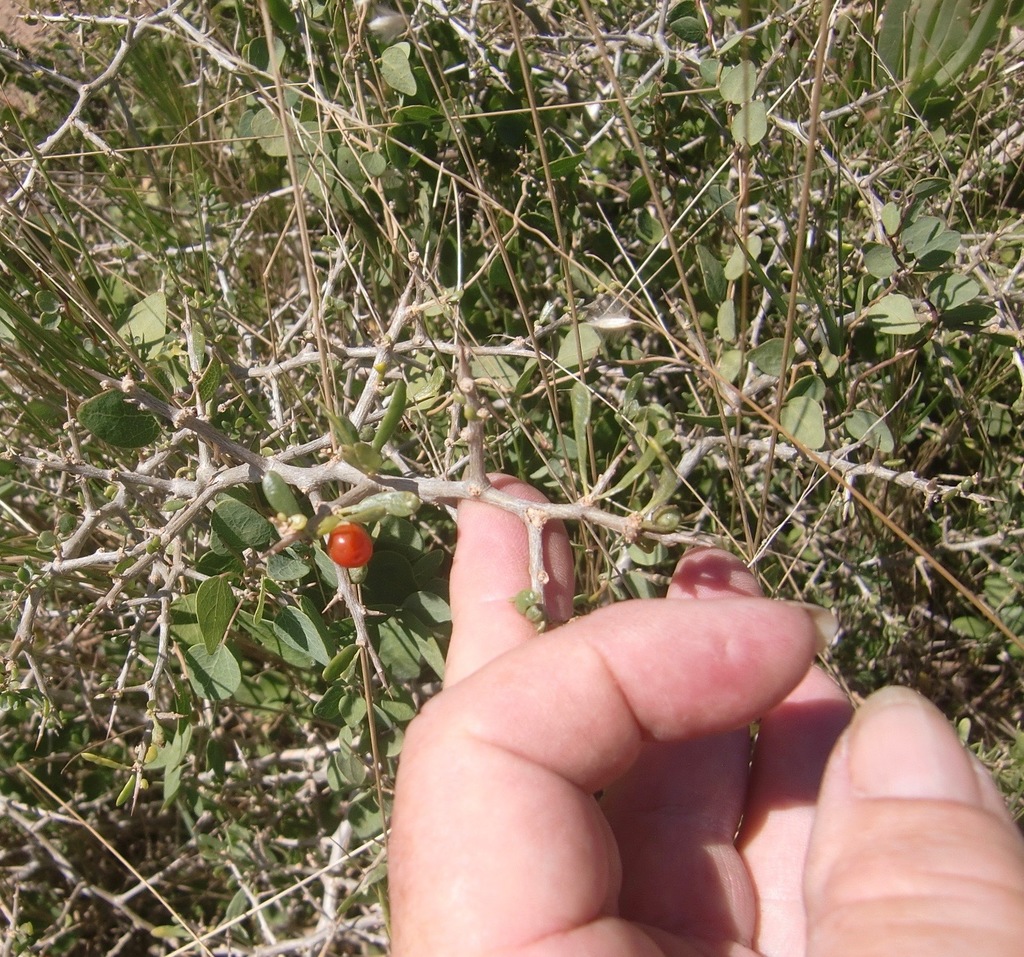
Kleinkaroo Honeythorn
Lycium tenue
Lycium tenue is a shrub in the nightshade family (Solanaceae) indigenous to South Africa.
From the article Lycium tenue on Wikipedia (CC BY-SA), quoted section by section
Description
Lycium tenue is a small, stiff, spiny shrub. The young stems are grey-white with striations, while the older stems become dark grey. The spines are of randomly varying lengths along the branch. Like many other Lycium species, the leaves are pale green and narrowly obovate in shape. The flowers emerge from the leaf axils. The corolla is narrowly trumpet shaped, with five large reflexed lobes (petals). The stamens are extended and very clearly exserted from the corolla mouth. The calyx is tubular, and relatively short, covering less than half of the corolla tube. The fruits are small, elliptic-to-ovoid, red berries.
== References ==
Range & habitat
This species is indigenous to the Western Cape Province, South Africa. It occurs as far west as Ceres, southwards into the Overberg region, as far north as the Swartberg mountains, and as far east as Calitzdorp. Its habitat is typically dry riverbeds and their surrounds, often in sands and gravels derived from limestone.
Wikipedia: “Distribution”
Where it lives
Recorded sightings
—
geo-referenced records in GBIF, from museums, herbaria and field observers.
Drag the globe to turn it. Dots are where records exist, not a range map; darker means more records.
In the stacks
Searching the stacks…
Every page naming Lycium tenue in the Biodiversity Heritage Library →
This page is assembled live from iNaturalist, GBIF, Wikipedia, the Source Library and the Internet Archive. It is not yet part of the hand-edited codex. iNaturalist taxon 589495.