- Plants
- ›Vascular Plants
- ›flowering plants
- ›Dicots
- ›Legumes, Milkworts, and Allies
- ›Legumes
- ›Faboideae
- ›Trifolieae
- ›Melilotus
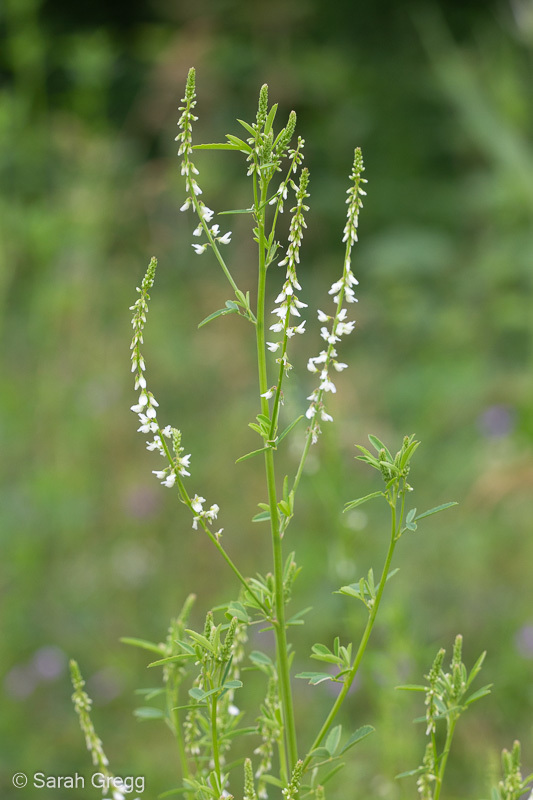
White Sweetclover
Melilotus albus
Melilotus albus, known as honey clover, white melilot (UK), Bokhara clover (Australia), white sweetclover (US), and sweet clover, is a nitrogen-fixing legume in the family Fabaceae. Melilotus albus is considered a valuable honey plant and source of nectar and is often grown for forage. Its characteristic sweet odor, intensified by drying, is derived from coumarin.
Melilotus albus is of Eurasian origin but can now be found throughout the subtropical to temperate zones, especially in North America, and is common in sand dune, prairie, bunchgrass, meadow, and riparian habitats. This species is listed as an "exotic pest" in Tennessee, "ecologically invasive" in Wisconsin, and a "weed" in Kentucky and Quebec.
From the article Melilotus albus on Wikipedia (CC BY-SA), quoted section by section
Description
Melilotus albus is an annual or biennial legume that can reach 2.5 m (8 ft 2 in) in height. The light green stems are round or slightly terete (furrowed on all sides), glabrous (smooth), and often branched. The 1/2 - 2 inch long alternate leaves are trifoliate and sparsely distributed along the stem and alternate in arrangement. The upper stems terminate in narrow racemes of white flowers about 2-6 inches long that have a tendency to hang downward from the central stalk of the raceme. Each flower is about 1⁄3 inch (8.5 mm) long, consisting of 5 white petals and a light green calyx with 5 teeth. Flowers are small, floppy, tubular at the base and become broader toward the outer edges and wing and keel petals are about equal in length. The ovoid seedpods are black to dark grey, smooth or slightly reticulated and about 0.3 inches long (3-4mm). Each pod usually contains one, but sometimes two, yellow seeds that are ovate to kidney-shaped. Plants generally flower and die during the second year of growth. The blossoming period occurs from early summer to fall, reaching its peak during mid-summer, and lasts for about 1–2 months for a colony of plants. An extensive root system of deep taproots imparts resistance to summer drought. The roots of M. albus are associated with nitrogen-fixing bacteria.
Similarity to other species. …
Range & habitat
White sweetclover is native to much of Asia and southern Europe, from France and Spain to Kazakhstan and Myanmar, and also northeastern Africa. M. albus has been introduced from Eurasia into South Africa, North and South America, New Zealand, Australia, and Tasmania, as well as many parts of Europe outside its native range. In the US, the species is considered most common in the upper Midwest and Great Plains regions, including Kentucky, Nebraska, Tennessee and Wisconsin. White sweetclover was brought to North America as early as 1664 as a forage crop. Since then, it has spread from cultivation and thrives in waste places and roadsides. White sweetclover is found in every state in the United States and all but 2 Canadian provinces. It establishes in aspen woodlands and prairies in Canada and the lower 48 states and riparian communities in Alaska. The early spread of M. albus was probably facilitated by beekeepers and agriculturalists, as it can be an important fodder crop and food source for honey bees, and it was brought to Alaska in 1913 as a potential forage and nitrogen (N) fixing crop.
Wikipedia: “Distribution”
What it does
White sweetclover has high seed germination rates. Most germination and development occurs in spring - temperatures of less than 59 degrees F are optimal for germination.
Wikipedia: “Reproduction and phenology”
At the table
White and yellow sweetclover are considered valuable honey plants, and the foliage and seeds are consumed by wildlife. They are frequently cultivated for livestock forage and as a cover crop. Melilotus albus has been promoted in Australia for use on dryland soils affected by salinity. It has been used in herbal medicine. It includes dicoumarol, which is an anticoagulant. It also has a high sugar content.
Wikipedia: “Uses”
Where it lives
Recorded sightings
—
geo-referenced records in GBIF, from museums, herbaria and field observers.
Drag the globe to turn it. Dots are where records exist, not a range map; darker means more records.
In the stacks
Searching the stacks…
Every page naming Melilotus albus in the Biodiversity Heritage Library →
This page is assembled live from iNaturalist, GBIF, Wikipedia, the Source Library and the Internet Archive. It is not yet part of the hand-edited codex. iNaturalist taxon 58907.