- Animals
- ›Arthropods
- ›Hexapods
- ›Insects
- ›Winged and Once-winged Insects
- ›Butterflies and Moths
- ›Butterflies
- ›Skippers
- ›Grass Skippers
- ›Hesperiini
- ›branded grass skippers
- ›Euphyes
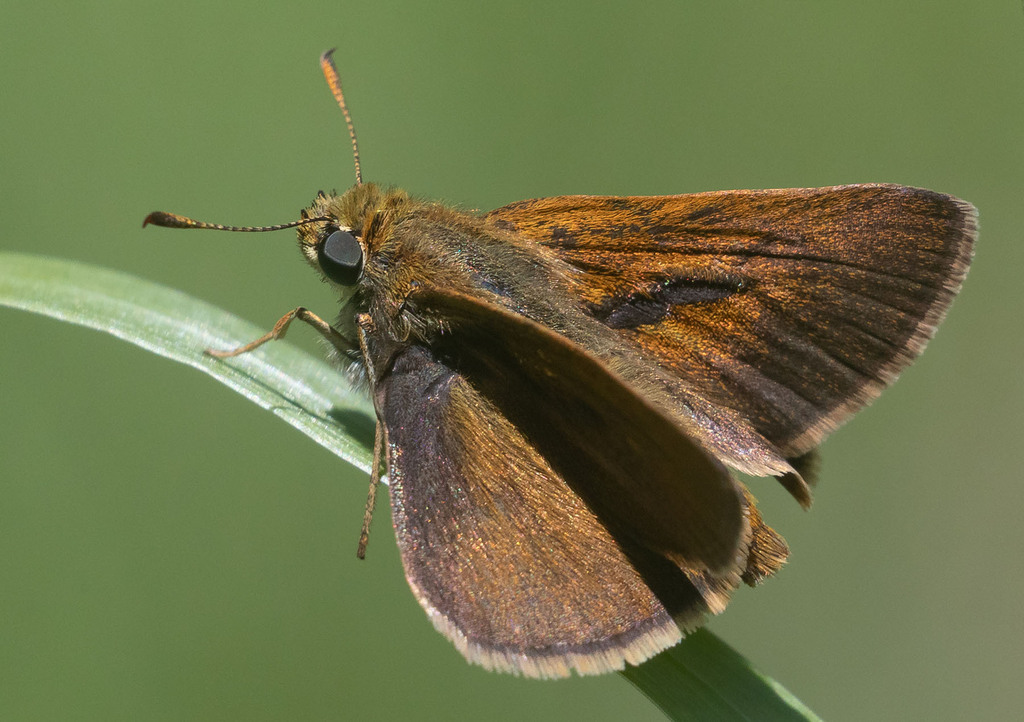
Dun Skipper
Euphyes vestris
Euphyes vestris, commonly referred to as the dun skipper, is a butterfly belonging to the Hesperiidae family. It appears as a brown, medium-sized butterfly found across the United States and southern Canada. Euphyes vestris inhabits multiple environments, including open fields, oak woodlands, and riparian wetlands. There are currently four recorded subspecies of Euphyes vestris, three of which have been identified across eatern, western, and mountainous regions of North America. These subspecies are E. v. metacomet, E. v. vestris, and E. v. kiowah. The fourth subspecies, Euphyes vestris harbisoni, known as the Harbison's dun skipper is geographically restricted to southern California and northern Mexico.
The dun skipper, Euphyes vestris, is categorized within the genus Euphyes, a known group of ten closely related skippers found in North America. Species belonging to this genus live in environments with high humidity, such as swampy habitats, and occur in small populations. Across its subspecies it has been recognized that E. vestris relies on sedges, which are plants in the family Cyperaceae, as host plants for its larval development.
From the article Euphyes vestris on Wikipedia (CC BY-SA), quoted section by section
Range & habitat
E. vestris is known to have a large geographical distribution, as it can be found across the United States and southern Canada. However, although the species as a whole is broadly distributed across North America, specific subspecies are restricted to specialized regions. Specifically, the subspecies Euphyes vestris harbisoni is very restricted and is found only in southern California and northern Mexico. Within California, it is most commonly found in San Diego County, in addition to western regions of Riverside County. Recent surveys examining the geographic distribution of this subspecies have shown a decline in its geographical distribution. At the time these surveys were conducted, from 2013 to 2018, there were 39 known sites where these butterflies had previously been recorded. Of the 39 known locations, 33 were publicly accessible, while the other six were located in restricted private areas. Among the accessible sites, 22 still supported the population, while 10 sites were found to no longer support the population. The remaining eight sites were classified as unknown because they were located on private property. These surveys show that the geographic distribution of the subspecies is concentrated within San Diego, Orange, and Riverside counties. …
Wikipedia: “Geographical distribution”
What it does
Studies have examined the reproduction of E. vestris by looking at spermatophores in females. Spermatophores are structures that are transferred by males during mating. Specifically, in butterflies, a successful mating results in the female having a spermatophore within her reproductive tract. In the publication Mating Frequency in Natural population of Skippers and Butterflies as Determined by Spermatophore Counts, it was found that the average spermatophore count within a mated female was 1.45. This result shows that E. vestris has an intermediate mating pattern, meaning that it falls between the two extremes of only mating only once or mating multiple times. It was also noted in the article that mating frequency may be related to population density, with females in denser populations mating less often and females in less dense populations mating more often. Additionally, reproduction is also dependent on the survival of the host plant because females lay eggs on plants such as San Diego sedge for E. v. harbisoni. Therefore, reproduction depends on whether the host plant is healthy.
Wikipedia: “Mating and reproduction”
Listen
Looking for field recordings…
Where it lives
Recorded sightings
—
geo-referenced records in GBIF, from museums, herbaria and field observers.
Drag the globe to turn it. Dots are where records exist, not a range map; darker means more records.
In the stacks
Searching the stacks…
Every page naming Euphyes vestris in the Biodiversity Heritage Library →
This page is assembled live from iNaturalist, GBIF, Wikipedia, the Source Library and the Internet Archive. It is not yet part of the hand-edited codex. iNaturalist taxon 58514.