- Plants
- ›Vascular Plants
- ›flowering plants
- ›Dicots
- ›Mustards, Capers, and Allies
- ›mustard family
- ›Brassicoideae
- ›Brassicodae
- ›Thelypodieae
- ›Stanleya
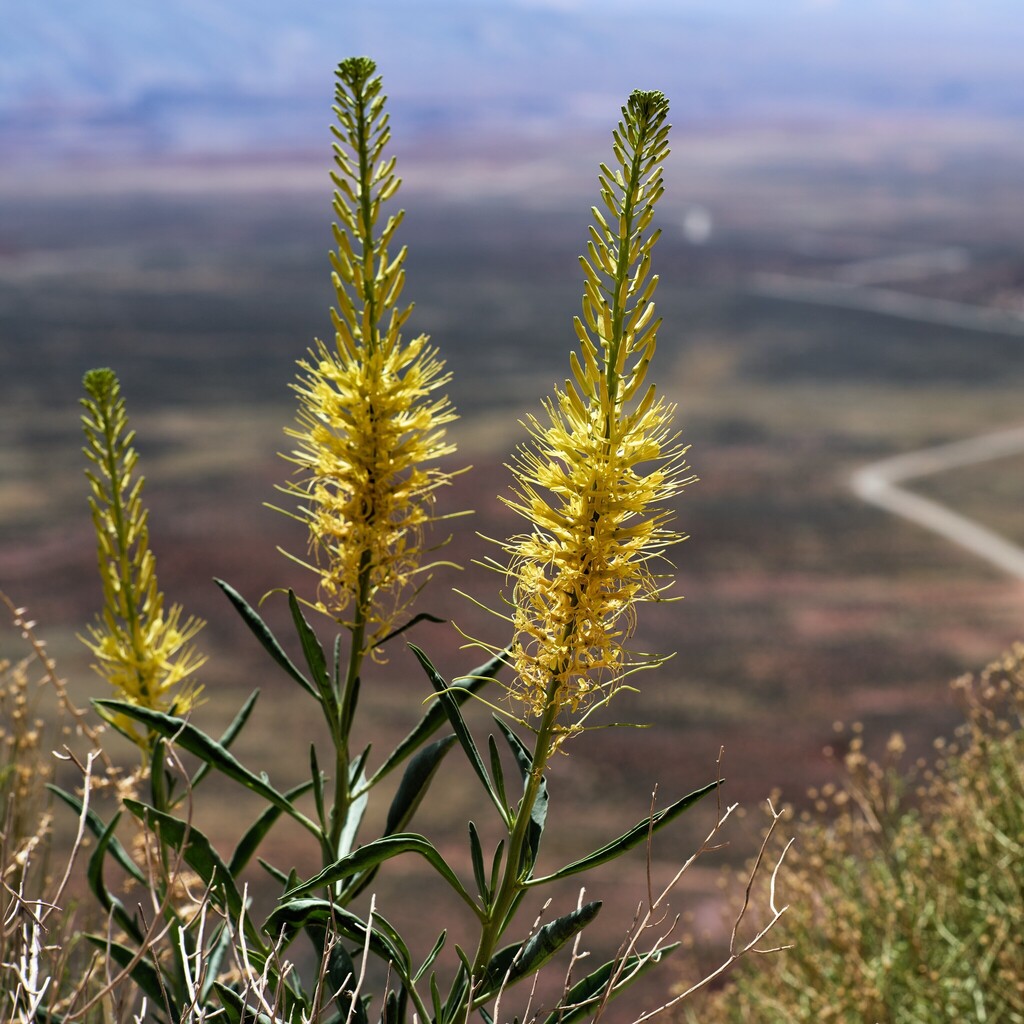
Desert Prince's Plume
Stanleya pinnata
Stanleya pinnata is a species of flowering plant in the family Brassicaceae known as desert prince's-plume. It is a perennial herb or shrub native to North America.
From the article Stanleya pinnata on Wikipedia (CC BY-SA), quoted section by section
Description
Stanleya pinnata is a perennial herb or shrub producing several erect stems reaching up to about 1.5 metres (4+11⁄12 ft) in maximum height. The stems are unbranched, hairless, often waxy in texture, and have woody bases. The leaves have fleshy blades up to 15 centimetres (5.9 in) long by 5 centimetres (2.0 in) wide which are divided into several long, narrow lobes. The blades are borne on petioles. The top of the stem is occupied by a long inflorescence which is a dense raceme of many flowers. Each flower has four narrow yellowish sepals which open to reveal four bright yellow petals each up to 2 centimetres (0.79 in) long. The stamens protruding from the flower's center may approach 3 cm in length. The fruit is a curving, wormlike silique up to 8 centimetres (3.1 in) long.
Range & habitat
The plant is native to the western Great Plains and western North America. It occurs in many types of open habitat, including deserts, chaparral, foothills, rocky cliffs, sagebrush, and prairie. It prefers alkali- and gypsum-rich soils.
Wikipedia: “Distribution”
What it does
It is a larval host to both Becker's white and checkered white caterpillars. Some of the plant's amino acids use selenium from the soil in place of sulfur, making it highly toxic to animals.
Wikipedia: “Ecology”
At the table
It has been used as a Native American traditional medicinal plant and food source, including by the Hopi, Zuni, Paiute, Navajo, Kawaiisu, and Tewa peoples.
Wikipedia: “Uses”
Where it lives
Recorded sightings
—
geo-referenced records in GBIF, from museums, herbaria and field observers.
Drag the globe to turn it. Dots are where records exist, not a range map; darker means more records.
In the stacks
Searching the stacks…
Every page naming Stanleya pinnata in the Biodiversity Heritage Library →
This page is assembled live from iNaturalist, GBIF, Wikipedia, the Source Library and the Internet Archive. It is not yet part of the hand-edited codex. iNaturalist taxon 58087.