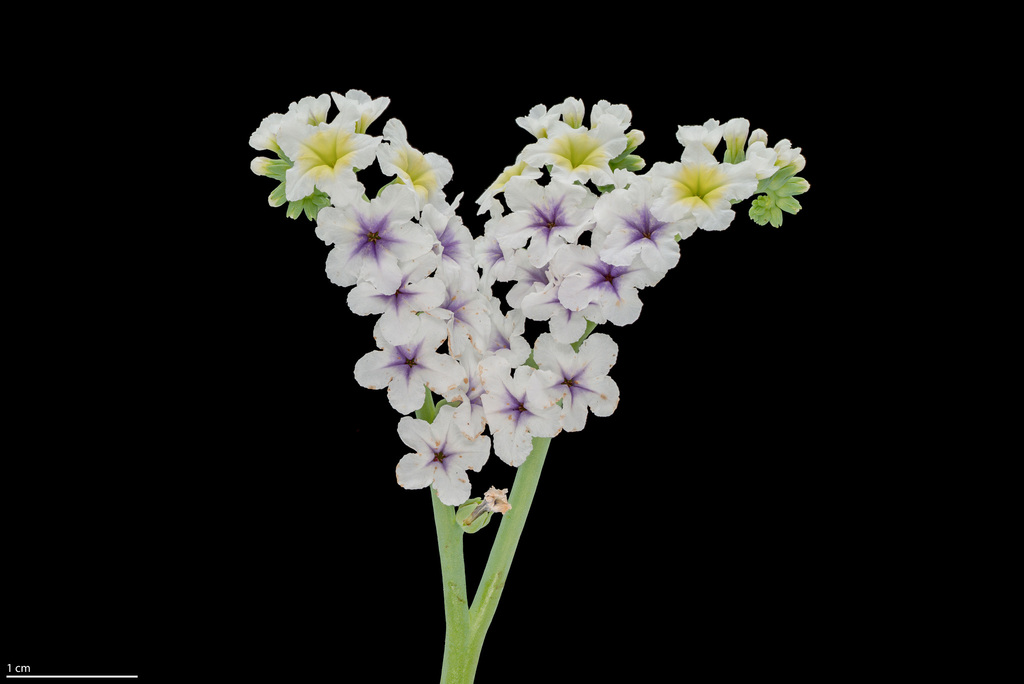
alkali heliotrope
Heliotropium curassavicum
Heliotropium curassavicum is a species of heliotrope that is native to much of the Americas, from Canada to Argentina, and can be found on other continents as an introduced species. It is known by several common names, such as seaside heliotrope, salt heliotrope, monkey tail, quail plant and "Chinese parsley" (although this last name is also used for coriander). in Latin American Spanish it is known as cola de mico,cola de gama or rabo alacrán, and...
From the article Heliotropium curassavicum on Wikipedia (CC BY-SA), quoted section by section
Description
Heliotropium curassavicum is a perennial herb which can take the form of a prostrate creeper along the ground to a somewhat erect shrub approaching 0.5 m (1+1⁄2 ft) in height. The stem and foliage are fleshy, with the leaves thick and oval or spade-shaped. The plentiful inflorescences are curled, coiling double rows of small bell-shaped flowers. Each flower is white with five rounded lobes and a purple or yellow throat. The fruit is a smooth nutlet.
Range & habitat
The species is native to Northern Australia including the Northern Territory, Western Australia and Queensland, and to much of the Americas, from Canada to Argentina, including the West Indies and Hawaii. It can be found as an introduced species (in some cases being invasive) in Africa, Eurasia, and southern Australia. It thrives in salty soils, such as beach sand, alkali flats, and salt marshes. It is often found in disturbed coastal sites.
Wikipedia: “Distribution and habitat”
Where it lives
Recorded sightings
—
geo-referenced records in GBIF, from museums, herbaria and field observers.
Drag the globe to turn it. Dots are where records exist, not a range map; darker means more records.
In the stacks
Searching the stacks…
Every page naming Heliotropium curassavicum in the Biodiversity Heritage Library →
This page is assembled live from iNaturalist, GBIF, Wikipedia, the Source Library and the Internet Archive. It is not yet part of the hand-edited codex. iNaturalist taxon 58058.