- Plants
- ›Vascular Plants
- ›flowering plants
- ›Dicots
- ›Sunflowers, Bellflowers, Fanflowers, and Allies
- ›Sunflowers, Daisies, Asters, and Allies
- ›Asteroideae
- ›groundsels and allies
- ›Senecioninae
- ›Senecio
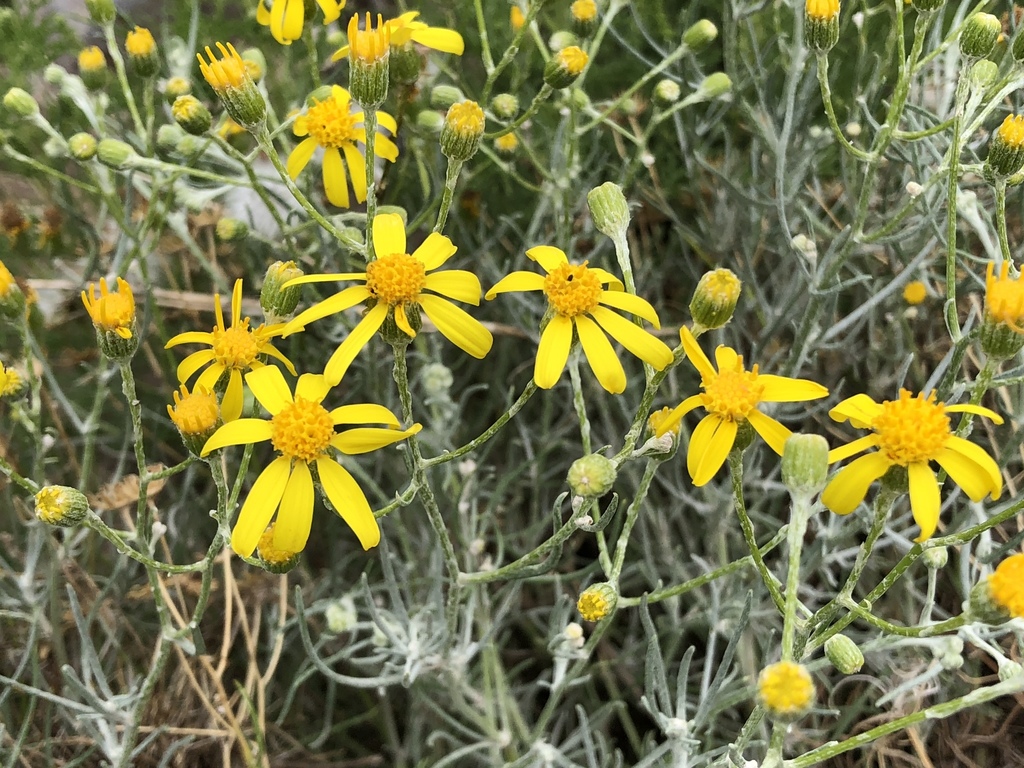
threadleaf groundsel
Senecio flaccidus
Senecio flaccidus, formerly recorded as Senecio douglasii (in honor of the botanist David Douglas) member of the daisy family and genus Senecio also known as threadleaf ragwort (and threadleaf groundsel, bush senecio, creek senecio, shrubby butterweed, comb butterweed, smooth threadleaf ragwort, Mono ragwort, Douglas ragwort, Douglas groundsel, sand wash groundsel, felty groundsel, old man, yerba cana, squawweed or cenicillo) is a native of the southwestern Great Plains of North America.
From the article Senecio flaccidus on Wikipedia (CC BY-SA), quoted section by section
Description
Threadleaf ragwort is a fast-growing, short-lived (3 to 6 years) bushy perennial shrub growing to 4 feet 6 inches (1.37 m) tall. It is covered by a white close wool. The stems are grooved and the branches are thin, herbaceous above and woody near the base. The leaves are 1 to 5 inches (2.5 to 12.7 cm) long. They are alternate and deeply pinnate, divided into five to nine narrow lobes. These are gray-green above and tomentose. From April to September appear showy yellow flowering heads, 3–4 inches (7.6–10.2 cm) across. They have eight to thirteen sterile ray flowers, and purplish brown disk florets that produce the seeds.
Seeds Dicotyledon fruits; each a 1⁄8 inch (3.2 mm)-long achene that is ribbed and hoary, covered with short white hairs.
Range & habitat
S. flaccidus can be found from the central to the southwestern United States, overlapping with the Great Plains region. It is native between Utah and Kansas, south to Arizona, New Mexico and Texas, and much of northern and central Mexico. Like other members of its genus, it prefers disturbed habitats, especially overgrazed rangelands, dried-up streambeds and desert grasslands. It can be found at altitudes between 1,800 and 6,500 feet (550 and 1,980 m). It is common in gravelly washes, dry creek beds, along roads and trails, and mostly away from the coast.
Native
America North-Central U.S.: Kansas, Oklahoma Northwestern: Colorado South-Central: New Mexico, Texas Southwestern: Arizona, Northern Mexico: Chihuahua, Coahuila, Durango, San Luis Potosí, Sonora, Zacatecas Central Mexico: Aguascalientes, Guanajuato, Hidalgo, Jalisco (n.e.), Veracruz Current
America North-Central: Kansas, Oklahoma, Wyoming Northwestern: Colorado South-Central: New Mexico, Texas Southwestern: Arizona, California, Nevada, Utah Northern Mexico: Chihuahua, Coahuila, Durango, San Luis Potosí, Sonora, Zacatecas, Baja California Central Mexico: Aguascalientes, Baja Norte, Guanajuato, Hidalgo, Jalisco (n.e.), Veracruz
Wikipedia: “Distribution and habitat”
What it does
Colonizing disturbed areas including over-grazed lands, S. flaccidus helps to achieve a quick groundcover and helps to stabilize the soil for longer-lived perennials.
Wikipedia: “Ecology”
Toxicity
The species is poor forage for cattle and horses due to the alkaloids contained in the plant; these cause liver disease when consumed in large quantities. Also known as Senecio longilobus, one of the alkaloids found in this species is longilobine, as well as senecionine, seneciphylline, florosenine, otonecine-based florosenine, and retrorsine.
Where it lives
Recorded sightings
—
geo-referenced records in GBIF, from museums, herbaria and field observers.
Drag the globe to turn it. Dots are where records exist, not a range map; darker means more records.
In the stacks
Searching the stacks…
Every page naming Senecio flaccidus in the Biodiversity Heritage Library →
This page is assembled live from iNaturalist, GBIF, Wikipedia, the Source Library and the Internet Archive. It is not yet part of the hand-edited codex. iNaturalist taxon 58036.