- Plants
- ›Vascular Plants
- ›flowering plants
- ›Dicots
- ›proteas, lotuses, planes, and allies
- ›Protea family
- ›Singlet Proteas
- ›Hairiseed Proteoid Clade
- ›Protea
- ›Leiocephalae
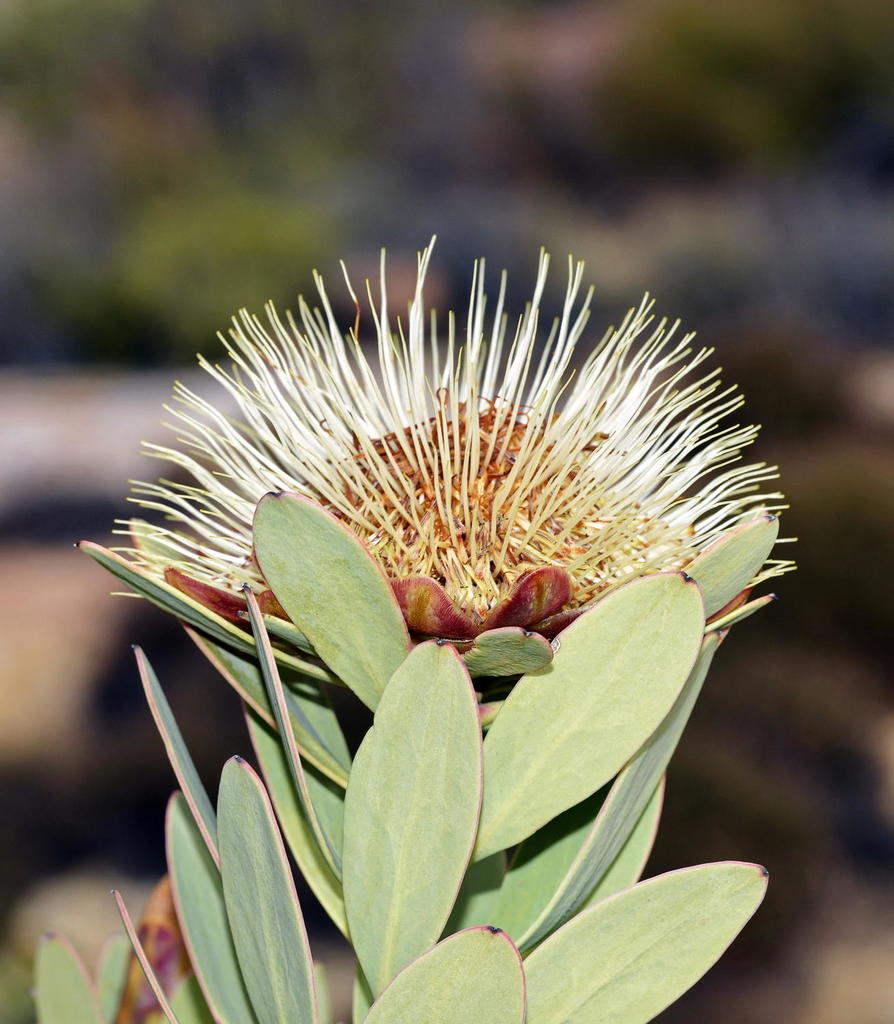
Clanwilliam Sugarbush
Protea glabra
Protea glabra, also called the Clanwilliam sugarbush, is a flowering shrub belonging to the genus Protea.
Other vernacular names for this plant are chestnut sugarbush, Clanwilliam protea or kayang bush. In Afrikaans it is known as the kaiingbos, kaiing-suikerbos, kaiinghout, kayangbos, kreupelwaboom or tolletjiewaboom.
From the article Protea glabra on Wikipedia (CC BY-SA), quoted section by section
Description
The bush grows up to 5m high and has a conical shape. It blooms from July to November. The plant is monoecious with both sexes in each flower.
Range & habitat
This species is endemic to South Africa. The plant is found in the Western Cape, on the Bokkeveld escarpment up to the Olifants River and the Koue Bokkeveld Mountains. Here, it is a widespread and common species with no severe threats.
== References ==
Wikipedia: “Distribution”
What it does
Pollination occurs through the action of birds and beetles. The seed is not stored in the woody fruit and is spread by the wind as soon as it is ripe. The plant grows in shallow sandstone soils or cracks in rock at altitudes of 500 - 1,500m. It is long-lived and can re-sprout after burning from a bole-shaped rootstock, although it normally grows in areas where there is low risk of wildfires.
Wikipedia: “Ecology”
Where it lives
Recorded sightings
—
geo-referenced records in GBIF, from museums, herbaria and field observers.
Drag the globe to turn it. Dots are where records exist, not a range map; darker means more records.
In the stacks
Searching the stacks…
Every page naming Protea glabra in the Biodiversity Heritage Library →
This page is assembled live from iNaturalist, GBIF, Wikipedia, the Source Library and the Internet Archive. It is not yet part of the hand-edited codex. iNaturalist taxon 577926.