- Animals
- ›Arthropods
- ›Hexapods
- ›Insects
- ›Winged and Once-winged Insects
- ›Ants, Bees, Wasps, and Sawflies
- ›Narrow-waisted Wasps, Ants, and Bees
- ›Ants, Bees, and Stinging Wasps
- ›Vespoid Wasps
- ›Hornets, Paper Wasps, Potter Wasps, and Allies
- ›Hornets and Yellowjackets
- ›Vespula
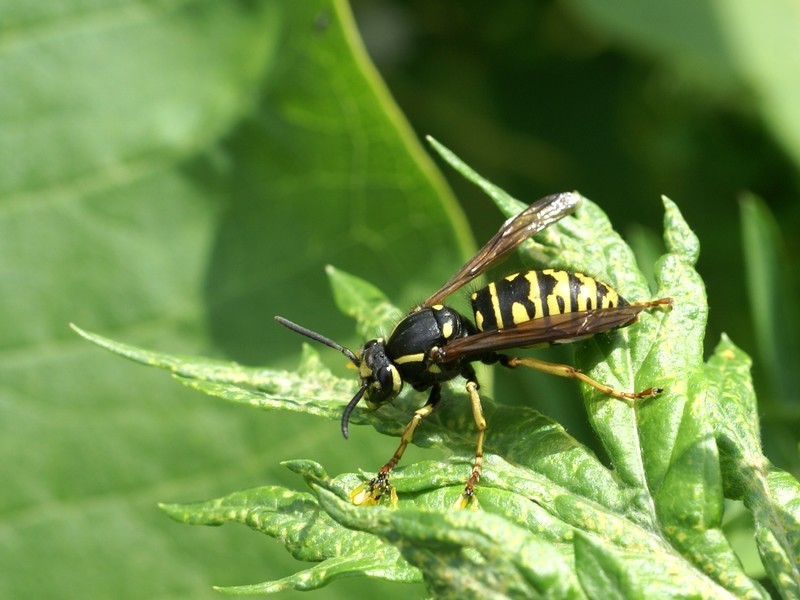
Cuckoo Yellowjacket
Vespula infernalis
Vespula infernalis is an obligate parasitic wasp, parasitizing the nests of other species in the genus Vespula. Its common host species is V. acadica in North America. It is sometimes called the cuckoo yellowjacket wasp due to its inquiline lifestyle. They differ from other parasitic wasps in their intensely aggressive behaviour during invasion and occupation of the host colony. Several morphological adaptations such as bigger body parts and highly curved stingers are present in these wasps to aid their aggressive parasitic behaviour.
Once they occupy a host's nest, V. infernalis are known to engage in mauling and chasing of host workers and forced trophallaxis. Female wasps will also force host workers to feed and take care of their brood .
From the article Vespula infernalis on Wikipedia (CC BY-SA), quoted section by section
Description
This wasp is an obligate social parasite. As a result, it possess special morphological adaptations to take over host colonies. These adaptations include larger body parts such as a larger head width than its host V. acadica. As an adaptation to its parasitic lifestyle, V. infernalis has a large, heavily curved stinger; this curving allows the parasitic wasp to puncture through the intersegmental membranes of host colony workers who are defending their nests. The male abdomen is longer with thick lateral black bands while the female abdomen is wider with fewer lateral black bands and black dots. V. infernalis wasps have a characteristic black and yellow colouring throughout their bodies. Irregular margins and narrow yellow marks on the scape are often used to identify Vespula infernalis.
Wikipedia: “Description and identification”
Range & habitat
Vespula infernalis is found in the Nearctic region, in the Boreal region of North America. The species is not considered rare and is stable throughout its range. These wasps are seen throughout all the provinces and territories of Canada and in certain states in the United States; Alaska, New Jersey, Michigan, Wisconsin, North Dakota, New Mexico, Arizona, and California.
Wikipedia: “Distribution and habitat”
What it does
V. infernalis parasitises V. acadica. Near the dorsal edge of V. infernalis mandibles, there is a fourth marginal tooth whereas the host, V. acadica has three. When researchers dissected individuals of V. infernalis, they found that they had larger, sturdier mature muscle bundles in abdominal sterna and tergum than the muscles in a queen of V. acadica. As a result, it was more difficult to dissect V. infernalis. Nests of V. acadica were found to be smaller than normal due to the parasitism of V. infernalis.
Wikipedia: “Parasitic behaviour”
Toxicity
Due to the parasitic lifestyle of V. infernalis, the sting is a vital apparatus. It consists of the shaft, aculeus, Dufour's gland, and the venom glands. The Dufour's gland and venom reservoirs are the biggest among V. infernalis females. In an experiment where the oily venom extracted from V. infernalis was injected into Vespula pensylvanica workers, the Lethal Dose (LD50) value was between 20 and 30 mg/kg. V. pensylvanica queens had a higher tolerance to V. infernalis venom than workers (LD50=81 mg/kg). On average, it took 18.6 μg of venom to kill about half of the queens and 2–3 μg of venom to kill half the workers. The venom has the ability to paralyze and impair activities such as flying. Material obtained from the Dufour's gland was also injected into V. pensylvanica wasps; no significant effects were observed, indicating the gland does not contain a poison. Generally, in order to kill a host worker, a V. infernalis has to use about a third of its venom supply. More venom is needed to kill a queen. Surprisingly, given that their survival and success as parasites depend upon it, V. infernalis venom is no more lethal than the venom from V. atropilosa and V. pensylvanica.
Wikipedia: “Characteristics of the venom”
Listen
Looking for field recordings…
Where it lives
Recorded sightings
—
geo-referenced records in GBIF, from museums, herbaria and field observers.
Drag the globe to turn it. Dots are where records exist, not a range map; darker means more records.
In the stacks
Searching the stacks…
Every page naming Vespula infernalis in the Biodiversity Heritage Library →
This page is assembled live from iNaturalist, GBIF, Wikipedia, the Source Library and the Internet Archive. It is not yet part of the hand-edited codex. iNaturalist taxon 577826.