- Animals
- ›Arthropods
- ›Hexapods
- ›Insects
- ›Winged and Once-winged Insects
- ›Ants, Bees, Wasps, and Sawflies
- ›Narrow-waisted Wasps, Ants, and Bees
- ›Ants, Bees, and Stinging Wasps
- ›Bees and Apoid Wasps
- ›Bees
- ›Honey Bees, Bumble Bees, and Allies
- ›Carpenter Bees
- ›Large Carpenter Bees
- ›Xylocopa
- ›Xylocopoides
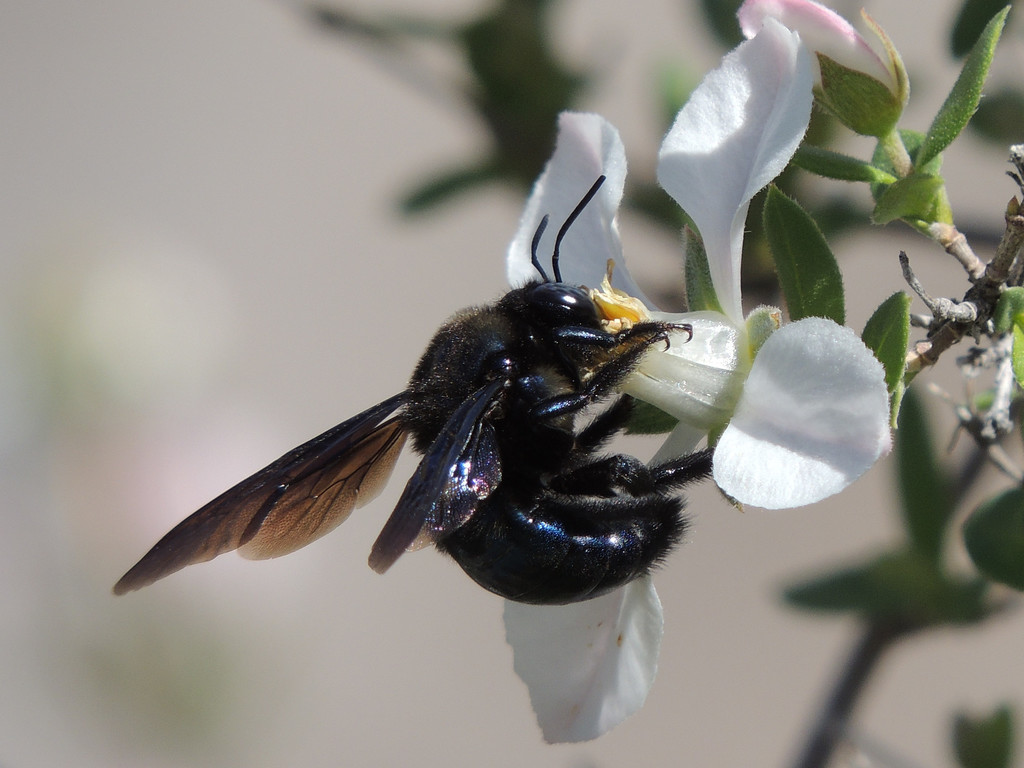
Western Carpenter Bee
Xylocopa californica
The California carpenter bee or Western carpenter bee, Xylocopa californica, is a species of carpenter bee in the order Hymenoptera, and it is native to western North America.
From the article California carpenter bee on Wikipedia (CC BY-SA), quoted section by section
Description
Their head is larger and thicker than their thorax; however, the size of the head differs between females and males. Female carpenter bees have bigger heads than males with more narrow heads. The California carpenter bee is all black, with bluish/greenish reflections. The males typically have at least a few light hairs on the pronotum (dorsal prothorax) and the abdominal segments. California carpenter bees have hair on their heads; most of their hair lays in the lower part of their head and cheeks compared to the sparse hairs on the top of the head. They have dark wings without stigma and are 13–30 mm long overall.
Range & habitat
There are approximately 400 species worldwide of the genus Xylocopa. X. californica is typically found in California, Nevada, Oregon, Washington, Utah, Arizona, New Mexico, Texas, and Northwestern Mexico. It is especially abundant, along with X. sonorina, in the Central Valley and in Southern California, including the Mojave Desert. They are agriculturally beneficial insects and pollinators of diverse California chaparral and woodlands and desert native plant species. This carpenter bee is active during hot seasons. Therefore, they are considered an endothermic insect as it absorbs heat in the desert conditions. As the bee absorbs too much heat in its body, it has to limit the time it flies and fly in the time of day in which it is cooler.
Wikipedia: “Distribution”
What it does
Xylocopa californica feeds on both nectar and pollen and, because of its large body size, generally visits larger, open flowers. Its foraging behavior consists of three principal forms of movement: rapid forward flight, hovering, and perching or walking across flower blossoms. Although its nectar sources are relatively varied, its pollen sources appear to be more specialized, with a preference for creosote bush (Larrea tridentata) and mesquite (Prosopis glandulosa). The species may also engage in nectar robbing by chewing a hole in the side of a flower and extracting nectar without pollinating it during that particular visit. In Big Bend National Park, Texas, X. californica has been observed robbing nectar from ocotillo (Fouquieria splendens), while also serving as the plant’s primary pollinator within the park.
Floral sonication. Floral sonication is essential for the foraging of many Hymenoptera. X. californica performs floral sonication to obtain pollen. They do this by gripping the poricidal anthers with their mandibles and contracting their flight muscles, rapidly vibrating their body and the flower's anthers, releasing the pollen onto the abdomen and legs of the bees. This process allows for pollination to happen. The vibration frequency is different throughout their body; their head's natural vibration is 87 Hz, and their abdominal terga is 163 Hz.X. …
Wikipedia: “Foraging behavior”
Listen
Looking for field recordings…
Where it lives
Recorded sightings
—
geo-referenced records in GBIF, from museums, herbaria and field observers.
Drag the globe to turn it. Dots are where records exist, not a range map; darker means more records.
In the stacks
Searching the stacks…
Every page naming Xylocopa californica in the Biodiversity Heritage Library →
This page is assembled live from iNaturalist, GBIF, Wikipedia, the Source Library and the Internet Archive. It is not yet part of the hand-edited codex. iNaturalist taxon 57688.