- Plants
- ›Vascular Plants
- ›flowering plants
- ›monocots
- ›Agaves, Orchids, Irises, and Allies
- ›Orchids
- ›Lower Epidendroid Orchids
- ›Neottieae
- ›Limodorinae
- ›Cephalanthera
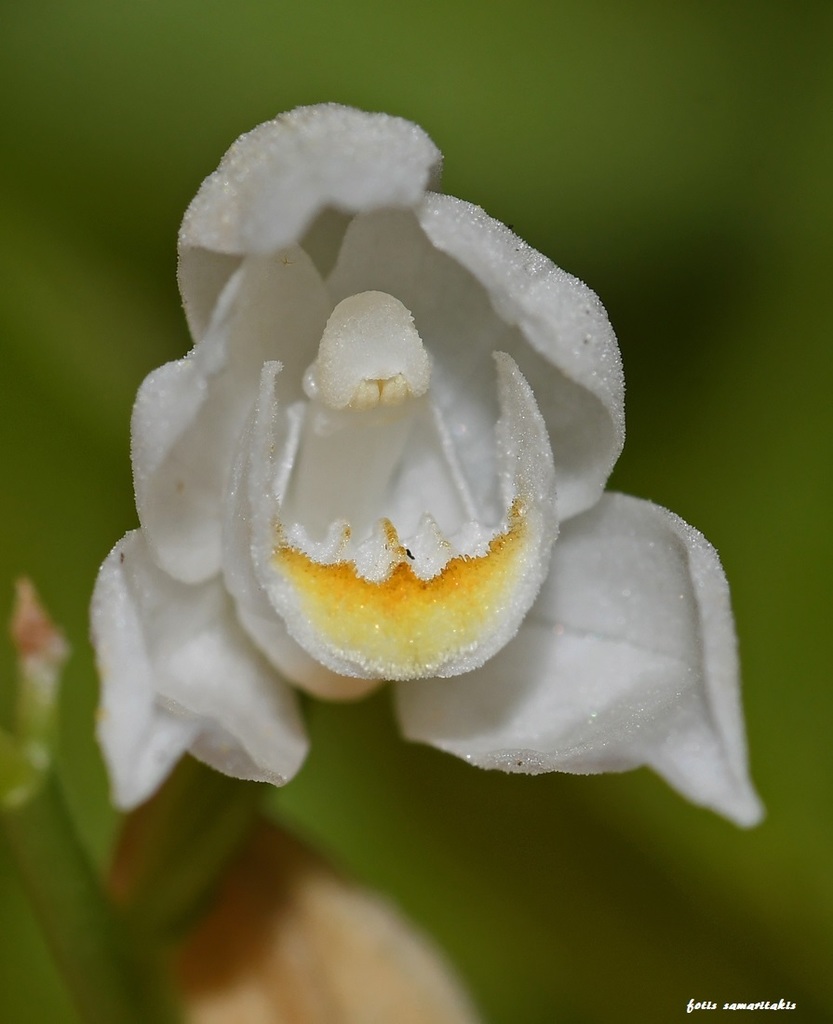
Narrow-leaved Helleborine
Cephalanthera longifolia
Cephalanthera longifolia, known by the common names narrow-leaved helleborine or sword-leaved helleborine or long-leaved helleborine, is a herbaceous perennial plant with rhizomes of the family Orchidaceae. It is native to light woodland, widespread across Europe, Asia and North Africa from Ireland and Morocco to China. This includes Iran, Russia, Kazakhstan, Turkey, Algeria, India, Pakistan, Germany, Italy, France, Spain, Portugal and many other countries.
From the article Cephalanthera longifolia on Wikipedia (CC BY-SA), quoted section by section
Description
Cephalanthera longifolia reaches on average 20–60 centimetres (7.9–23.6 in) in height in typical conditions. This orchid has erect and glabrous multiple stems. The leaves are dark green, long and narrowly tapering (hence the common name "sword-leaved helleborine"). The inflorescence is a lax, 5-20 flowered spike with the bell-shaped flowers ascending in an oblique spiral. The flowers are white, about 1 cm (0.4 in) long, with a yellow-edged labellum and they usually open only during the warmest and brightest hours of the day. This plant can be found in bloom from April to June, depending on location and altitude. The fruit is a dry capsule and the dust-like seed is dispersed by the wind. One unusual characteristic of this species is that some individuals are achlorophyllous (lacking green pigment) and take all their nutrition from mycorrhizal fungi.
Range & habitat
Cephalanthera longifolia is common in some parts of its European range, such as southern France and Spain, but endangered particularly in northern areas such as Belgium. In Britain and Ireland it is a quite uncommon and declining species, and conservation work is being carried out at a number of sites to safeguard it (see also Galley Down Wood). In 2007 it was listed as a priority species under the UK Biodiversity Action Plan. The charity Plantlife International is leading this work in the United Kingdom.
Wikipedia: “Distribution”
What it does
The flowers are pollinated by solitary burrowing bees. The flowers produce little nectar and the yellowish dust on the labellum which the insects collect is of little nutritional value. The actual pollen is contained in two pollinia which adhere to the hairs on the bee's back. An investigation in Estonia determined that the mycorrhizal partners of this orchid species include Thelephoraceae and Helotiales. Another investigation indicated 9 mycorrhizal partners (still fewer than those recorded for Cephalanthera damasonium): Bjerkandera adusta, Phlebia acerina, Sebacinaceae, Tetracladium sp., and Tomentella sp. Cephelanthera longifolia is vulnerable to grazing by deer.
Wikipedia: “Ecology”
In human culture
The genus name Cephalanthera comes from the Greek κεφαλή kephalē (head) and ἄνθηρα anthēra (anther): the anther is placed at the top (head) of the column. The Latin name longifolia means with long leaves . "Helleborine" may refer to deer using the orchid for food (many conservationists have noted that helleborine orchids are grazed by deer). Alternatively it may denote that the plants are similar to hellebores (a group of species in the family Ranunculaceae). "Hellebore" comes from the Greek "álkē" and "bora", translating as "fawn" and "food of beasts".
Wikipedia: “Etymology”
Where it lives
Recorded sightings
—
geo-referenced records in GBIF, from museums, herbaria and field observers.
Drag the globe to turn it. Dots are where records exist, not a range map; darker means more records.
In the stacks
Searching the stacks…
Every page naming Cephalanthera longifolia in the Biodiversity Heritage Library →
This page is assembled live from iNaturalist, GBIF, Wikipedia, the Source Library and the Internet Archive. It is not yet part of the hand-edited codex. iNaturalist taxon 57470.