- Animals
- ›Arthropods
- ›Hexapods
- ›Insects
- ›Winged and Once-winged Insects
- ›Butterflies and Moths
- ›Lasiocampoidea
- ›Lappet Moths
- ›Lasiocampinae
- ›Eutricha
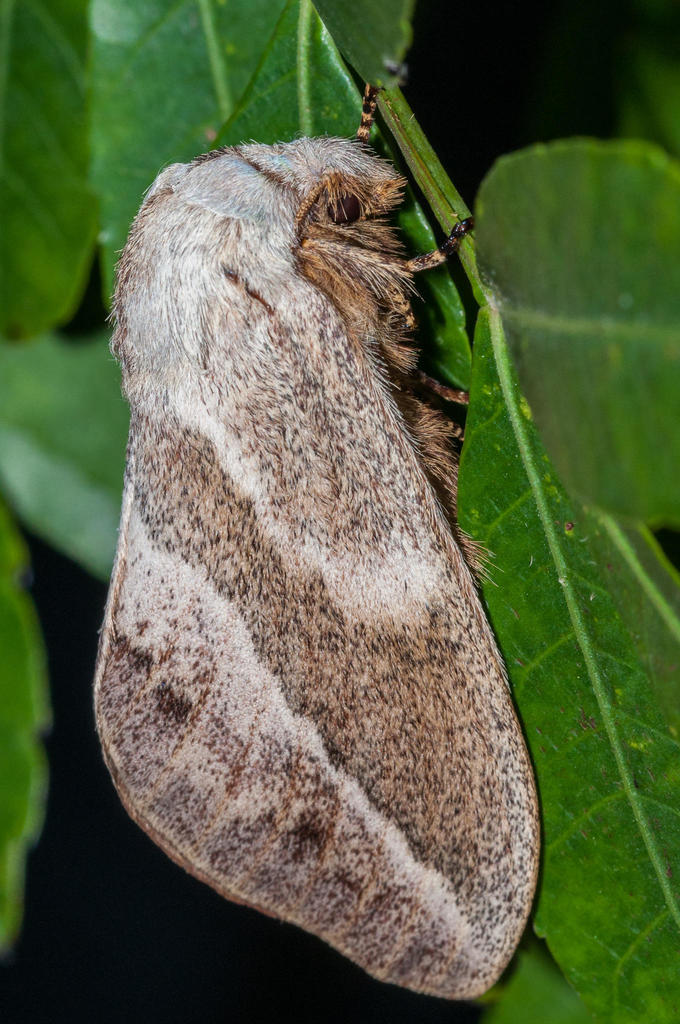
Cape Lappet
Eutricha capensis
Eutricha capensis, the Cape lappet moth, is a species of moth in the family Lasiocampidae primarily found in South Africa. During the larval stage, cape lappets feed on a wide variety of African plants and can often be found aggregating in gardens. The caterpillars are brightly coloured and conspicuously hairy, while the bulky adult moths are mostly brown and much less striking in appearance.
From the article Eutricha capensis on Wikipedia (CC BY-SA), quoted section by section
Description
The adults are large and stocky, with an average wingspan of about 70 mm (2.8 in). Both hind wings and fore wings are reddish brown. The fore wings are flecked with yellow and bear three wavy white stripes. Females are typically paler in colour and larger than males. Adult moths lack developed mouthparts and therefore do not feed. The antennae of females are deeply pectinate and are the length of the thorax. The larvae are distinctly hairy with rows of orange tufts of long hair along the sides of the body. Arranged at the head are three large coppery tufts and two smaller purple tufts. Along the dorsal side of the caterpillars is a row of black triangles flanked either side by white.
Range & habitat
There is little agreement regarding the extent of the Cape lappet moth's range in southern Africa. While all sources agree that its primary geographical home is South Africa, varied sources also state Malawi, Mozambique, and Tanzania. Being able to feed on a wide variety of plants, the caterpillars are common in domestic gardens and also in more remote and wild areas.
Wikipedia: “Distribution and habitat”
What it does
Gregarious as larvae, the caterpillars clump together in numbers. The reason for this behaviour is not well understood, with several proposed theories. For E. capensis at least, aggregating behaviour appears to be of no benefit to the caterpillars in terms of either water or energy conservation, according to a 2013 study. The larvae feed on Acacia cyclops, A. mearnsii, A. saligna, A. karroo, Bauhinia, Celtis africana, Chrysanthemoides monilifera, C. incana, Cupressus macrocarpa, Combretum molle, Eucalyptus macarthurii, E. paniculata, Euclea racemosa, Mangifera indica, Pinus patula, P. radiata, P. elliottii, P. montezumae, Populus, Prunus armeniaca, P. persica, Rhus lancea, Searsia lucida, Rhus crenata, Schinus molle, S. terebinthifolius, Rosa banksiae and Taxodium distichum. The emergence of the adults occurs in early summer. When disturbed, adults are non-aggressive.
Wikipedia: “Behaviour and life cycle”
Listen
Looking for field recordings…
Where it lives
Recorded sightings
—
geo-referenced records in GBIF, from museums, herbaria and field observers.
Drag the globe to turn it. Dots are where records exist, not a range map; darker means more records.
In the stacks
Searching the stacks…
Every page naming Eutricha capensis in the Biodiversity Heritage Library →
This page is assembled live from iNaturalist, GBIF, Wikipedia, the Source Library and the Internet Archive. It is not yet part of the hand-edited codex. iNaturalist taxon 574697.