- Plants
- ›Vascular Plants
- ›flowering plants
- ›monocots
- ›grasses, sedges, cattails, and allies
- ›grasses
- ›Pooideae
- ›Poeae
- ›Phalaridinae
- ›Phalaris
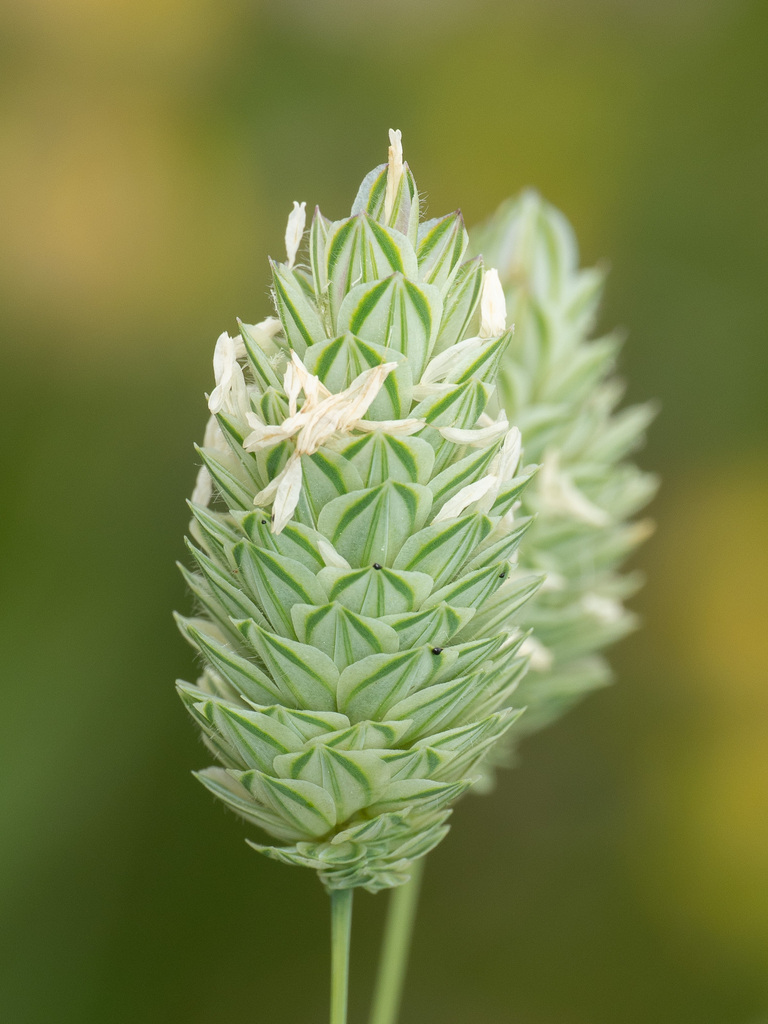
canary grass
Phalaris canariensis
Canary grass is a plant, Phalaris canariensis, belonging to the family Poaceae. Originally a native of the Mediterranean region, it is now grown commercially in several parts of the world for birdseed. This large, coarse grass has erect, hairless stems, usually from 2 to 6 feet (0.6- 1.8 metres) tall. The ligule is prominent and membranous, ¼ inch (0.6 cm) long and rounded at the apex. The gradually tapering leaf blades are 3½–10 inches (8.9–25.4 cm) long, ¼–¾ inch (0.6–1.9 cm)...
From the article Canary grass on Wikipedia (CC BY-SA), quoted section by section
Description
Phalaris canariensis resembles Phalaris arundinacea (reed canary grass), a perennial forage crop and a wild grass. Although heads of both crops are panicles, Phalaris canariensis heads resemble club wheat. This large, coarse grass has erect, hairless stems, usually from 2 to 6 feet (0.61 to 1.83 m) tall. The ligule is prominent and membranous, 1⁄4 inch (0.64 cm) long and rounded at the apex. The gradually tapering leaf blades are 3+1⁄2 to 10 inches (8.9 to 25.4 cm) long, 1⁄4 to 3⁄4 inch (0.64 to 1.91 cm) wide, flat, and often harsh on both surfaces. The compact panicles are erect or sometimes slightly spreading and range from 3 to 16 inches (7.6 to 40.6 cm) long with branches 1⁄2 to 1+1⁄2 inches (1.3 to 3.8 cm) long. Single flowers occur in dense clusters in May to mid-June or August. Inflorescences are green or slightly purple at first, then become tan.
Where it lives
Recorded sightings
—
geo-referenced records in GBIF, from museums, herbaria and field observers.
Drag the globe to turn it. Dots are where records exist, not a range map; darker means more records.
In the old herbals & bestiaries

In the stacks
Searching the stacks…
Every page naming Phalaris canariensis in the Biodiversity Heritage Library →
This page is assembled live from iNaturalist, GBIF, Wikipedia, the Source Library and the Internet Archive. It is not yet part of the hand-edited codex. iNaturalist taxon 57191.