- Plants
- ›Vascular Plants
- ›flowering plants
- ›monocots
- ›grasses, sedges, cattails, and allies
- ›grasses
- ›Pooideae
- ›Poeae
- ›Phalaridinae
- ›Phalaris
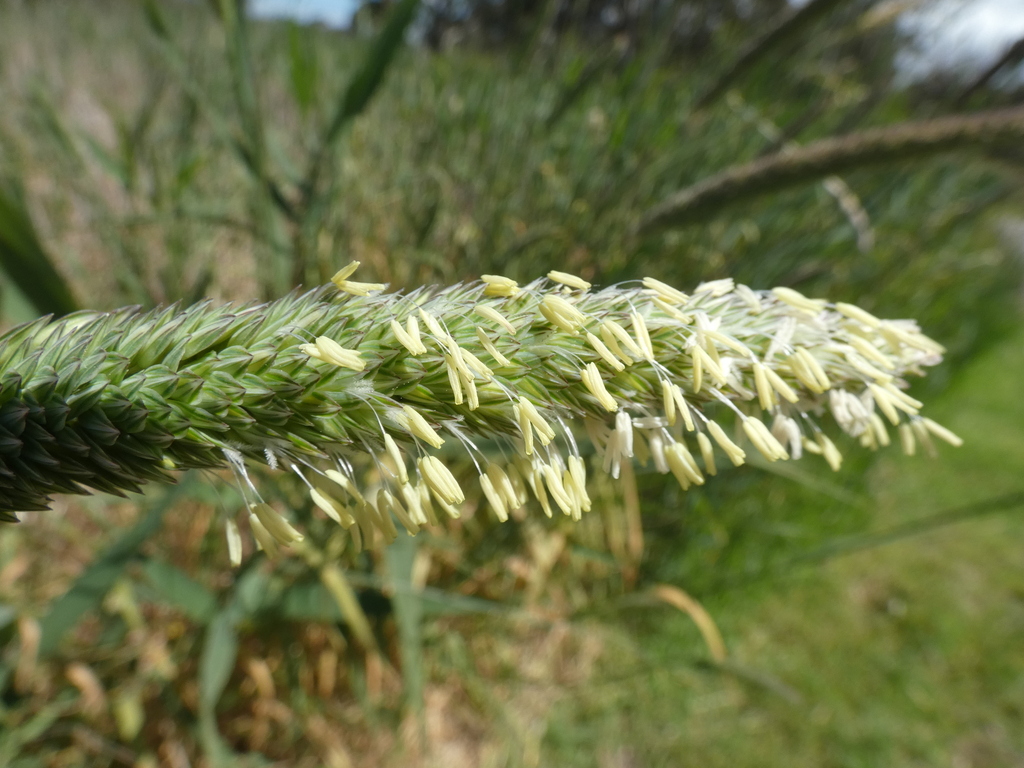
harding grass
Phalaris aquatica
Phalaris aquatica (syn. P. tuberosa) known by the common names bulbous canary-grass and Harding grass, is a species of grass in the genus Phalaris of the Poaceae Family.
From the article Phalaris aquatica on Wikipedia (CC BY-SA), quoted section by section
Description
It is an erect, waist-high, stout perennial bunch grass, with grayish to bluish green leaves. Flowering heads are dense, spike-like, and usually 2 to 5 inches (50 to 125 mm) long. It is slow to develop from seed, but can form large bunches after several years. Phalaris arundinacea (reed canary grass) differs from Harding grass in having more distinct rhizomes, and an inflorescence that is compact at first but becomes more open as the branches spread. Interspecific hybrids between Phalaris aquatica and Phalaris arundinacea have been produced through plant breeding programs to combine agronomic traits from both species. P. aquatica is a quick-growing grass which incorporates and utilises soil nitrogen rapidly.
Toxicity
Grazing on Phalaris-dominated pastures can cause livestock toxicoses:
Phalaris staggers: A chronic neurological condition associated with ruminants grazing Phalaris containing toxic alkaloids; appropriate cobalt supplementation can reduce the risk of the staggers syndrome. Sudden death: Acute mortality caused by peracute ammonia toxicity from young shoot consumption; not preventable by cobalt. Low-alkaloid cultivars are widely used to reduce grazing risk.
In Victoria, Australia, it is reported that kangaroos grazing on Phalaris aquatica may develop a condition known familiarly as "Phalaris staggers", in which coordination and mobility are affected.
How it is grown
Phalaris aquatica is commercial propagated as a cultivated pasture plant and can provide high-quality fodder for 8 to 12 months of the year. It has been widely adopted in pasture management due to its fast growth rate and high nutritional value. Breeding and selection programs in Argentina, several states of the USA, New Zealand, Israel, Tunisia, and Greece also produced cultivars such as Sirocco, Sirolan, Holdfast and Landmaster with specific adaptations to address agronomic challenges such as toxicity, seed shattering, and acid soil tolerance.
Wikipedia: “Agricultural use”
Where it lives
Recorded sightings
—
geo-referenced records in GBIF, from museums, herbaria and field observers.
Drag the globe to turn it. Dots are where records exist, not a range map; darker means more records.
In the stacks
Searching the stacks…
Every page naming Phalaris aquatica in the Biodiversity Heritage Library →
This page is assembled live from iNaturalist, GBIF, Wikipedia, the Source Library and the Internet Archive. It is not yet part of the hand-edited codex. iNaturalist taxon 57188.