- Plants
- ›Vascular Plants
- ›flowering plants
- ›Dicots
- ›pinks, cactuses, and allies
- ›Stone plants
- ›Brightfig Subfamily
- ›Brightfig Tribe
- ›Lithops
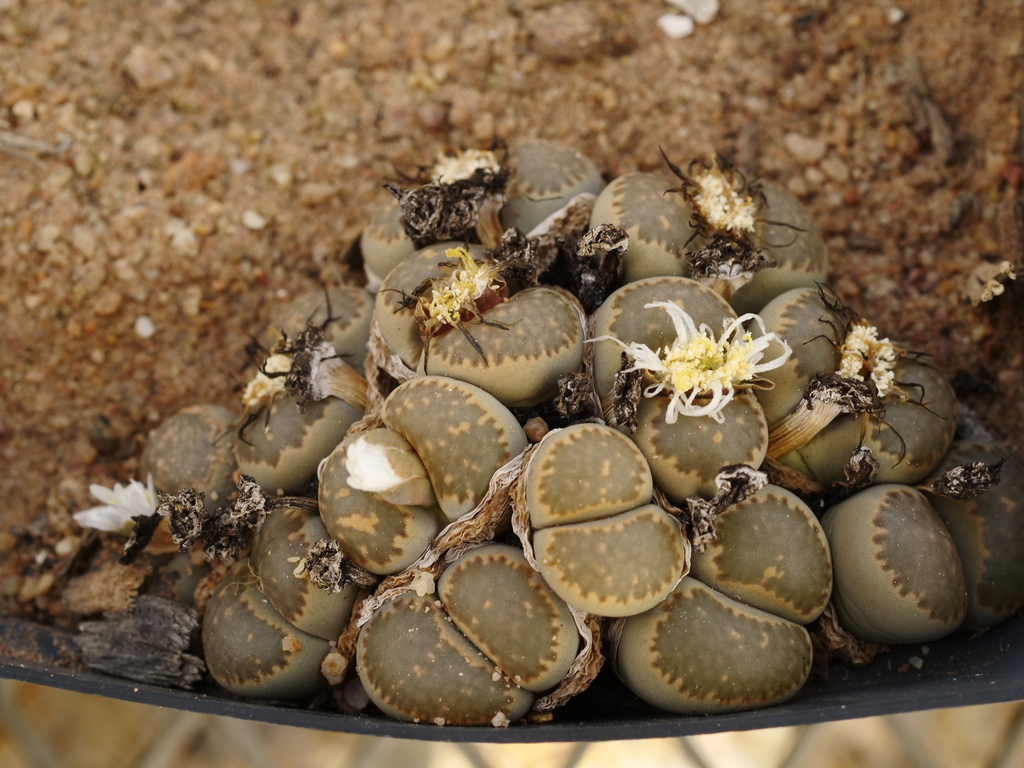
Lithops salicola
Lithops salicola is a species of perennial plant in the family Aizoaceae, often called living stones, because of its resemblance to round grey pebbles.
From the article Lithops salicola on Wikipedia (CC BY-SA), quoted section by section
Description
Lithops salicola has two coupled leaves, divided by a fissure through which the flowers appear. It is cylindrical or conical with a flat surface and green-gray coloration. The flowers are white and very small. It grows to a height of 2 cm (0.79 in).
Range & habitat
This species can be found in the Cape Provinces and Free State of South Africa at an elevation of 1,000 metres (3,300 ft) to 1,350 metres (4,430 ft). It is generally found in well-drained soil or in rock crevices. It occurs in an area of summer rainfall.
Wikipedia: “Distribution”
How it is grown
L. salicola is commonly used as a houseplant or for landscaping. Like all Lithops species, it requires extremely well-drained soil. It also grows in annual cycles, as the leaf-pairs flower, and then each produces a new leaf-pair that replaces the old one (which shrivels away). The principal rule of watering is that plants should be kept dry from when they finish flowering, up until the old leaf-pairs are fully replaced. Of the Lithops species, L. salicola is one of the species which is most tolerant of occasional incorrect watering, and therefore among the easiest to cultivate (together with L. lesliei, L. hookeri and L. aucampiae). In the United Kingdom L. salicola has gained the Royal Horticultural Society's Award of Garden Merit.
Wikipedia: “Cultivation”
Where it lives
Recorded sightings
—
geo-referenced records in GBIF, from museums, herbaria and field observers.
Drag the globe to turn it. Dots are where records exist, not a range map; darker means more records.
In the stacks
Searching the stacks…
Every page naming Lithops salicola in the Biodiversity Heritage Library →
This page is assembled live from iNaturalist, GBIF, Wikipedia, the Source Library and the Internet Archive. It is not yet part of the hand-edited codex. iNaturalist taxon 571069.