- Plants
- ›Vascular Plants
- ›flowering plants
- ›Dicots
- ›proteas, lotuses, planes, and allies
- ›Protea family
- ›Paired Proteas
- ›Embothrieae
- ›Hakeinae
- ›Hakea
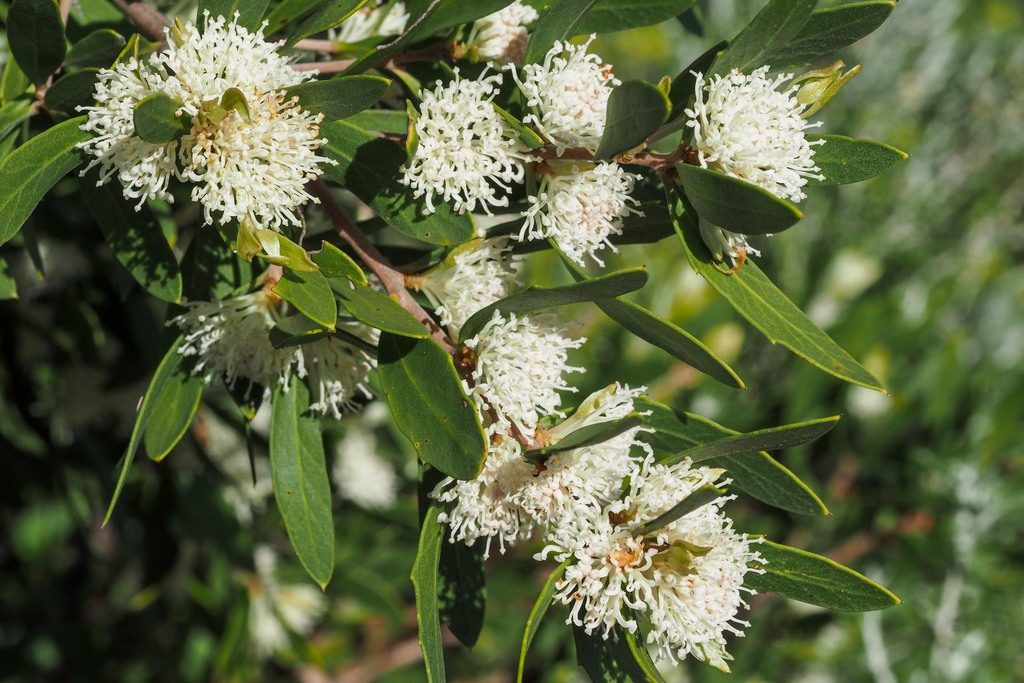
olive-leaved hakea
Hakea oleifolia
Hakea oleifolia, commonly known as dungyn, or the olive-leaved hakea, is a shrub or tree of the family Proteaceae and is endemic to an area along the south coast in the South West and Great Southern regions of Western Australia.
From the article Hakea oleifolia on Wikipedia (CC BY-SA), quoted section by section
Description
Hakea oleifolia is an upright, rounded shrub or tree that typically grows to a height of 2 to 10 metres (6.6 to 32.8 ft). It blooms from August to October and produces strong sweetly scented white large flowers on short racemes in leaf axils. Up to 28 showy flowers may appear per raceme. Leaves are elliptic olive-like 3–9 cm (1–4 in) long by 0.5–2.5 cm (0.2–1 in) wide and smooth edged or sparsely toothed. The ovoid fruit are horned woody capsules 2–3 cm (0.8–1 in) long by 1–2 cm (0.4–0.8 in) wide and taper to two prominent horns.
Range & habitat
Olive-leaved hakea grows in the wet south-western tip of Western Australia from Busselton to Bremer Bay. An understorey plant growing in woodland and coastal locations withstanding salt-laden winds on clay, sand, loam and gravelly soils. A frost-tolerant species requiring a well-drained site.
Wikipedia: “Distribution and habitat”
Where it lives
Recorded sightings
—
geo-referenced records in GBIF, from museums, herbaria and field observers.
Drag the globe to turn it. Dots are where records exist, not a range map; darker means more records.
In the stacks
Searching the stacks…
Every page naming Hakea oleifolia in the Biodiversity Heritage Library →
This page is assembled live from iNaturalist, GBIF, Wikipedia, the Source Library and the Internet Archive. It is not yet part of the hand-edited codex. iNaturalist taxon 570827.