- Plants
- ›Vascular Plants
- ›flowering plants
- ›Dicots
- ›nightshades, bindweeds, gooseweeds, and allies
- ›bindweed family
- ›Cuscuteae
- ›Cuscuta
- ›Grammica
- ›Californicae
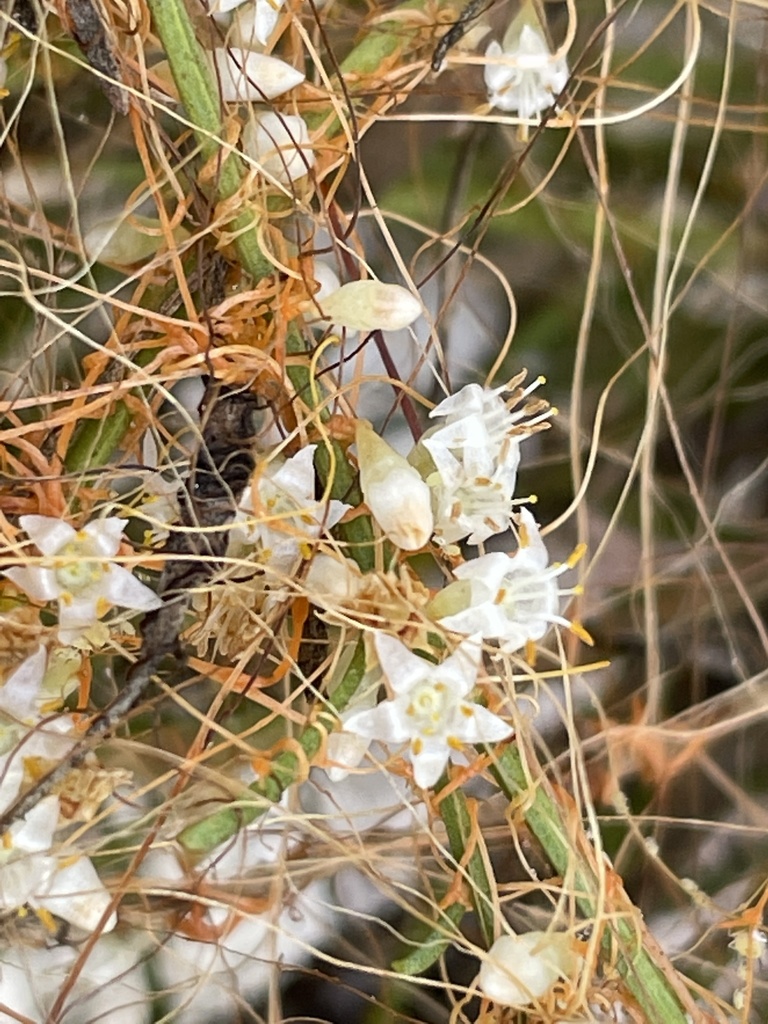
California dodder
Cuscuta californica
Cuscuta californica is a species of dodder known by the common names chaparral dodder and California dodder. This is an annual parasitic plant that may resemble fine strands of spaghetti or twine strewn across other species in its habitat. A mature plant of this species may fulfill all of its food and water needs from the host plant, but they rarely kill their host. It is native to western United States and Baja California in Mexico.
From the article Cuscuta californica on Wikipedia (CC BY-SA), quoted section by section
Description
Cuscuta californica is a parasitic vine that resembles a pile of yellow-orange straw wrapped tightly around its host plant. It is mostly stem; the leaves are reduced to scales on the stem's surface, since they are not needed for photosynthesis while the dodder is obtaining nutrients from its host.
It bears tiny white flowers which are only about 3 to 5 millimeters wide, and spheric or ovid fruits which are 1.5-2.2 millimeters wide. The flowers can be used as a diagnostic feature in determining the species of dodder; on C. californica, the calyx length is 3⁄4 to equaling the length of the corolla. The bell-shaped corolla lobes are also equaling or longer than the corolla tube, and the filaments are 0.6 to 1.1 mm long.
Host interaction and parasitism. Like all dodders, Cuscuta californica is a holoparasite that detects suitable hosts by means of "foraging" patterns, as dodder seedlings can detect the volatile compounds emitted by host plants. Dodder seedlings are even capable of "selecting" host plants based on their compounds emitted. The plant then coils and forms special organs called haustoria, which exert mechanical pressure and produce enzymes to penetrate cell walls. This process creates a direct connection between the host plant’s vascular bundles and the dodder, enabling the extraction and bidirectional transfer of macromolecules such as mRNA.
Phenology. …
Range & habitat
This species is found throughout the western United States and parts of Mexico. In the United States, it is found in Arizona, California, Nevada, Oregon, Utah and Washington. In Mexico, it is primarily found in the northwestern portion of the state of Baja California. It grows on numerous herbs and shrubs such as black sage, buckwheat, and deerweed from various habitats, including sandy desert areas, chaparral, coastal sage scrub, grasslands, forests of Pinus ponderosa, and weedy, partially disturbed areas like roadsides. Under these circumstances, they are not considered a noxious weed, but do become problematic when inhabiting agricultural fields and nursery crops. It was also discovered in Flowood, Mississippi on August 12, 2022.
Wikipedia: “Distribution and habitat”
Where it lives
Recorded sightings
—
geo-referenced records in GBIF, from museums, herbaria and field observers.
Drag the globe to turn it. Dots are where records exist, not a range map; darker means more records.
In the stacks
Searching the stacks…
Every page naming Cuscuta californica in the Biodiversity Heritage Library →
This page is assembled live from iNaturalist, GBIF, Wikipedia, the Source Library and the Internet Archive. It is not yet part of the hand-edited codex. iNaturalist taxon 57019.