- Animals
- ›Arthropods
- ›Hexapods
- ›Insects
- ›Winged and Once-winged Insects
- ›Butterflies and Moths
- ›Flannel, Slug Caterpillar, Leaf Skeletonizer, and Allied Moths
- ›New World Flannel Moths
- ›Trosiinae
- ›Trosia
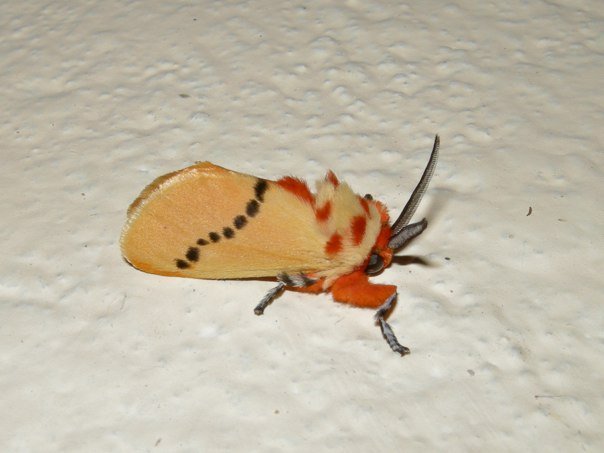
Trosia incostata
Trosia dimas, the rosy ermine, is a moth of the Megalopygidae family. It was described by Pieter Cramer in 1775. It is found in Colombia, Venezuela, Ecuador, Brazil and Peru. The habitat consists of rainforests and cloudforest at altitudes between 300 and 1,700 meters.
From the article Trosia dimas on Wikipedia (CC BY-SA), quoted section by section
Description
This species has a wingspan of about 34 millimetres (1.3 in). The head, abdomen, and legs are reddish and the tarsi black, spotted with white. The collar and thorax are yellowish buff, the latter spotted with red. The forewings are greenish yellow, with a postmedial row of black spots. The hindwings are roseate. The underside is dull roseate. In this species, the costa of the forewings is of the same color as the wing.
Range & habitat
Trosia dimas is found in rainforests and cloud-forest at altitudes between 300 and 1,700 meters (980 and 5,580 ft). Byrsonima coccolobifolia is the host plant of Trosia dimas.
Wikipedia: “Habitat”
Listen
Looking for field recordings…
Where it lives
Recorded sightings
—
geo-referenced records in GBIF, from museums, herbaria and field observers.
Drag the globe to turn it. Dots are where records exist, not a range map; darker means more records.
In the stacks
Searching the stacks…
Every page naming Trosia incostata in the Biodiversity Heritage Library →
This page is assembled live from iNaturalist, GBIF, Wikipedia, the Source Library and the Internet Archive. It is not yet part of the hand-edited codex. iNaturalist taxon 569562.