- Plants
- ›Vascular Plants
- ›flowering plants
- ›Dicots
- ›Nances, Willows, and Allies
- ›St. John's wort family
- ›St. John's worts tribe
- ›Hypericum
- ›Olympia
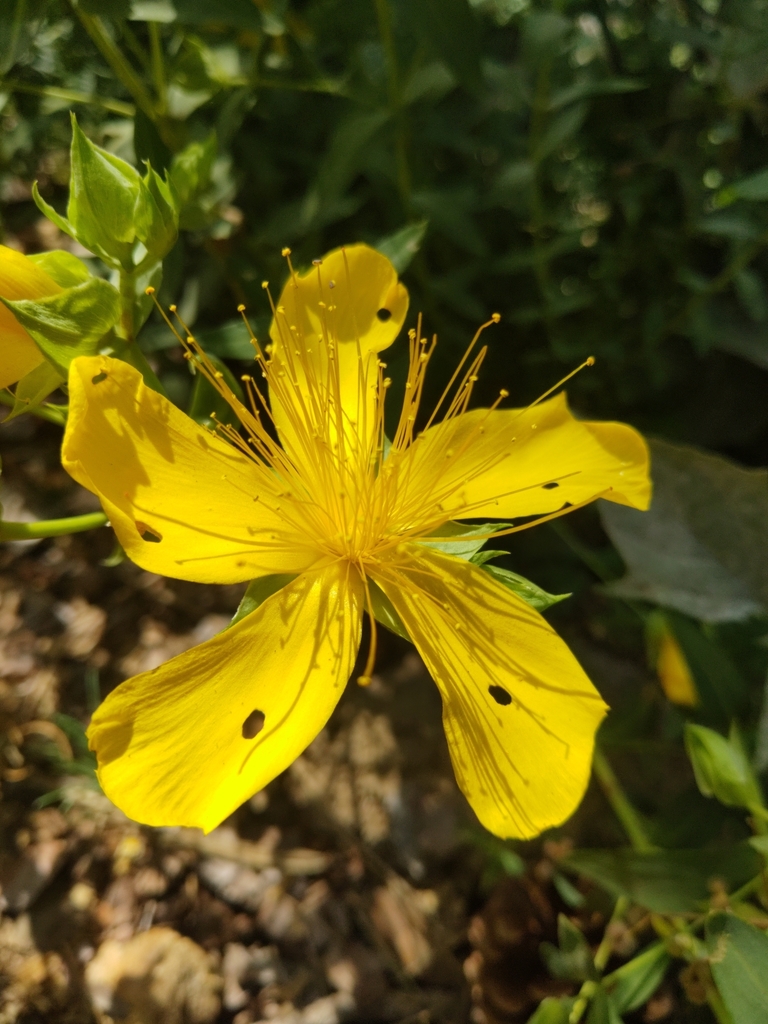
Olympic St John's-wort
Hypericum olympicum
Hypericum olympicum (Mount Olympus St. John's wort) is a species of flowering plant in the family Hypericaceae. It is native to Eurasia, including Albania, Bulgaria, the states of the former Yugoslavia, Greece, Turkey, and Syria. It is a dwarf deciduous shrub growing to 25 cm (10 in) tall by 30 cm (12 in) broad, with small oval grey-green leaves, and clusters of star-shaped yellow flowers with prominent stamens in summer. As it requires sharp drainage to prevent winter rot, it...
From the article Hypericum olympicum on Wikipedia (CC BY-SA), quoted section by section
Description
The species is a shrub or subshrub that grows to be 0.1–0.55 metres (0.33–1.80 ft) tall. It can grow in an erect to decumbent manner, or rarely prostrate. It can have few to numerous stems, and it is caespitose, occasionally rooting, and unbranched below its flowers. The stems' internodes are 5–15 millimetres (0.20–0.59 in) long, and can be either short or longer than the leaves. The leaves are spreading to erect, and are more or less glaucous, and are 5–30 by 2–12 millimetres (0.197 in–1.181 in × 0.079 in–0.472 in) in size. They are elliptic or rarely lanceolate-elliptic, are concolorous and thinly coriaceous. Their apex is acute to subacute or rounded-obtuse, with a rounded or cuneate base. They have 0-3 pairs of lateral veins and are unbranched (at least visibly). The laminar glands are pale and not prominent, and the intramarginal glands are black, small, and few in number. The plant is usually 1–5 flowered, but can have up to nine flowers that grow from three nodes, and rarely from one lower node. Their pedicels are 2–4 millimetres (0.079–0.157 in) long and rather stout. The bracts are reduced-foliar, are broadly imbricate, and lack black glands, and the bracteoles are similar but smaller in size. The flowers are 30–65 millimetres (1.2–2.6 in) in diameter, and their buds are ovoid-pyramidal and rounded. …
Range & habitat
The species is native to Southeastern Serbia, Macedonia, Albania, Bulgaria, Greece (excluding Crete and western Aegean islands), and northwestern Turkey. The species was first introduced to England in 1676 by Sir George Wheeler from seeds found in Turkey, and it was cultivated at the Oxford Botanical Garden. The species has also been recorded as establishing itself in Belgium and France, where it is considered an invasive species. It can be found in sandy, stony, and sometimes grassy places or among rocks in open ground, or in pine woodland at elevations of 0 to 2,000 m (6,600 ft).
Wikipedia: “Distribution and habitat”
In medicine
H. olympicum f. olympicum is used alongside other Hypericum species in parts of rural Turkey as traditional folk medicine. Typically, its flowers are harvested and used to treat stomach aches, cuts, and burns.
Wikipedia: “Folk medicine”
How it is grown
Because of its large, showy flowers, relative hardiness, and dense shape, the species is valued among gardeners, specifically in the United Kingdom. It has been noted for these properties and won several awards, including in 1930, under the incorrect name of H. fragile, winning the Royal Horticultural Society's Award of Garden Merit. While the species is not at all harmful to humans, it can be toxic to dogs, cats, and horses, and should be planted away from such animals. It can be grown in chalk, clay, sand, or loam, and requires moist ground, but with sharp drainage. As it requires sharp drainage to prevent winter rot, it is a suitable subject for the rockery or alpine garden. The species requires pH to be between 6.1 and 7.8, which means it can tolerate both mildly acidic and mildly alkaline conditions. The plant usually takes 5–10 years to reach its full height, but much less than that to reach maturity. The species should be planted in May or June, will flower from June to August, and cuttings should be taken from May to July.
Cultivars. There are several cultivated forms of H. olympicum, with H. olympicum 'Citrinum' being by far the best known. So-called because of its lemon-colored petals, it is often the plant that is found in home or botanical gardens.
Wikipedia: “Cultivation”
Where it lives
Recorded sightings
—
geo-referenced records in GBIF, from museums, herbaria and field observers.
Drag the globe to turn it. Dots are where records exist, not a range map; darker means more records.
In the stacks
Searching the stacks…
Every page naming Hypericum olympicum in the Biodiversity Heritage Library →
This page is assembled live from iNaturalist, GBIF, Wikipedia, the Source Library and the Internet Archive. It is not yet part of the hand-edited codex. iNaturalist taxon 567176.