- Plants
- ›Vascular Plants
- ›flowering plants
- ›Dicots
- ›Nances, Willows, and Allies
- ›St. John's wort family
- ›St. John's worts tribe
- ›Hypericum
- ›Thornea
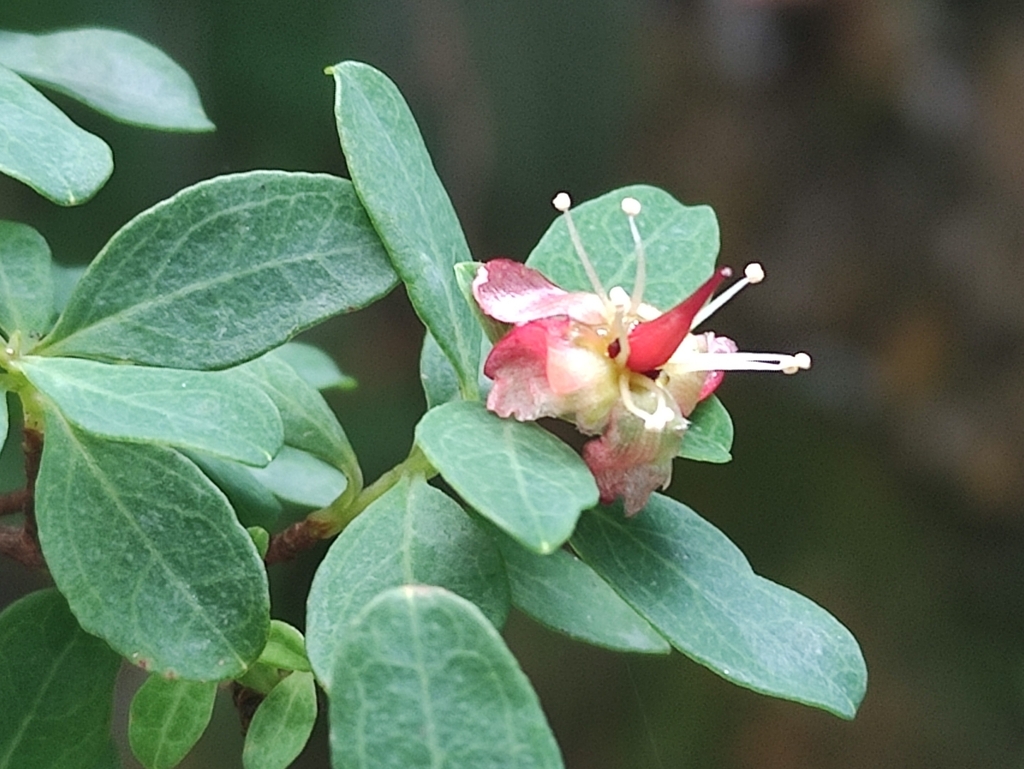
Hypericum calcicola
Hypericum calcicola is a species of flowering plant of the St. John's wort family Hypericaceae. It is a perennial herb with dense branches that can grow up to 3 meters (9.8 ft) tall. The species has small leaves and pink or rose red petals. Originally described in 1944, it was later moved into the genus Thornea, only to be returned to Hypericum when Thornea was demoted to sectional status. Found in Guatemala and Mexico, the plant grows on limestone bluffs in the Sierra de los Cuchumatanes mountain range. It often becomes dominant in its ecosystem, and grows alongside a variety of other trees and shrubs.
From the article Hypericum calcicola on Wikipedia (CC BY-SA), quoted section by section
Description
Hypericum calcicola is a perennial herb with dense branches which lacks hairs (is glabrous). It grows upright, usually 30–60 centimeters (12–24 in) tall but up to 3 meters (9.8 ft) tall. It has many short lateral branches, and the older branches are a blackish color while the younger are more reddish. The leaves are small, and are an oblong to oval shape. They have a short leaf stalk and are placed opposite one another on the stem. They are a somewhat leathery texture, and are 0.5–1.5 cm long and 0.2–0.6 cm wide. On the underside of the leaf, there is a visible net of veins. The flowers are placed at the ends of branches, and have a short and slender pedicel. There are four ovate sepals that are around 0.2 cm long. The petals are pink to rose red, and are 0.5–0.7 cm long. There are three styles that are around 0.2 cm long. The seed capsule is around 0.5 cm long, and there are few seeds that are around 0.1 cm long. The wood of H. calcicola is porous and diffuse, with faintly visible growth rings. The wood tissue lacks axial parenchyma, but does have both uniseriate and multiseriate rays. It is distinguished from its sister species Hypericum matudae by having more dense branches, shorter internodes, leathery instead of papery leaf texture, and smaller petals and seed capsules. When it was first described, its resemblance to Symphoricarpos microphyllus was pointed out.
Range & habitat
The holotype of the Hypericum calcicola was collected in its type locality of Huehuetenango, Guatemala, in 1942. It is distributed across Guatemala and southeast Mexico. It is commonly found on limestone bluffs, and particularly on the mountain peaks of the Sierra de los Cuchumatanes range at an altitude of 3,700 meters (12,100 ft). It grows in the Montane rainforest ecosystem, especially on the lake shores of Lagunas de Montebello National Park. Hypericum calcicola often becomes somewhat dominant in its ecosystem, where it grows alongside numerous trees and shrubs.
Wikipedia: “Distribution, habitat, and ecology”
In human culture
One origin of the genus name Hypericum is that it is derived from the Greek words hyper (above) and eikon (picture), in reference to the tradition of hanging the plant over religious icons in the home. According to Rye, the specific epithet calcicola is derived from the Latin words calcis ("limestone") and cola ("inhabitant"), and refers to the habitat of the plant. The Latin word for "limestone" is however calx and the word for "inhabitant" is incola.
Wikipedia: “Etymology”
Where it lives
Recorded sightings
—
geo-referenced records in GBIF, from museums, herbaria and field observers.
Drag the globe to turn it. Dots are where records exist, not a range map; darker means more records.
In the stacks
Searching the stacks…
Every page naming Hypericum calcicola in the Biodiversity Heritage Library →
This page is assembled live from iNaturalist, GBIF, Wikipedia, the Source Library and the Internet Archive. It is not yet part of the hand-edited codex. iNaturalist taxon 564954.