On eBird ↗
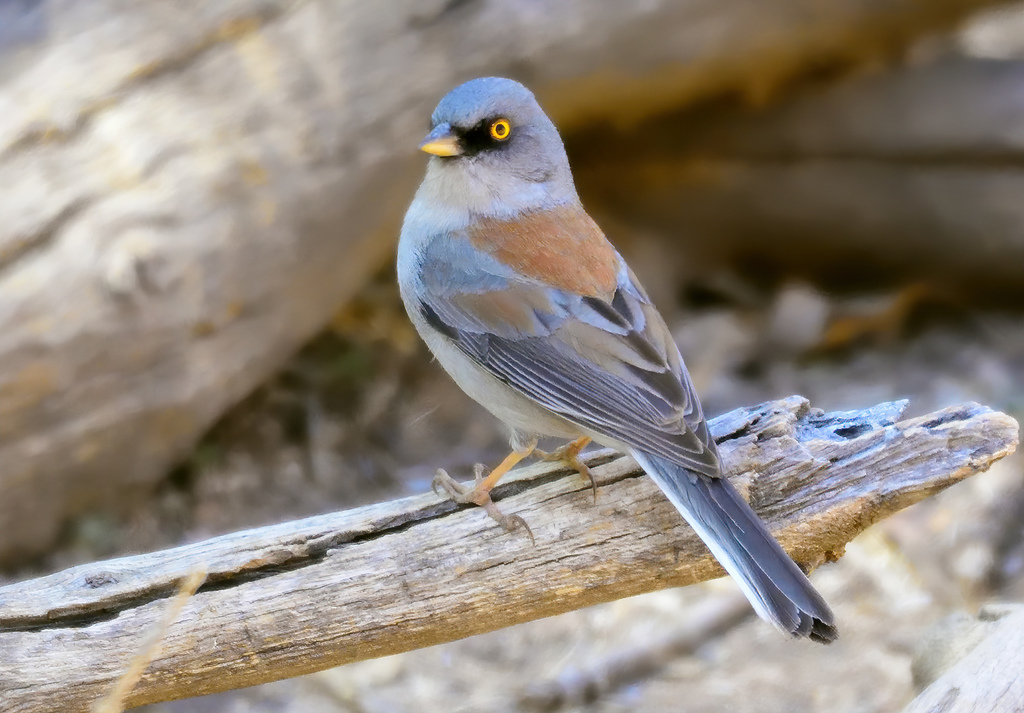
Yellow-eyed Junco
Live sightings near you, the range map, bar charts of when it is seen, and Macaulay Library photos and recordings.
Yellow-eyed Junco
Junco phaeonotus
The yellow-eyed junco (Junco phaeonotus) is a species of bird in the family Passerellidae, the New World sparrows. It is found from the southwestern United States to Guatemala.
From the article Yellow-eyed junco on Wikipedia (CC BY-SA), quoted section by section
Description
The yellow-eyed junco is about 16 cm (6.3 in) long. Subspecies J. p. palliatus weigh 18 to 22 g (0.63 to 0.78 oz). The species is sexually dimorphic but not dramatically so. Adult males of the nominate subspecies J. p. phaeonotus have a mostly medium gray head with black lores, a black "mask" around the eye, and a paler gray chin and throat with an olive tinge. Their upper back is the same medium gray as their head, their lower back and scapulars are rufous, and their rump and uppertail coverts are olive-gray. Their wing's lesser coverts are gray with dusky centers, their medium coverts gray often with a rufous tinge, and their greater coverts are gray with bright rufous bases on their inner webs. The last visually extend the rufous of the scapulars onto the closed wing. Their flight feathers are dusky; the primaries have thin white edges on their outer webs, the secondaries than thin pale gray edges on their outer webs, and the tertials have bright rufous outer webs. Their tail is mostly dark gray-brown; the outermost pair of feathers are mostly white and the next pair inward have dark bases and much white beyond. Their upper breast and sides are the same olive-tinged pale gray as their throat. Their flanks are the same pale gray with a strong olive-buff tinge. Their lower breast, belly, and undertail coverts are grayish white. …
Range & habitat
The yellow-eyed junco has a disjunct distribution. The subspecies are found thus:
J. p. palliatus: southeastern Arizona and extreme southwestern New Mexico in the U. S. south through western Mexico to Jalisco and Guanajuato and also in Mexico from Coahuila south to Guanajuato J. p. phaeonotus: Mexico from Jalisco east to Hidalgo and from there south to Veracruz and Oaxaca J. p. fulvescens: interior of southeastern Mexico's Chiapas J. p. alticola from southeastern Chiapas into western Guatemala The yellow-eyed junco is a montane species. It primarily inhabits pine and pine-oak forest and also scrublands and brushy pastures and fields in the upper subtropical and temperate zones. Sources are in general agreement on its elevational range. A twentieth century one states it is 1,200 to 3,400 m (3,900 to 11,200 ft). A 2006 field guide states it is 1,250 to 3,500 m (4,100 to 11,500 ft). A 2020 publication says the species ranges from 1,200 to 3,500 m (3,900 to 11,500 ft) though mostly is found above 2,000 m (6,600 ft). In its limited Guatemalan range it is found between 1,700 to 3,600 m (5,600 to 11,800 ft).
Wikipedia: “Distribution and habitat”
What it does
During the breeding season the yellow-eyed junco feeds mostly on insects. At other times it adds other arthropods and seeds to its diet. It does much foraging on the ground, usually amid vegetation or otherwise under cover, where it scratches through leaf litter and soil. It also gleans prey from branches, strips seeds from plants, and takes insects in mid-air with a short flight. It also has been observed feeding on sap coming from woodpecker holes. During the breeding season it forages mostly in pairs but forms small flocks during winter.
Wikipedia: “Feeding”
Listen
Looking for field recordings…
Where it lives
Recorded sightings
—
geo-referenced records in GBIF, from museums, herbaria and field observers.
Drag the globe to turn it. Dots are where records exist, not a range map; darker means more records.
In the stacks
Searching the stacks…
Every page naming Junco phaeonotus in the Biodiversity Heritage Library →
This page is assembled live from iNaturalist, GBIF, Wikipedia, the Source Library and the Internet Archive. It is not yet part of the hand-edited codex. iNaturalist taxon 564898.