On eBird ↗
Palawan Babbler
Live sightings near you, the range map, bar charts of when it is seen, and Macaulay Library photos and recordings.
Palawan Babbler
Malacopteron palawanense
The Melodious babbler or Palawan babbler (Malacopteron palawanense) is a species of bird in the family Pellorneidae.
It is endemic to the Philippines and found only on Palawan and Balabac.
From the article Melodious babbler on Wikipedia (CC BY-SA), quoted section by section
Description
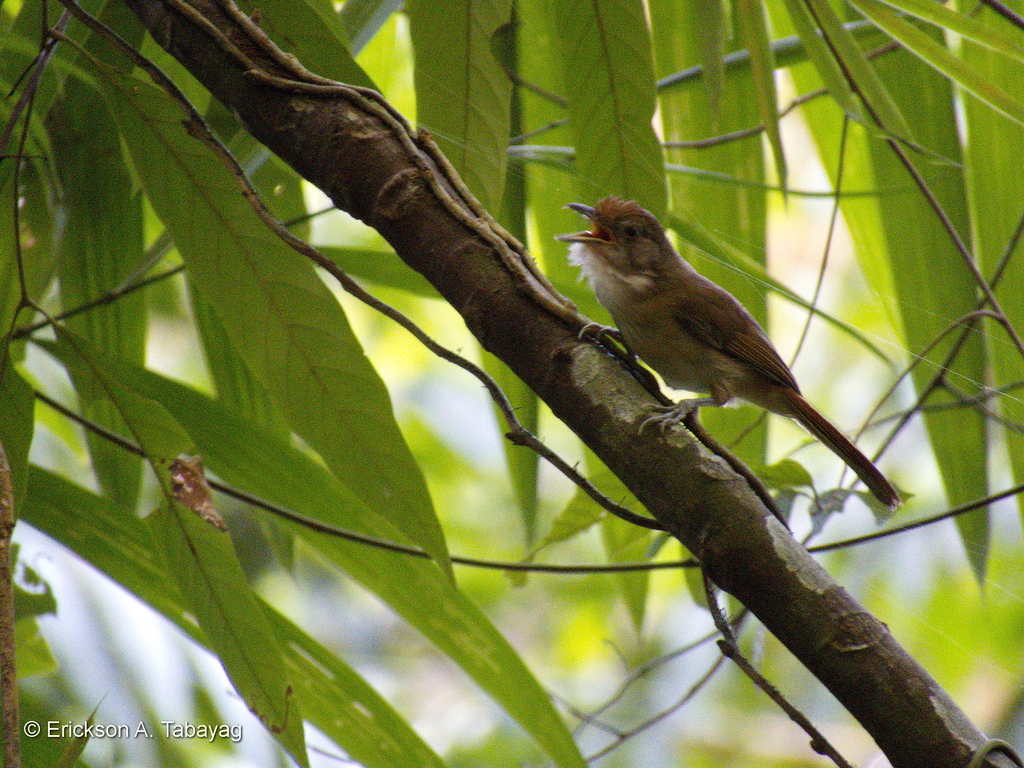
Described as a medium sized bird of the lowland forests of Palawan and Balabac. Primarily light brown with more hints of reddish brown on the tail, shoulder and top of the head. Has a while belly and a pufffy white throat. Iris is grayish white. Bill is straight with a hooked tip. This species does not exhibit any obvious sexual dimorphism. Song is a series of mournful whistles alternate between high and low notes that progressively increase in volume and then accompanied by a swift and harsh "whip". This species is monotypic.
Wikipedia: “Description and taxonomy”
Range & habitat
The species inhabits tropical moist lowland primary forest and mature secondary forest only up to 100 meters above sea level. This species has been assessed a Vulnerable species in 2025 as there is believed to be a significant decline of this species due to the damage from Typhoon Odette. This species is especially reliant on thick underbrush and the degradation of this areas, even temporarily due to typhoons can significantly cause population declines and low surviviability. Population is now estimated at just 4,500 to 13,500 mature individuals with a declining population. Populations believed to be decreasing due to habitat loss, deforestation and mining. The whole of Palawan was designated as a Biosphere Reserve; however, protection and enforcement of laws has been difficult and these threats still continue. It occurs in just one protected area in the Iwahig Prison and Penal Farm.
Wikipedia: “Habitat and conservation status”
What it does
Diet is largely unknown but presumed to feed on insects and some vegetable matter. It is often seen foraging alone or in small groups foraging in the understorey in tangles and vines. It appears to be loyal to its territory and pairs are often observed in the same general area. Birds in breeding but otherwise nothing is known about its breeding behaviour and the nest remains undescribed.
Wikipedia: “Ecology and behavior”
Listen
Looking for field recordings…
Where it lives
Recorded sightings
—
geo-referenced records in GBIF, from museums, herbaria and field observers.
Drag the globe to turn it. Dots are where records exist, not a range map; darker means more records.
In the stacks
Searching the stacks…
Every page naming Malacopteron palawanense in the Biodiversity Heritage Library →
This page is assembled live from iNaturalist, GBIF, Wikipedia, the Source Library and the Internet Archive. It is not yet part of the hand-edited codex. iNaturalist taxon 564847.