- Plants
- ›Vascular Plants
- ›flowering plants
- ›Dicots
- ›Legumes, Milkworts, and Allies
- ›Legumes
- ›Acacias, Mimosas, Mesquites, and Allies
- ›Vachellia
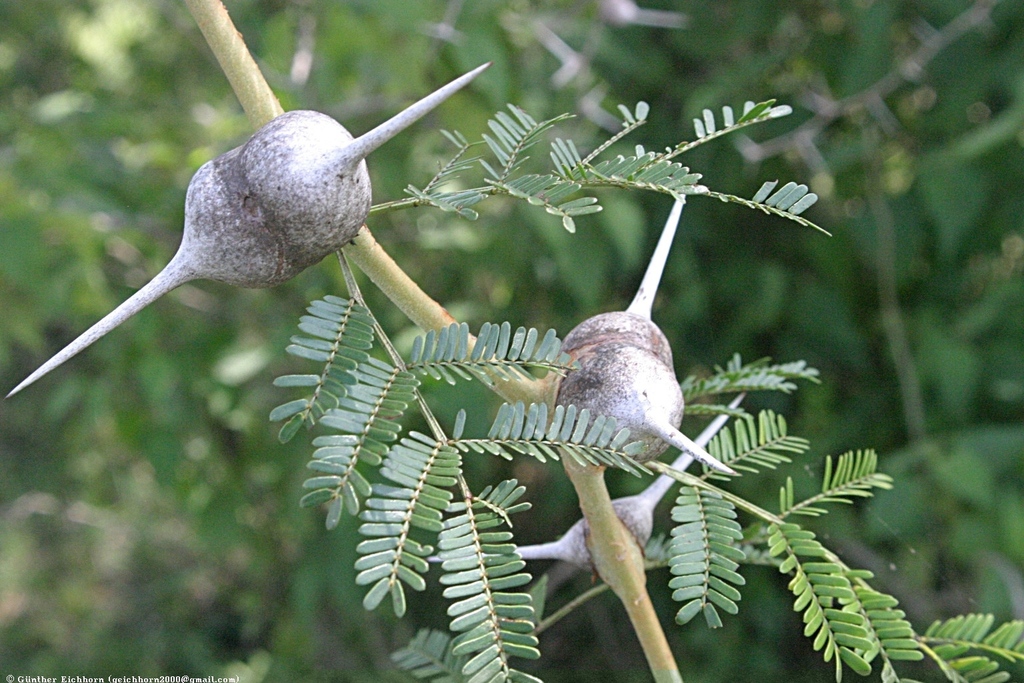
whistling thorn
Vachellia drepanolobium
Vachellia drepanolobium, more commonly known as Acacia drepanolobium or whistling thorn, is a swollen-thorn acacia native to East Africa. The whistling thorn grows up to 6 meters tall. It produces a pair of straight spines at each node, some of which have large bulbous bases. These swollen spines are naturally hollow and occupied by any one of several symbiotic ant species. The common name of the plant is derived from the observation that when wind blows over bulbous spines in which ants have made entry and exit holes, they produce a whistling noise.
Whistling thorn is the dominant tree in some areas of upland East Africa, sometimes forming a nearly monoculture woodland, especially on "black cotton" soils of impeded drainage with high clay content. It is browsed upon by giraffes and other large herbivores. It is apparently fire-adapted, coppicing readily after "top kill" by fire.
From the article Vachellia drepanolobium on Wikipedia (CC BY-SA), quoted section by section
What it does
Like other acacias, whistling thorns have leaves that contain tannins, which are thought to serve as deterrents to herbivory. Like all African acacias, they are defended by spines. In addition, whistling thorn acacias are myrmecophytes that have formed a mutualistic relationship with some species of acacia ants. In exchange for shelter in the bulbous spines (domatia) and nectar secretions, these ants appear to defend the tree against herbivores, such as elephants and giraffes, as well as herbivorous insects. At a site in Kenya, three Crematogaster and one Tetraponera ant species compete for exclusive possession of individual whistling thorn trees: Crematogaster mimosae, C. sjostedti, C. nigriceps, and Tetraponera penzigi. Ant species vary in their level of mutualism with whistling thorn trees. The most common ant symbiote (~ 50% of trees), C. mimosae, has the strongest mutualistic relationship, aggressively defending trees from herbivores while relying on swollen-spines for shelter and feeding from nectar produced by glands near the base of leaves. (See also: Crematogaster peringueyi.) 3-Octanone and 3-Octanol have been identified as the alarm pheromones of Crematogaster negriceps and C. mimosa used in defending their tree. These chemicals are components of the ant's mandibular gland secretion. Later analysis of the mandibular gland secretion of these ants and of C. …
Wikipedia: “Symbiosis with ants”
Where it lives
Recorded sightings
—
geo-referenced records in GBIF, from museums, herbaria and field observers.
Drag the globe to turn it. Dots are where records exist, not a range map; darker means more records.
In the stacks
Searching the stacks…
Every page naming Vachellia drepanolobium in the Biodiversity Heritage Library →
This page is assembled live from iNaturalist, GBIF, Wikipedia, the Source Library and the Internet Archive. It is not yet part of the hand-edited codex. iNaturalist taxon 564613.