- Plants
- ›Vascular Plants
- ›flowering plants
- ›Dicots
- ›Heathers, Balsams, Primroses, and Allies
- ›heath family
- ›blueberries, cranberries, huckleberries, and allies
- ›Vaccinieae
- ›Vaccinium
- ›Vitis-idaea
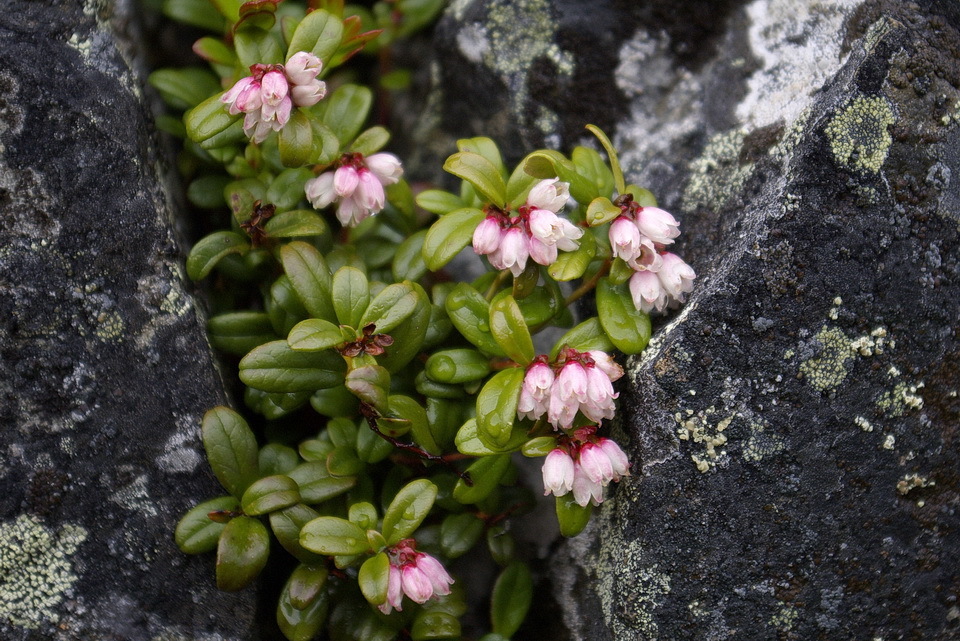
Lingonberry
Vaccinium vitis-idaea
Vaccinium vitis-idaea (lingonberry, partridgeberry, mountain cranberry or cowberry) is a short evergreen shrub in the heath family that bears edible fruit, native to boreal forest and Arctic tundra throughout the Northern Hemisphere from Eurasia to North America. Lingonberries are picked in the wild and used to accompany a variety of dishes in Northern Baltoscandia and Russia. Commercial cultivation is undertaken in the U.S. Pacific Northwest and in many other regions of the world.
From the article Vaccinium vitis-idaea on Wikipedia (CC BY-SA), quoted section by section
Description
Vaccinium vitis-idaea spreads by underground stems to form dense clonal colonies. Slender and brittle roots grow from the underground stems. The stems are rounded in cross-section and grow from 10 to 40 cm (4 to 16 in) in height. Leaves grow alternately and are oval, 5–30 mm (1⁄4–1+1⁄8 in) long, with a slightly wavy margin, and sometimes with a notched tip. The flowers are bell-shaped, white to pale pink, 3–8 mm (1⁄8–3⁄8 in) long. V. vitis-idaea begins to produce flowers from five to ten years of age. They are pollinated by multiple insect species, including Andrena lapponica and several species of bumblebee. The fruit is a red berry 6–10 mm (1⁄4–3⁄8 in) across, with an acidic taste, ripening in late summer to autumn. While bitter early in the season, they sweeten if left on the branch through winter. Cytology is 2n = 24. Its fruit persists for an average of 13.4 days, and bears an average of 11.2 seeds per fruit. Fruits average 84.9% water, and their dry weight includes 15.4% carbohydrates and 1.5% lipids.
Related species. Vaccinium vitis-idaea differs from the related cranberries in having white flowers with petals partially enclosing the stamens and stigma, rather than pink flowers with petals reflexed backwards, and rounder, less pear-shaped berries. Vaccinium oxycoccos is similar. Hybrids between V. vitis-idaea and V. …
Range & habitat
It is native to boreal forest and Arctic tundra throughout the Northern Hemisphere, including Eurasia and North America.
Wikipedia: “Distribution and habitat”
What it does
Vaccinium vitis-idaea keeps its leaves all winter even in the coldest years, unusual for a broad-leaved plant, though in its natural habitat it is usually protected from severe cold by snow cover. It is extremely hardy, tolerating temperatures as low as −50 °F (−45 °C) or lower, but grows poorly where summers are hot. It prefers some shade (as from a forest canopy) and constantly moist, acidic soil. Nutrient-poor soils are tolerated but not alkaline soils.
Wikipedia: “Ecology”
At the table
Raw lingonberries are 86% water, 13% carbohydrates, 1% protein, and contain negligible fat. In a 100-gram (3.5-ounce) reference amount, lingonberries supply 54 kcal, and are low-to-moderate sources of vitamin C, B vitamins, and dietary minerals. The berries collected in the wild are a popular fruit in northern, central and eastern Europe, notably in the Nordic countries, the Baltic states, and northern and central Europe. In some areas, they can be picked legally on both public and private lands in accordance with the freedom to roam. The berries are quite tart, so they are often cooked and sweetened before eating as lingonberry jam, compote, juice, smoothie or syrup. The raw fruits are also frequently simply mashed with sugar. Fruit served this way or as compote often accompanies game and liver dishes. In Sweden the traditional Swedish meatballs are served with lingonberry jam alongside boiled or mashed potatoes and gravy sauce. In Sweden, Finland and Norway, reindeer and elk steaks are traditionally served with gravy and lingonberry sauce. Preserved fruit is commonly eaten with meatballs, as well as potato pancakes. A traditional Swedish dessert is lingonpäron (literally 'lingonberry pears'), consisting of fresh pears which are peeled, boiled and preserved in lingondricka (lingonberry juice) and is commonly eaten during Christmas. …
Wikipedia: “Culinary”
In medicine
In traditional medicine, V. vitis-idaea was used as an apéritif and astringent. The Upper Tanana ate the berries or used their juice to treat minor respiratory disorders.
Wikipedia: “Traditional medicine”
How it is grown
Lingonberry has been commercially cultivated in the Netherlands, Germany, Sweden, Poland, the United States (including the Pacific Northwest) and Latvia since the 1960s. Some cultivars are grown for their ornamental rather than culinary value. In the United Kingdom, the Koralle Group has gained the Royal Horticultural Society's Award of Garden Merit.
Wikipedia: “Cultivation”
In human culture
Vaccinium vitis-idaea is most commonly known in English as 'lingonberry' or 'cowberry'. The name 'lingonberry' originates from the Swedish name lingon ([ˈlɪŋɔn] ) for the species deriving from Old Norse lyngr, a cognate (thus also a doublet) to 'ling'. The genus name Vaccinium is a classical Latin name for a plant, possibly the bilberry or hyacinth, and may be derived from the Latin bacca, 'berry'. The specific name is derived from Latin vitis ('vine') and idaea, the feminine form of idaeus (literally 'from Mount Ida', used in reference to raspberries Rubus idaeus). Worldwide, Vaccinium vitis-idaea is known by at least 25 other common English names, including:
Wikipedia: “Etymology”
Where it lives
Recorded sightings
—
geo-referenced records in GBIF, from museums, herbaria and field observers.
Drag the globe to turn it. Dots are where records exist, not a range map; darker means more records.
In the old herbals & bestiaries

Six Groups of the History of Plants
Rembert Dodoens · 1583 · p.779

History of Rare Plants Observed in Pannonia
Carolus Clusius · 1583 · p.84

History of Rare Plants Observed in Pannonia
Carolus Clusius · 1583 · p.83

Rariorum Plantarum Historia (with Fungorum Historia)
Carolus Clusius · 1601 · p.79

Rariorum Plantarum Historia (with Fungorum Historia)
Carolus Clusius · 1601 · p.80
In the stacks
Searching the stacks…
Every page naming Vaccinium vitis-idaea in the Biodiversity Heritage Library →
This page is assembled live from iNaturalist, GBIF, Wikipedia, the Source Library and the Internet Archive. It is not yet part of the hand-edited codex. iNaturalist taxon 56312.