- Plants
- ›Vascular Plants
- ›flowering plants
- ›Dicots
- ›Mints, Plantains, Olives, and Allies
- ›Mint Family
- ›Lamioideae
- ›Marrubieae
- ›Ballota
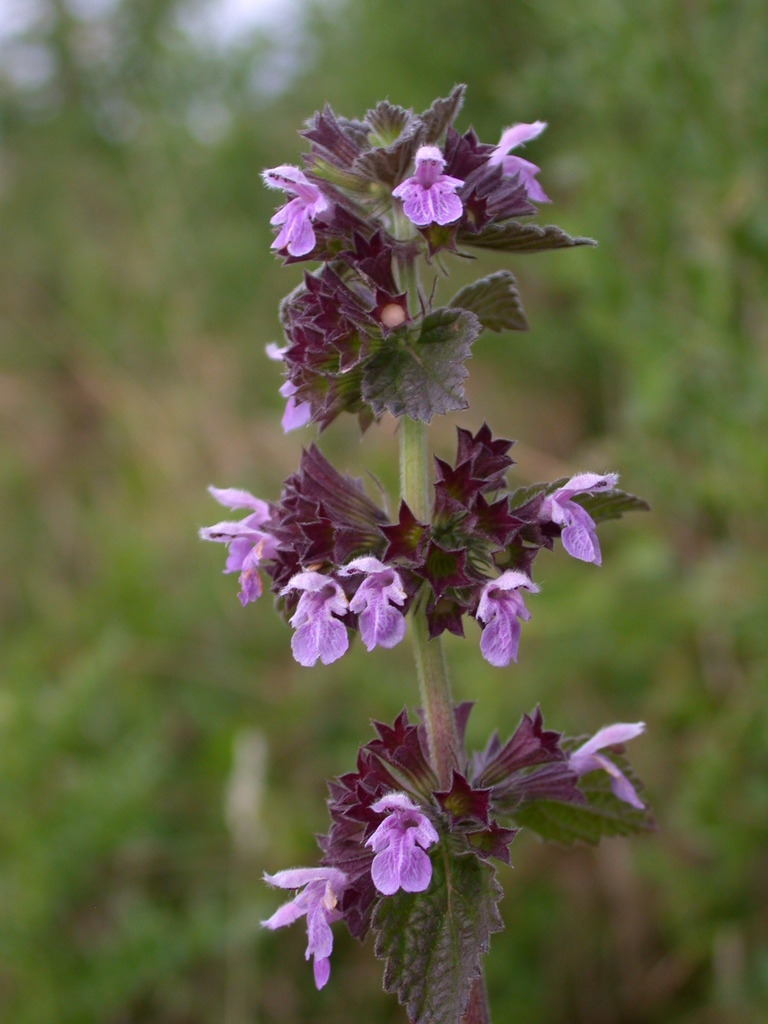
Black horehound
Ballota nigra
Ballota nigra (black horehound) is a perennial herb of the family Lamiaceae. It is native to the Mediterranean region and to central Asia, and it can be found throughout Europe. It is also naturalized in Argentina, New Zealand, and the Eastern United States. It blooms in the Northern Hemisphere from May to August.
From the article Ballota nigra on Wikipedia (CC BY-SA), quoted section by section
Description
Ballota nigra has a very strong characteristic smell reminiscent of mould or damp soil, and can be recognised by its clusters of hairy, reddish-purple flowers. It can grow up to 1 m (3 ft 3 in) tall.
Stem and root. It has erect herbaceous stems, wooden and branched at bottom, covered by downy hairs. The plant has a taproot system.
Leaves. The leaves are opposite and decussate, and range from oval-lanceolate to heart-shaped, with crenate or dentate border. They are dark green and usually pubescent, measuring 2–8 cm by 2–6 cm, and have a 1–3 cm petiole. Upper face is wrinkled, with a net-like vein pattern.
Flowers. The flowers are arranged in verticillasters, subspherical to one-sided, with 15–30 flowers. Each verticillaster consist of two condensed dichasial cymes in the axils of normal leaves. Each flower has an actinomorphic calyx, length 9–10 mm, width 7 mm, made up of five sepals fused together in a tube with five teeths; and a labiate corolla of 12–14 mm, ranging from pink to pale purple to withish. The corolla consist of a tube of about 6 mm and two lips; the upper one slightly concave (like a hood) and externally hairy; the lower one glabrous, with two minor lateral lobes and a major central bifid lobe. There are four didynamous stamens, running parallel under the upper lip, with glabrous filaments and yellow anthers. …
Range & habitat
Ballota nigra is a nitrophilous plant; it grows in ruins, fallows, and hedges at elevations up to 1,300 m (4,300 ft). It prefers loose, calcareous (alkaline) soils. It tolerates temperatures as low as -5°/-10 °C.
Wikipedia: “Habitat”
At the table
Usually the plant is used dry and harvested when blooming. Syrups can be made from fresh plants.
Biochemistry. Ballota nigra contains diterpenoids like marrubiin, ballonigrin, ballotinone, ballotenol and 7-acetoxymarrubiin.
Wikipedia: “Uses”
In human culture
The common name comes from the Old English words har, meaning "downy or hoary", and hune, meaning the plant itself. This name refers to the hairs that give the herb its distinctive appearance. In modern times, some alternative medicine practitioners have referred to the plant as "seed of Horus" and claiming that horehound takes its name from Horus, the Egyptian sun god.
Wikipedia: “Etymology”
Where it lives
Recorded sightings
—
geo-referenced records in GBIF, from museums, herbaria and field observers.
Drag the globe to turn it. Dots are where records exist, not a range map; darker means more records.
In the old herbals & bestiaries

Six Groups of the History of Plants
Rembert Dodoens · 1583 · p.110

Notable Commentaries on the History of Plants
Leonhart Fuchs · 1542 · p.188

Notable Commentaries on the History of Plants
Leonhart Fuchs · 1549 · p.186

On the Names of Plants
Hieronymus Bock (Tragus) · 1552 · p.80

Commentaries on the Six Books of Dioscorides
Pietro Andrea Mattioli · 1560 · p.595

Commentaries on the Six Books of Dioscorides on Medical Matter
Pietro Andrea Mattioli · 1563 · p.539

Commentaries on the Six Books of Pedanius Dioscorides on Medical Matter
Pietro Andrea Mattioli · 1565 · p.997

A New Herbal, or History of Plants
Rembert Dodoens (trans. Henry Lyte) · 1578 · p.281

Herbarium Portatile, Oder Behendes Kräuter- und Gewächs-Buch: Darinn nicht allein 1363. so wol Einheimische als Außländndische Kräuter mit Lateinisch und Deutscher Benennung abgebildet, sondern auch die meisten, so in der Medicin gebräuchlich, kürtzlich erkläret werden
Panckow, Thomas · 1656 · p.203

Herbarium Portatile, Oder Behendes Kräuter- und Gewächs-Buch: Darinn nicht allein 1363. so wol Einheimische als Außländndische Kräuter mit Lateinisch und Deutscher Benennung abgebildet, sondern auch die meisten, so in der Medicin gebräuchlich, kürtzlich erkläret werden
Panckow, Thomas · 1656 · p.202
In the stacks
Searching the stacks…
Every page naming Ballota nigra in the Biodiversity Heritage Library →
This page is assembled live from iNaturalist, GBIF, Wikipedia, the Source Library and the Internet Archive. It is not yet part of the hand-edited codex. iNaturalist taxon 56158.