- Plants
- ›Vascular Plants
- ›flowering plants
- ›Dicots
- ›Heathers, Balsams, Primroses, and Allies
- ›heath family
- ›Epacrids, Styphelias and Allies
- ›Styphelieae
- ›Lissanthe
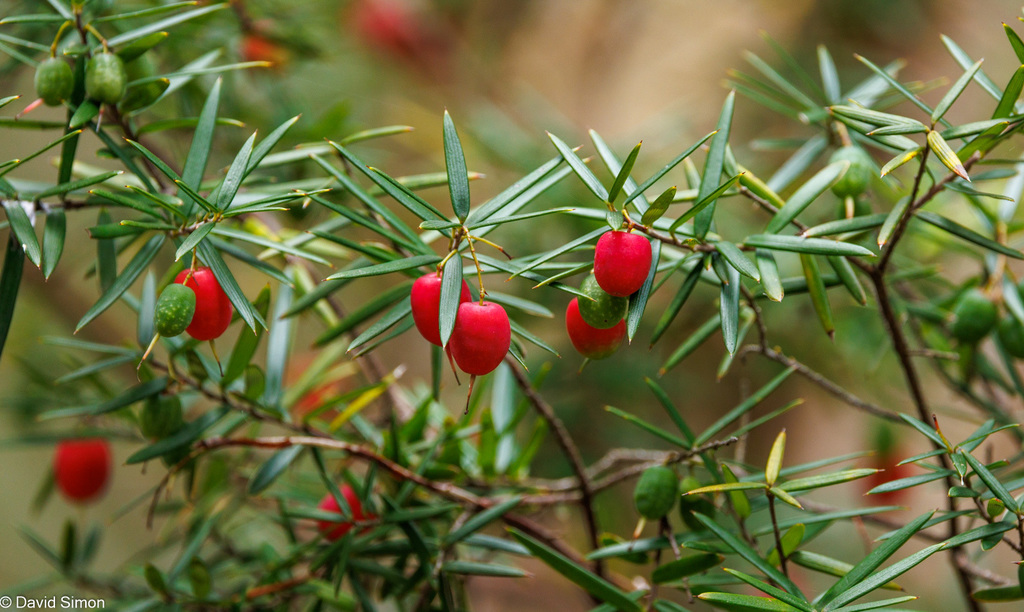
Native Cranberry
Lissanthe sapida
Lissanthe sapida, sometimes referred as the native cranberry, is a species of flowering plant in the family Ericaceae, and is endemic to areas near Sydney Australia. It is a bushy scrub with more or less lance-shaped leaves and creamy-white, cylindrical flowers.
From the article Lissanthe sapida on Wikipedia (CC BY-SA), quoted section by section
Description
Lissanthe sapida is a bushy shrub that typically grows to a height of 1 m (3 ft 3 in), sometimes to 2.5 m (8 ft 2 in) and has bristly branchlets. Its leaves are more or less lance-shaped, sometimes with the narrower end towards the base, 15.5–27.5 mm (0.61–1.08 in) long and 2.2–4.2 mm (0.087–0.165 in) wide on a petiole 1.3–2.7 mm (0.051–0.106 in) long. There are 7 or 8 ribs on the lower surface of the leaves. Up to 4 pendent, creamy-white flowers are borne in leaf axils with bracteoles 0.75–1.1 mm (0.030–0.043 in) long at the base. The sepals are 1.6–1.9 mm (0.063–0.075 in) long and the petals are joined at the base to form a cylindrical tube 5.4–6.5 mm (0.21–0.26 in) long with glabrous lobes 2.1–3.9 mm (0.083–0.154 in) long. Flowering occurs from July to September and the fruit is a glabrous red, spherical to oval capsule about 5.7 mm (0.22 in) long.
Range & habitat
Lissanthe sapida grows on ridges, hillsides and rocky ledges in open forest on sandy soil on sandstone. It is found in the lower Blue Mountains, including near Glenbrook, Woodford and Lawson.
Wikipedia: “Distribution and habitat”
Where it lives
Recorded sightings
—
geo-referenced records in GBIF, from museums, herbaria and field observers.
Drag the globe to turn it. Dots are where records exist, not a range map; darker means more records.
In the stacks
Searching the stacks…
Every page naming Lissanthe sapida in the Biodiversity Heritage Library →
This page is assembled live from iNaturalist, GBIF, Wikipedia, the Source Library and the Internet Archive. It is not yet part of the hand-edited codex. iNaturalist taxon 560968.