- Plants
- ›Vascular Plants
- ›flowering plants
- ›monocots
- ›Agaves, Orchids, Irises, and Allies
- ›Aloe family
- ›Aloes and allies
- ›Aloidendron
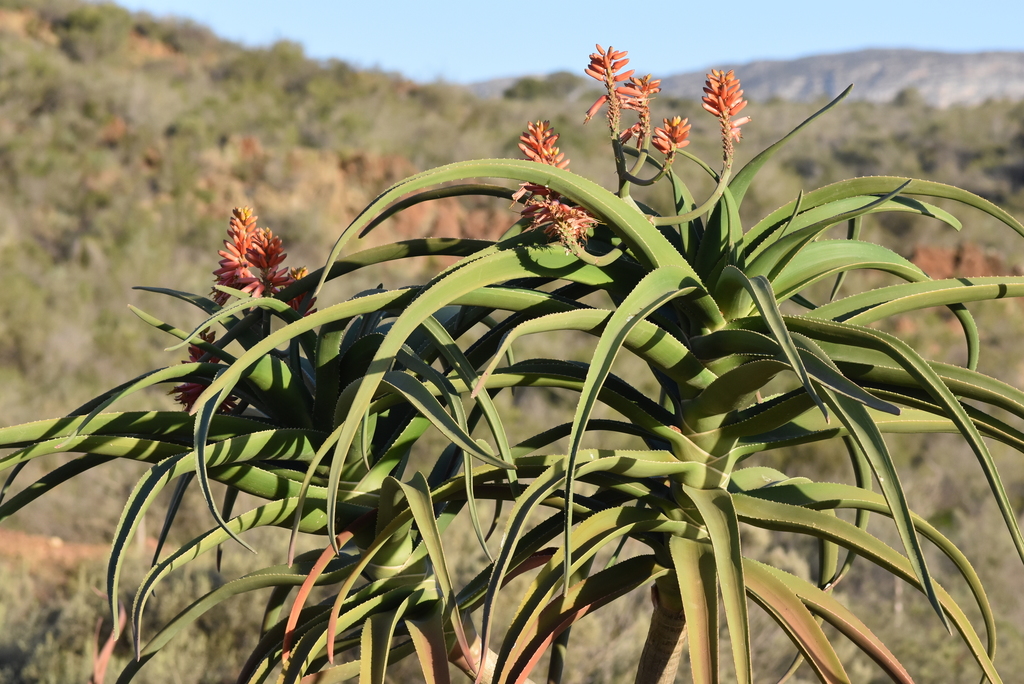
Eastern Tree Aloe
Aloidendron barberae
Aloidendron barberae, formerly Aloe bainesii and Aloe barberae, also known as the tree aloe, is a species of succulent plant in the genus Aloidendron. It is native to South Africa northwards to Mozambique. In its native climes this slow-growing tree can reach up to 18 metres (59 ft) high and 0.9 m (3 ft) stem in stem diameter. Aloidendron barberae is Africa's largest aloe-like plant. The tree aloe is often used as an ornamental plant. Its tubular flowers are rose pink (green-tipped); it flowers in winter and in its natural environment is pollinated by sunbirds.
From the article Aloidendron barberae on Wikipedia (CC BY-SA), quoted section by section
Range & habitat
The tree aloe's habitat is subtropical coastal forests, kloofs (ravines) and dry valleys in the eastern regions of southern Africa. Aloidendron barberae is widely distributed from the Eastern Cape through KwaZulu-Natal, Eswatini and Mpumalanga; and northwards to Mozambique and East Africa.
Wikipedia: “Distribution”
How it is grown
Aloidendron barberae forms a striking focal point in the garden, being an enormous sculptural tree with a neat crown. A specimen planted at the Kirstenbosch Botanical Garden in Cape Town in 1922 had by 2011 grown to have a basal diameter (not girth) of 3 m (9.8 ft). It is easily propagated, especially by cuttings (truncheons) which should be left to dry for a week or two before planting. It prefers well-drained soil, especially on a slope, and can tolerate some shade when small. It should not be planted in between buildings or in spots where its roots will be constrained, as its trunk and roots need to expand and spread.
Hybrids and cultivars. Several hybrid varieties have been created between this species and its relative Aloidendron dichotomum (the quiver tree) and, more rarely, with Aloe species. These all tend to be more short and compact than pure A. barberae. Some of the more popular hybrids include:
'Hercules' (A. barberae × dichotoma), the most common hybrid, with golden-grey trunk, and compact grey leaves. 'Rex' (A. barberae × dichotoma), a fast-growing cultivar developed in Swellendam, which has a grey trunk, and more slender grey-green leaves with pink teeth. Seed parent is dichotoma. 'Goliath' (A. barberae × Aloe vaombe), a very fast-growing top-heavy hybrid, with a slender trunk and an enormous head of massive rubbery dark-green leaves. 'Nick Deinhart' (A. …
Wikipedia: “Cultivation”
Where it lives
Recorded sightings
—
geo-referenced records in GBIF, from museums, herbaria and field observers.
Drag the globe to turn it. Dots are where records exist, not a range map; darker means more records.
In the stacks
Searching the stacks…
Every page naming Aloidendron barberae in the Biodiversity Heritage Library →
This page is assembled live from iNaturalist, GBIF, Wikipedia, the Source Library and the Internet Archive. It is not yet part of the hand-edited codex. iNaturalist taxon 560374.