- Plants
- ›Vascular Plants
- ›flowering plants
- ›Dicots
- ›Gentians, Dogbanes, Madders, and Allies
- ›madder family
- ›Ixoroideae
- ›Vanguerieae
- ›Canthium
Turkeyberry
Canthium inerme
Canthium inerme (Turkey-berry) is a tough, adaptable medium-sized tree from South Africa. It bears small edible fruits and has a variety of uses in traditional medicine.
From the article Canthium inerme on Wikipedia (CC BY-SA), quoted section by section
Description
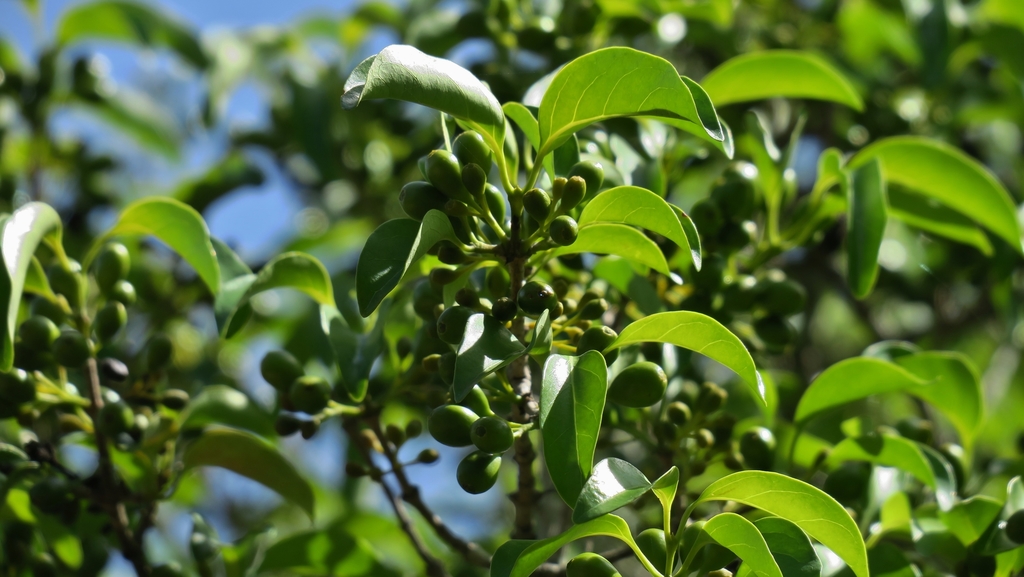
This is a very variable species, but it generally grows as a small to medium-sized tree. Like many trees, in shady conditions it grows tall and sparse up to 14m in height, while in direct sunlight it forms a small, dense, domed tree of about 5m. A very distinctive feature of this species is the way it grows its thorns in opposite pairs, at perfect right angles on the branch. These thorns often become branches in their own right, similarly at striking right angles - both to the parent branch, and to the neighboring pairs of branches. The leaves, also borne in opposite pairs, are small, light green and glossy, while the flowers appear in Spring as dense creamy-yellow clusters. Each tree produces both male and female flowers, but they are functionally uni-sexual.
Another distinctive characteristic of this tree is the small, tough fruits which appear soon after flowering and stay on the tree for much of the year. They are initially smooth and green, but they soon become black and dry, and remain firmly attached in small bunches to the tree. They are relished by birds which are consequently greatly attracted by this tree, however they are also edible for humans. Its one or more trunks can become twisted and knotted in larger specimens, and are generally a smooth, pale grey.
Wikipedia: “Appearance”
Range & habitat
It has a wide distribution, occurring from Cape Town in the south, along the eastern coast of South Africa as far as Mozambique and inland as far as Zimbabwe, including Natal, Eswatini and Transvaal. This adaptable tree also occurs in a variety of habitats, ranging from afro-montane forest to coastal grassland and bushveld, and from sea-level up to 1700 m. It is not however found in the most arid environments, nor in the wettest forests, preferring drier scrub forests.
Wikipedia: “Distribution”
At the table
In a garden, this hardy evergreen tree attracts birds, while also serving as a possible security hedge. To assure a typical tree shape, prune off the lower branches. It is known to grow very easily from seed. The foliage and typically twisted trunk of a fully grown tree:
Wikipedia: “Uses”
Where it lives
Recorded sightings
—
geo-referenced records in GBIF, from museums, herbaria and field observers.
Drag the globe to turn it. Dots are where records exist, not a range map; darker means more records.
In the stacks
Searching the stacks…
Every page naming Canthium inerme in the Biodiversity Heritage Library →
This page is assembled live from iNaturalist, GBIF, Wikipedia, the Source Library and the Internet Archive. It is not yet part of the hand-edited codex. iNaturalist taxon 559528.