On eBird ↗
White-faced Ground-Sparrow
Live sightings near you, the range map, bar charts of when it is seen, and Macaulay Library photos and recordings.
White-faced Ground-Sparrow
Melozone biarcuata
Prevost's ground sparrow (Melozone biarcuata), also known as the white-faced ground sparrow, is an American sparrow.
From the article Prevost's ground sparrow on Wikipedia (CC BY-SA), quoted section by section
Description
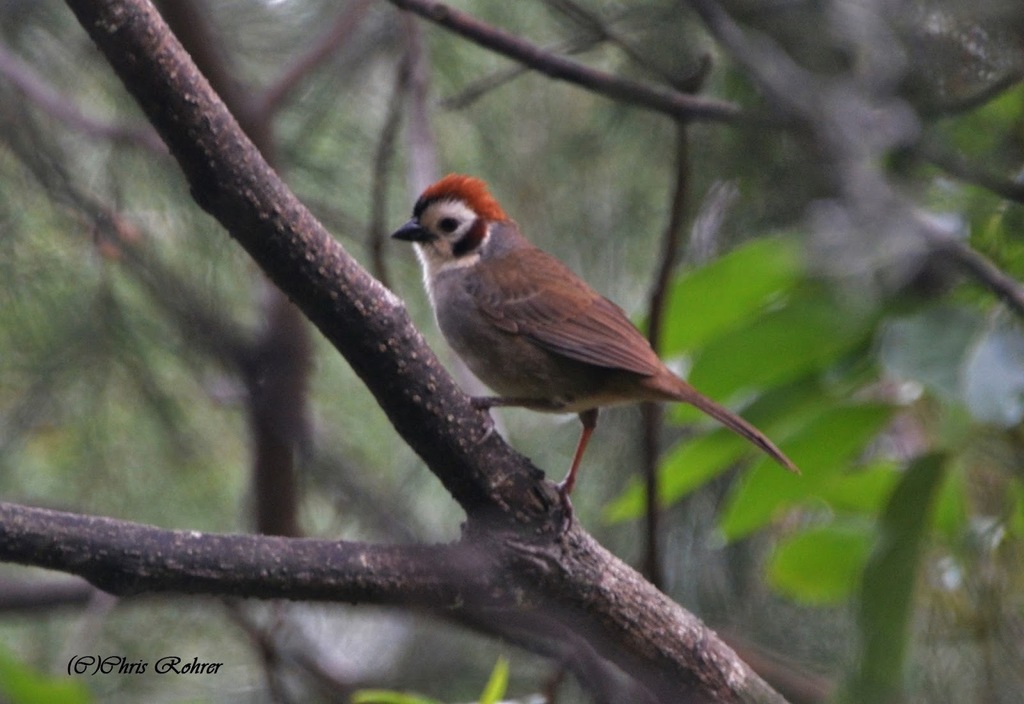
Prevost's ground sparrow is on average 15 cm long and weighs 28 g. The adult has a stubby dark-grey bill, unstreaked olive-brown upperparts, a rufous crown and mainly white underparts. Young birds are browner above, have yellower underparts, and a duller indistinct head pattern. It has a simple head pattern in which the rufous of the crown extends down the sides of the neck as a half collar behind the white face.
Range & habitat
This bird breeds at middle altitudes from southern Mexico to western Honduras. The Cabanis's ground sparrow was previously considered a subspecies. It is found typically at altitudes between 600 and 1600 m in the undergrowth and thickets of semi-open woodland, coffee plantations, hedgerows and large gardens.
Wikipedia: “Distribution and habitat”
What it does
Usually found in pairs, the bird is a shy species best seen at or near dusk. They sometimes venture in the open in the early morning.
Breeding. The nest, built by the female, is a neat lined cup constructed less than 2 m up in a bush or large tussock. The female lays a clutch of two or three ruddy-blotched white eggs, which she incubates for 12–14 days. The male helps in feeding the chicks. This species is sometimes parasitised by the bronzed cowbird.
Feeding. The bird feeds on the ground on seeds, fallen berries, insects and spiders.
Voice. Calls include a thin tsit or a clearer psee. The male's song, given from a hidden perch in the wet season, is a whistled pst’t’t’t peer peer peer whee whee whee.
Wikipedia: “Behaviour”
Listen
Looking for field recordings…
Where it lives
Recorded sightings
—
geo-referenced records in GBIF, from museums, herbaria and field observers.
Drag the globe to turn it. Dots are where records exist, not a range map; darker means more records.
In the stacks
Searching the stacks…
Every page naming Melozone biarcuata in the Biodiversity Heritage Library →
This page is assembled live from iNaturalist, GBIF, Wikipedia, the Source Library and the Internet Archive. It is not yet part of the hand-edited codex. iNaturalist taxon 559376.