- Plants
- ›Vascular Plants
- ›flowering plants
- ›Dicots
- ›carrots, ivies, and allies
- ›ivy family
- ›Aralioideae
- ›Hedera
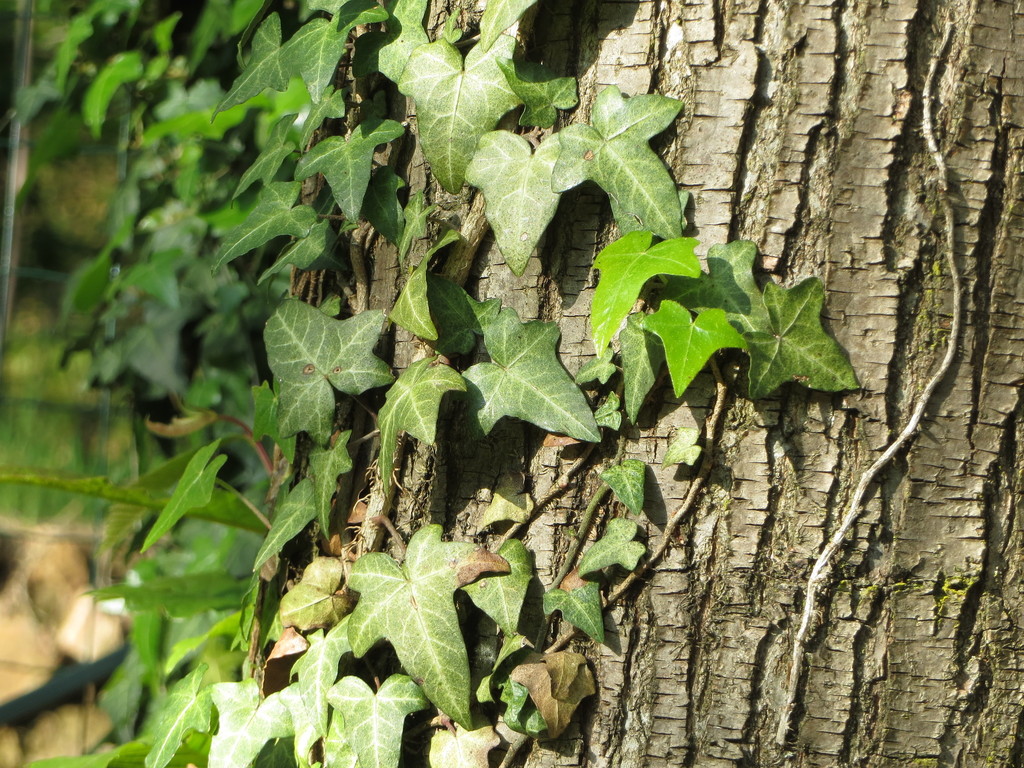
common ivy
Hedera helix
Hedera helix, simply ivy, or common ivy, English ivy, European ivy, or King's choice ivy, is a species of flowering plant in the family Araliaceae. It is native to most of Europe and parts of western Asia. Ivy is a clinging evergreen vine that grows on tree trunks, walls, and fences in gardens, waste spaces, and wild habitats. Ivy is common as an ornamental plant, but escaped plants become naturalised outside its native range. Ivy has considerable cultural significance and symbolism.
Synonyms include Hedera acuta, Hedera arborea ('tree ivy'), Hedera baccifera, and Hedera grandifolia. Other common names are bindwood and lovestone.
From the article Hedera helix on Wikipedia (CC BY-SA), quoted section by section
Description
Hedera helix is an evergreen climbing plant, growing to 20–30 m (66–98 ft) high where suitable surfaces (trees, cliffs, walls) are available, and also growing as groundcover where no vertical surfaces occur. It climbs by means of aerial rootlets with matted pads which cling strongly to the substrate. The ability to climb on surfaces varies with the plant's variety and other factors: H. helix prefers non-reflective, darker and rough surfaces with near-neutral pH. It generally thrives in a wide range of soil pH with 6.5 being ideal, prefers moist, shady locations and avoids exposure to direct sunlight, the latter promoting drying out in winter. The leaves are alternate, 50–100 mm (2–4 in) long, with a 15–20 mm (0.6–0.8 in) petiole; they are of two types, with palmately five-lobed juvenile leaves on creeping and climbing stems, and unlobed cordate adult leaves on fertile flowering stems exposed to full sun, usually high in the crowns of trees or the top of rock faces. The flowers are produced from late summer until late autumn, individually small, in 3-to-5 cm-diameter (1.2-to-2.0 in) umbels, greenish-yellow, and very rich in nectar, an important late autumn food source for bees and other insects. The fruit are purple-black to orange-yellow berries 6–8 mm (0.2–0.3 in) in diameter, ripening in late winter, and are an important food source for many birds. One to five seeds are in ea …
Range & habitat
The range of Hedera helix is from Ireland northeast to southern Scandinavia, south to Portugal, and east to Ukraine, Iran and northern Turkey. In Britain, it is very common and widespread, but absent from the Isle of Man and Channel Islands. The northern and eastern limits are at about the −2 °C (28 °F) winter isotherm, while to the west and southwest, it is replaced by other species of ivy. Hedera helix itself is much more winter-hardy and survives temperatures of −23.3 °C (−9.9 °F) (USDA Zone 6a) and above.
Wikipedia: “Distribution and habitat”
At the table
Ivy berries are somewhat poisonous to humans, but extracts from ivy leaves are part of current cough medicines. A 2020 evidence review found that H. helix preparations "may be a therapeutic option for treating early symptoms of respiratory tract infections", saying that "the best effectiveness for H. helix preparations has been proven for coughing, as an expectorant and to reduce the frequency and intensity of cough. Only weak evidence was found for all other researched symptoms." In the past, the leaves and berries were taken orally as an expectorant to treat cough and bronchitis. In 1597, the British herbalist John Gerard recommended water infused with ivy leaves as a wash for sore or watering eyes. The leaves can cause severe contact dermatitis in some people. People who have this allergy (strictly a type IV hypersensitivity) are also likely to react to carrots and other members of the Apiaceae as they contain the same allergen, falcarinol. Previous studies showed that the H. helix extract contains α-hederin and β-hederin, falcarinol, didehydrofalcarinol, rutin, caffeic acid, chlorogenic acid, emetine, nicotiflorin, hederasaponin B and hederacoside C. However, only three extracted components were detectable more than 1.5% in the Hedera helix leaves (hederacoside C 15.69%, chlorogenic acid 2.07%, and rutin 1.62%). …
Wikipedia: “Toxicity and medical uses”
How it is grown
Ivy is widely cultivated as an ornamental plant. Within its native range, the species is greatly valued for attracting wildlife. The flowers are visited by over 70 species of nectar-feeding insects, and the berries eaten by at least 16 species of birds. The foliage provides dense evergreen shelter, and is also browsed by deer. In Europe, it is frequently planted to cover walls and the Bavarian government recommends growing it on buildings for its ability to cool the interior in summer, while providing insulation in winter, as well as protecting the covered building from soil moisture, temperature fluctuations and direct exposure to heavy weather. Further uses include weed suppression in plantings, beautifying unsightly facades and providing additional green by growing on tree trunks. However, ivy can be problematic. It is a fast-growing, self-clinging climber that is capable of causing damage to brickwork, guttering, etc., and hiding potentially serious structural faults, as well as harbouring unwelcome pests. Careful planning and placement are essential.
Cultivars. Over 30 cultivars have been selected for leaf traits such as yellow, white, variegated (e.g. 'Glacier'), and deeply lobed (e.g. 'Sagittifolia'), and other traits like purple stems and slow, dwarfed growth. The following 16 cultivars have gained the Royal Horticultural Society's Award of Garden Merit:
Wikipedia: “Cultivation”
In human culture
The genus name Hedera is the Classical Latin word for 'ivy', which is cognate with Greek χανδάνω (khandánō) 'to get, grasp', both deriving ultimately from Proto-Indo-European *gʰed(h)- 'to seize, grasp, take'. The specific epithet helix was borrowed into Latin from Ancient Greek ἕλιξ (helix), 'helix', 'spiral'.. The binomial in its entirety thus has the meaning "the clinging plant that coils in spirals (helices)".
Wikipedia: “Etymology”
Where it lives
Recorded sightings
—
geo-referenced records in GBIF, from museums, herbaria and field observers.
Drag the globe to turn it. Dots are where records exist, not a range map; darker means more records.
In the old herbals & bestiaries

Garden of Health
Jacob Meydenbach · 1491 · p.160

Living Images of Plants
Otto Brunfels · 1532 · p.345

Notable Commentaries on the History of Plants
Leonhart Fuchs · 1549 · p.455

Commentaries on the Six Books of Dioscorides
Pietro Andrea Mattioli · 1560 · p.454

Commentaries on the Six Books of Pedanius Dioscorides on Medical Matter
Pietro Andrea Mattioli · 1565 · p.797

Commentaries on the Six Books of Pedanius Dioscorides on Medical Matter
Pietro Andrea Mattioli · 1565 · p.796
In the stacks
Searching the stacks…
Every page naming Hedera helix in the Biodiversity Heritage Library →
This page is assembled live from iNaturalist, GBIF, Wikipedia, the Source Library and the Internet Archive. It is not yet part of the hand-edited codex. iNaturalist taxon 55882.