On eBird ↗
Twite
Live sightings near you, the range map, bar charts of when it is seen, and Macaulay Library photos and recordings.
Twite
Linaria flavirostris
The twite (Linaria flavirostris) is a small brown passerine bird in the finch family Fringillidae. It is a partially migratory species that is found in a strongly disjunct distribution in northern Europe, and in Asian mountains from eastern Turkey to Nepal, western China and Mongolia. It mainly feeds on small seeds but occasionally also feeds on insects.
From the article Twite on Wikipedia (CC BY-SA), quoted section by section
Description
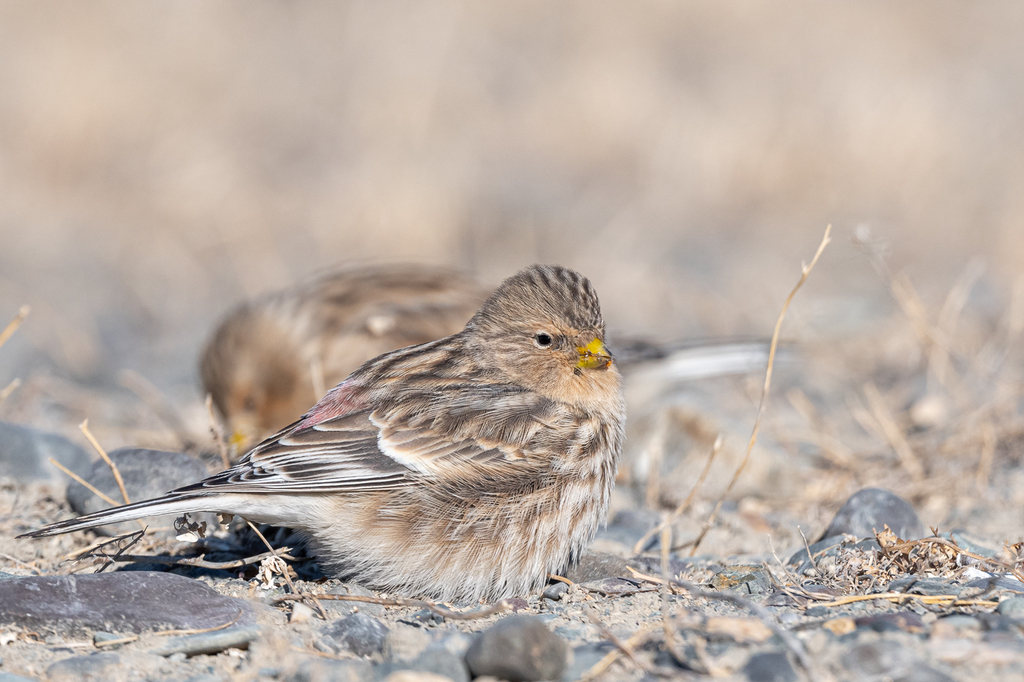
The twite is similar in size and shape to a linnet, at 13 to 13.5 cm (5.1 to 5.3 in) long. It lacks the red head patch and breast shown by the linnet and the redpolls. It is brown streaked with black above; adult males also have a pink rump, immatures and females a brown rump. The underparts are buff to whitish, streaked with brown. The conical bill is yellow in winter and grey in summer. The call is a very distinctive nasal twaa-it, from which its name derives, and the song contains fast trills and twitters. Twite often form large flocks outside the breeding season, sometimes mixed with other finches on coasts and salt marshes. They feed mainly on seeds. The subspecies vary in plumage tone, with L. f. pipilans of the hyper-humid oceanic climate of Britain and Ireland the darkest (following Gloger's rule) and nominate L. f. flavirostris in Scandinavia the next darkest. The Asian subspecies, found in much drier mountain habitats, are much paler.
Range & habitat
The twite breeds in northern Europe and across the Palearctic to Siberia and China. Alpine grassland and low shrubland is favoured for breeding; in the Asian part of its range, it breeds at high to very high altitudes, from 3,600–4,900 m, but in the much cooler oceanic climate summers of northwestern Europe, it breeds much lower, and down to sea level in northwestern Ireland, western and northern Scotland, and Norway; here it is strongly associated with traditional low-intensity farming on coastal machair grassland. It is partially resident and in winter many birds migrate further south, or move to the coasts. It has declined sharply in parts of its range, notably in Ireland.
Wikipedia: “Distribution and habitat”
Listen
Looking for field recordings…
Where it lives
Recorded sightings
—
geo-referenced records in GBIF, from museums, herbaria and field observers.
Drag the globe to turn it. Dots are where records exist, not a range map; darker means more records.
In the stacks
Searching the stacks…
Every page naming Linaria flavirostris in the Biodiversity Heritage Library →
This page is assembled live from iNaturalist, GBIF, Wikipedia, the Source Library and the Internet Archive. It is not yet part of the hand-edited codex. iNaturalist taxon 558633.