On eBird ↗
Sao Tome Grosbeak
Live sightings near you, the range map, bar charts of when it is seen, and Macaulay Library photos and recordings.
São Tomé Grosbeak
Crithagra concolor
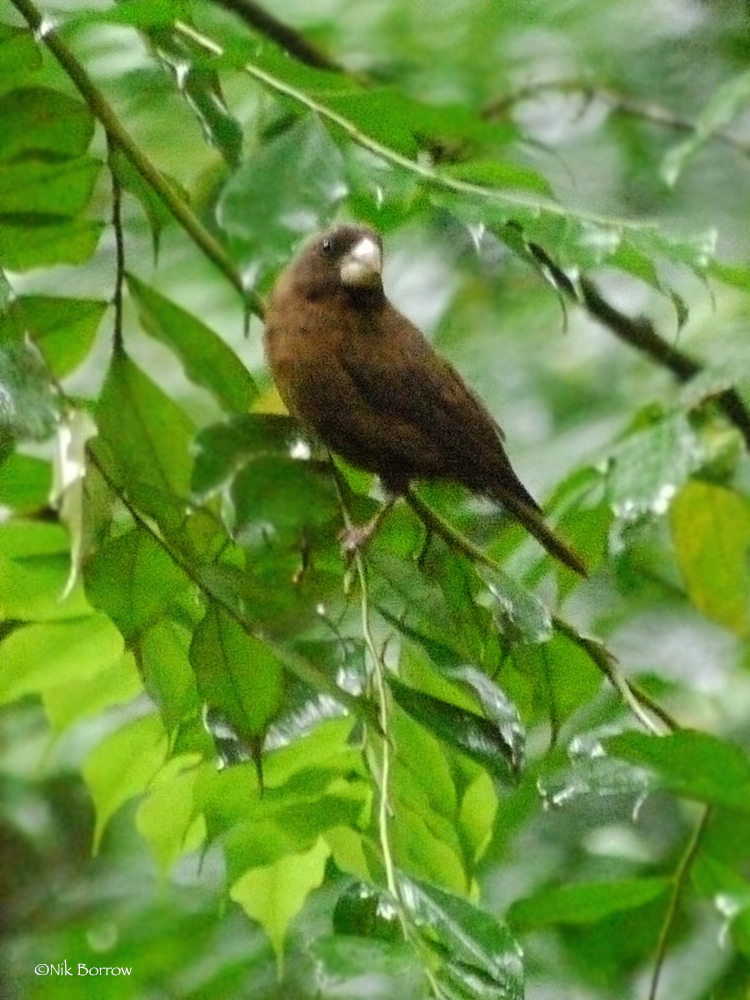
The São Tomé grosbeak (Crithagra concolor) is the largest member of the canary genus Crithagra, 50% heavier than the next largest canary species. It is endemic to the island of São Tomé.
For a long period this bird was known only from three nineteenth-century specimens. It was rediscovered in 1991. The current population is estimated at less than 250, and it is classified as critically endangered by the IUCN.
From the article São Tomé grosbeak on Wikipedia (CC BY-SA), quoted section by section
Range & habitat
The São Tomé grosbeak, when rediscovered, was thought to inhabit exclusively lowland, old-growth forests in the lower elevations of the south of the island. Observations in the early 2000s indicated that the species was also inhabiting younger forests at higher elevations (between 1,300–1,400 m). The grosbeak is a very discrete species, and thus difficult to detect; its believed scarcity may also be a function of persistent non-detection during surveys.
Wikipedia: “Habitat”
Listen
Looking for field recordings…
Where it lives
Recorded sightings
—
geo-referenced records in GBIF, from museums, herbaria and field observers.
Drag the globe to turn it. Dots are where records exist, not a range map; darker means more records.
In the stacks
Searching the stacks…
Every page naming Crithagra concolor in the Biodiversity Heritage Library →
This page is assembled live from iNaturalist, GBIF, Wikipedia, the Source Library and the Internet Archive. It is not yet part of the hand-edited codex. iNaturalist taxon 558624.