On eBird ↗
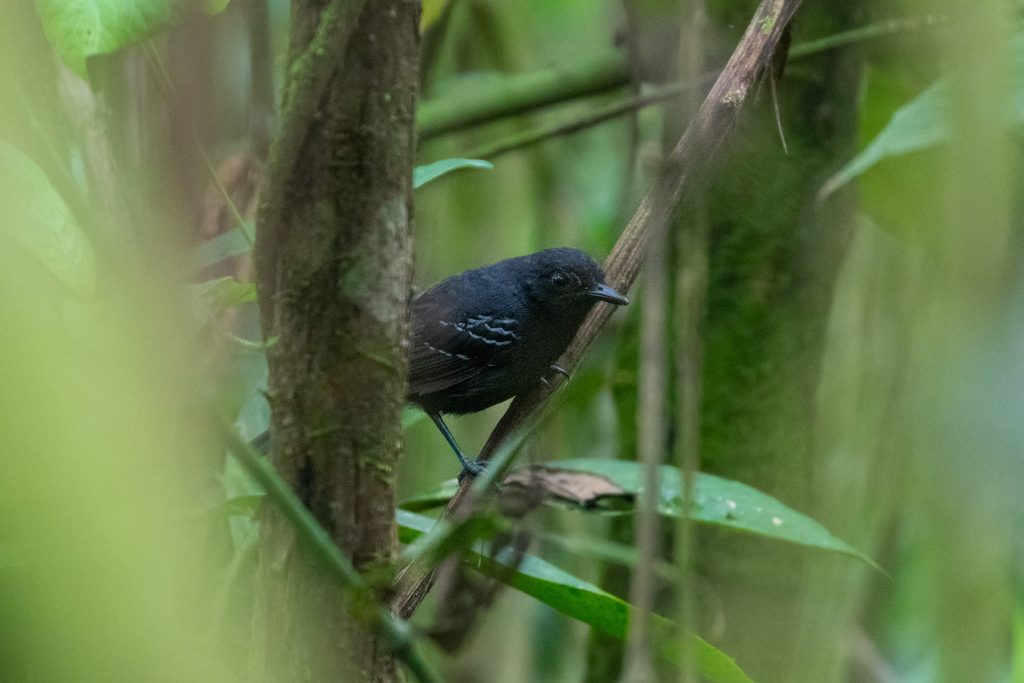
Black Antbird
Live sightings near you, the range map, bar charts of when it is seen, and Macaulay Library photos and recordings.
Black Antbird
Cercomacroides serva
The black antbird (Cercomacroides serva) is a species of passerine bird in the family Thamnophilidae. It is found in Bolivia, Brazil, Colombia, Ecuador, and Peru. Its natural habitat is subtropical or tropical moist lowland forests.
From the article Black antbird on Wikipedia (CC BY-SA), quoted section by section
Description
The black antbird is 13.5 to 15 cm (5.3 to 5.9 in) long and weighs 15 to 17 g (0.53 to 0.60 oz). Males are almost entirely blackish to dark gray. They have a white patch between their scapulars, a small hidden white patch under the scapulars, gray edges on their flight feathers, and white tips on their wing coverts. Females have an olive-tinged dark gray crown, upperparts, wings, and tail with a small white interscapular patch. Their wing coverts and the edges of their flight feathers have a yellowish brown tinge. Their underparts are reddish brown to reddish yellow-brown. Both sexes are darker in the northern part of the species' range than the southern part.
Range & habitat
The black antbird is a bird of the western Amazon Basin and adjoining Andean foothills. It is found from Putumayo Department in southern Colombia south through eastern Ecuador and eastern Peru into northwestern Bolivia's Pando and La Paz departments and east into Brazil to the rios Juruá, Purus, and Madeira. There are also scattered records further east. It inhabits the understorey of terra firme and várzea evergreen forest, the transitional forest between them, and nearby mature secondary forest. In all forest types it favors the edges, densely vegetated openings such as those caused by fallen trees, the margins of lakes, and (within the forest) stands of bamboo. In elevation it reaches 500 m (1,600 ft) in Colombia, 1,300 m (4,300 ft) in Ecuador, and locally 1,500 m (4,900 ft) but usually only 1,100 m (3,600 ft) in Peru.
Wikipedia: “Distribution and habitat”
What it does
The black antbird feeds on a wide variety of insects and probably also spiders. Single birds, pairs, and family groups usually forage within about 2 m (7 ft) of the ground and very rarely as high as 7 m (23 ft). It typically hops through dense vegetation, taking prey from vegetation by gleaning, reaching, lunging, and making short fluttery flights from a perch. It seldom joins mixed-species feeding flocks. In Ecuador it has been observed attending army ant swarms.
Wikipedia: “Feeding”
Listen
Looking for field recordings…
Where it lives
Recorded sightings
—
geo-referenced records in GBIF, from museums, herbaria and field observers.
Drag the globe to turn it. Dots are where records exist, not a range map; darker means more records.
In the stacks
Searching the stacks…
Every page naming Cercomacroides serva in the Biodiversity Heritage Library →
This page is assembled live from iNaturalist, GBIF, Wikipedia, the Source Library and the Internet Archive. It is not yet part of the hand-edited codex. iNaturalist taxon 558491.