- Plants
- ›Vascular Plants
- ›flowering plants
- ›monocots
- ›lilies, supplejacks, and allies
- ›lily family
- ›true lily subfamily
- ›true lilies and allies
- ›Tulipa
- ›Eriostemones
- ›Sylvestres
- ›Tulipa sylvestris
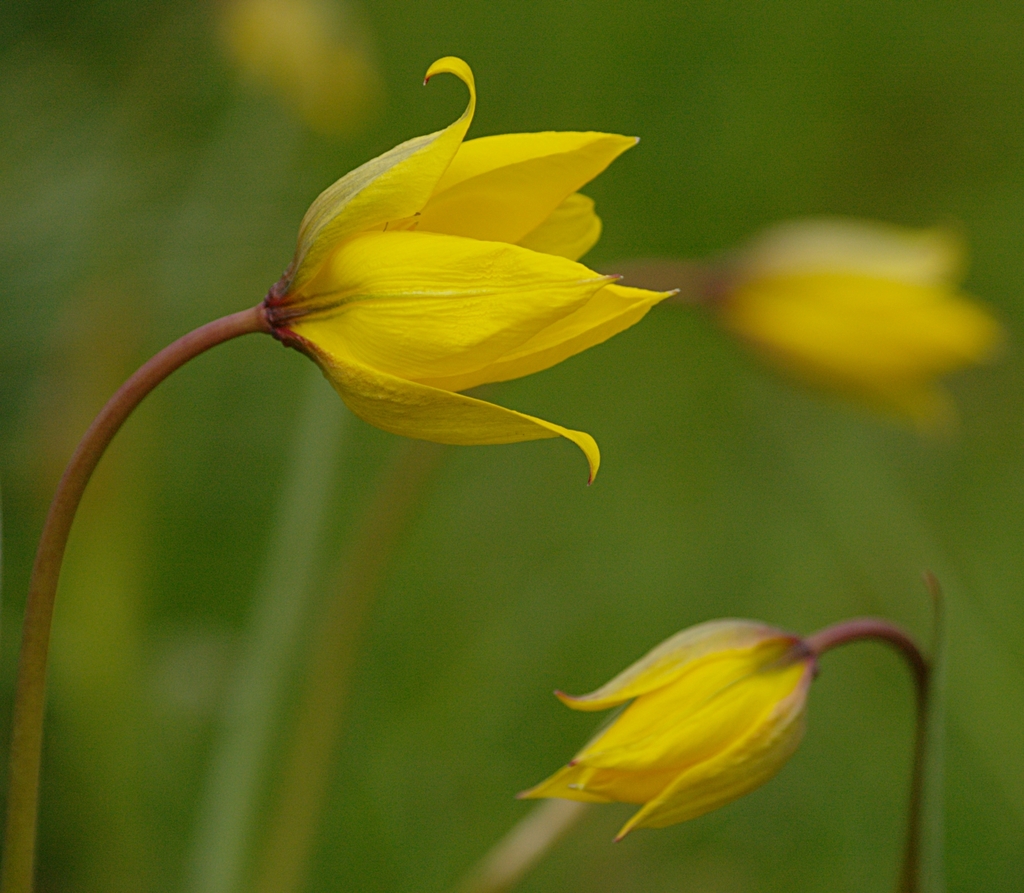
Wild Tulip
Tulipa sylvestris
Tulipa sylvestris, the wild tulip or woodland tulip, is a Eurasian and North African species of wild tulip, a plant in the lily family. Its native range extends from Portugal and Morocco to western China, covering most of the Mediterranean and Black Sea Basins, and Central Asia. The species is also cultivated as an ornamental and naturalized in central and northern Europe as well as a few scattered locations in North America.
It was first recorded as being naturalised in Britain in the late 17th century.
From the article Tulipa sylvestris on Wikipedia (CC BY-SA), quoted section by section
Description
It is a bulb-forming perennial, with narrow blue-grey leaves and usually with 1 or 2 flowers per stem. The stem can reach up to 50 cm (20 in) tall. The scented blooms appear between April and May, and the yellow flowers are sometimes tinged red on the outside. They rarely produce seed and are pollinated by small insects.
Biochemicals. Some tuliposides – a family of biochemicals – found in Tulipa sylvestris include:
6-tuliposide A and B Tuliposide D Tulipalin A and B
Subspecies. There are three T. sylvestris subspecies:
Tulipa sylvestris subsp. australis ((Link) Pamp) – from Portugal and Morocco to Xinjiang Tulipa sylvestris subsp. primulina ((Baker) Maire & Weiller) – Algeria, Morocco Tulipa sylvestris subsp. sylvestris – Italy, Libya Tulipa australis is also found on the island of Malta, in the Mediterranean Sea, limited to one specific area.
Where it lives
Recorded sightings
—
geo-referenced records in GBIF, from museums, herbaria and field observers.
Drag the globe to turn it. Dots are where records exist, not a range map; darker means more records.
In the stacks
Searching the stacks…
Every page naming Tulipa sylvestris in the Biodiversity Heritage Library →
This page is assembled live from iNaturalist, GBIF, Wikipedia, the Source Library and the Internet Archive. It is not yet part of the hand-edited codex. iNaturalist taxon 55798.