- Plants
- ›Vascular Plants
- ›flowering plants
- ›monocots
- ›Agaves, Orchids, Irises, and Allies
- ›Orchids
- ›Orchidoid Orchids
- ›Cranichideae
- ›Pterostylidinae
- ›Pterostylis
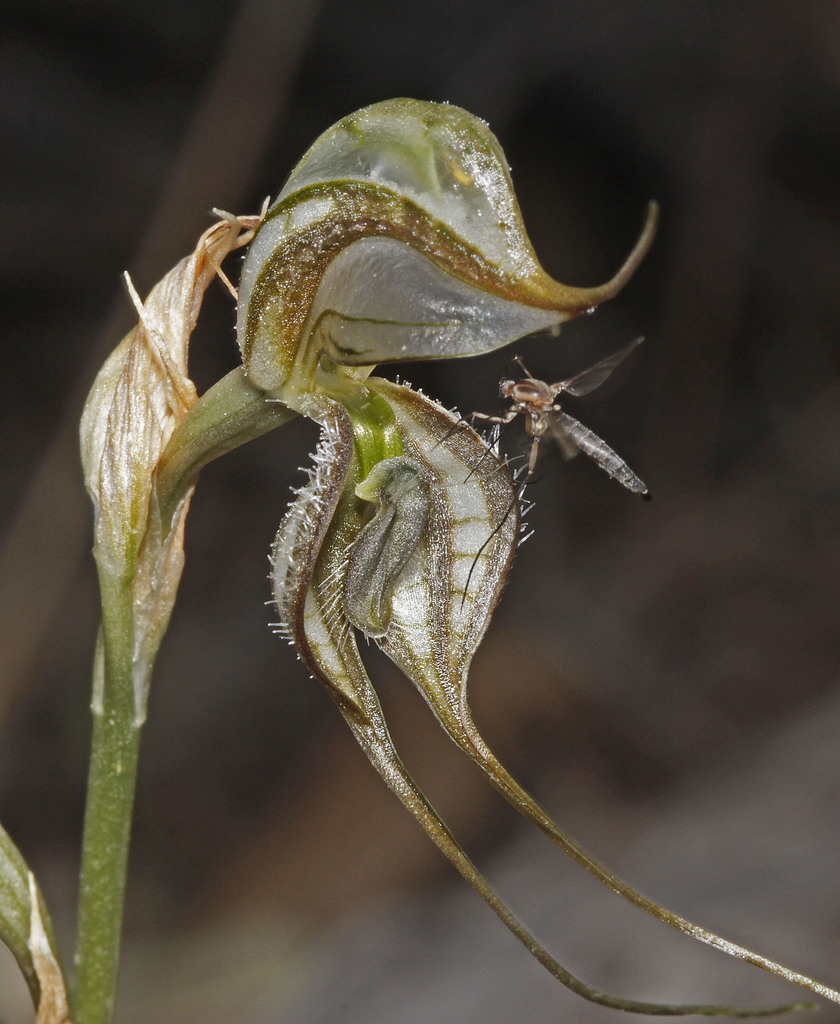
bristled rustyhood
Pterostylis biseta
Pterostylis biseta, commonly known as the bristled rustyhood, is a plant in the orchid family Orchidaceae and is endemic to south-eastern Australia. It has a rosette of leaves at its base and up to seven relatively large, translucent flowers with green and brown marking with a brown to green insect-like labellum with bristly hairs. It occurs in New South Wales, South Australia and Victoria although in the latter state it has been separated into three species and is also under review in New South Wales.
From the article Pterostylis biseta on Wikipedia (CC BY-SA), quoted section by section
Description
Pterostylis biseta, is a terrestrial, perennial, deciduous, herb with an underground tuber. It has a rosette of between six and fourteen leaves at the base of the flowering spike, each leaf 15–40 mm (0.6–2 in) long and 8–12 mm (0.3–0.5 in) wide. The leaves are often withered by the time of flowering. Up to seven translucent green and brown flowers 50–58 mm (2.0–2.3 in) long and 12–14 mm (0.5–0.6 in) wide are borne on a flowering spike 100–350 mm (4–10 in) tall. Two to six papery bracts are wrapped around the flowering spike. The dorsal sepal and petals are joined to form a hood called the "galea" over the column with the dorsal sepal having a thread-like tip 11–15 mm (0.4–0.6 in) long. The lateral sepals are wider than the galea, dished, densely hairy on their outer edges and suddenly taper to a thread-like tip. The lateral sepals are more or less parallel to each other, and the tips are 25–35 mm (0.98–1.4 in) long. The labellum is brown to green, thin and insect-like, 6–8 mm (0.2–0.3 in) long and about 4 mm (0.2 in) wide. The "head" end is swollen with two long bristles and there are up to 34 shorter bristles on the side. Flowering occurs from September to November.
Range & habitat
Pterostylis biseta as currently described by the National Herbarium of New South Wales, occurs in that state south from Hillston, in northern Victoria and in the south-east of South Australia. It grows in sparse forest, often on rocky ridges, and in arid scrubland.
== References ==
Wikipedia: “Distribution and habitat”
Where it lives
Recorded sightings
—
geo-referenced records in GBIF, from museums, herbaria and field observers.
Drag the globe to turn it. Dots are where records exist, not a range map; darker means more records.
In the stacks
Searching the stacks…
Every page naming Pterostylis biseta in the Biodiversity Heritage Library →
This page is assembled live from iNaturalist, GBIF, Wikipedia, the Source Library and the Internet Archive. It is not yet part of the hand-edited codex. iNaturalist taxon 557904.