- Plants
- ›Vascular Plants
- ›flowering plants
- ›Dicots
- ›honeysuckles, moschatels, and allies
- ›elder family
- ›Adoxa
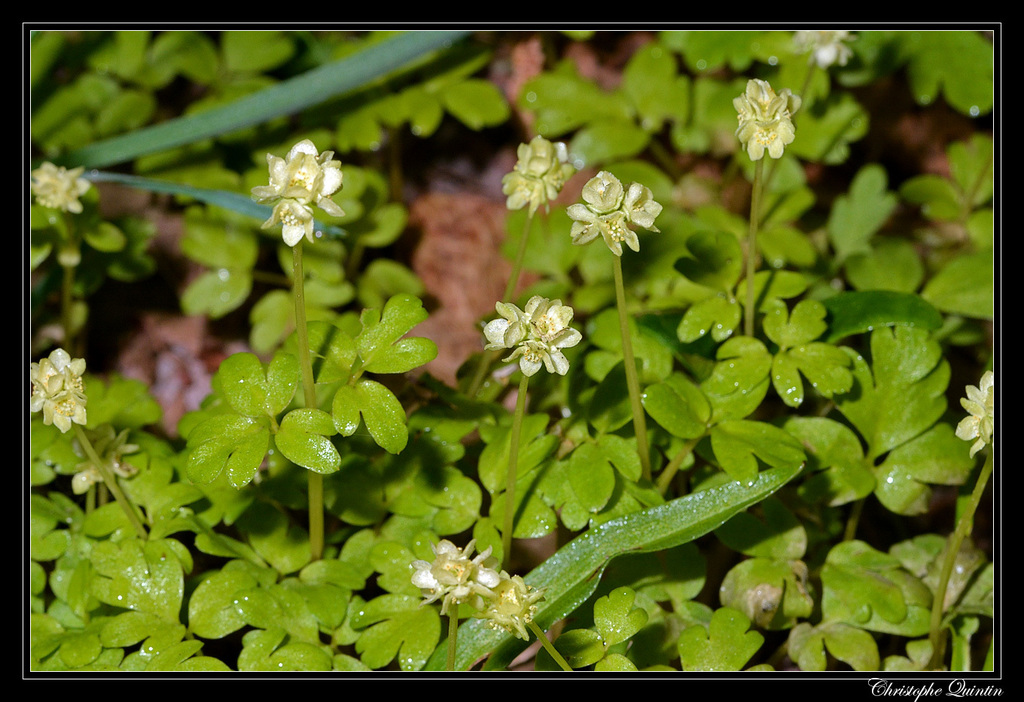
Moschatel
Adoxa moschatellina
Adoxa moschatellina, moschatel, is a species of flowering plant in the family Viburnaceae which has a highly distinctive inflorescence. This herbaceous perennial grows in relatively sunny places in old woodland, such as the edges of streams, and in shady places in open habitats such as rock crevices in limestone pavements. It has a limited ability to spread by seed, but expands vegetatively via its long stolons. It is a widespread but generally uncommon plant which is not considered to be threatened within its natural range.
From the article Adoxa moschatellina on Wikipedia (CC BY-SA), quoted section by section
Description
Moschatel is a patch-forming perennial about 10–15 cm (4–6 in) tall, with pale green foliage and a delicate appearance. It has swollen, fleshy rhizomes as well as long, slender stolons. The aerial stems are produced in early spring (typically around the end of February in England), long before the woodland canopy forms. They are slender, erect and unbranched, typically with two basal leaves on long petioles, which are almost as long as the stem, and two opposite leaves at the top, which have short petioles that are expanded towards the base. There are no stipules. The whole plant is entirely glabrous (hairless). The basal leaves are a dull green above, silvery and succulent below, and dotted with stomata only on the undersides. The basal leaves are ternate (i.e. divided into 3 lobes) or twice ternate, and up to 5 cm (2 in) long, whereas the stem leaves have 2 or 3 lobes, with blades up to 3 cm (1.2 in) long. At the top of the stem, on a peduncle which is at least as long as the stem itself, at flowering, is an inflorescence that is unique to this genus and highly distinctive. It consists of a cubical cluster of 5 green flowers, about 0.5 cm in diameter, with four 5-petalled flowers on the sides of the cube and one 4-petalled flower at the top. …
Range & habitat
Adoxa moschatellina has a boreal, circumpolar distribution in Europe, Asia and North America, and just extending into Morocco in North Africa. It is not established as an introduced species beyond its natural range, except possibly in Ireland. It is generally not considered to be rare or threatened: in the United States it is classified as "secure" and, while it has not been assessed internationally by the IUCN, many European countries classify it as "Least Concern". It is widespread in most parts of Britain but not common, being generally restricted to small patches in areas of ancient woodland. It becomes scarce in the north and west, where the soils are too acid for it, and parts of eastern England where there has been little woodland cover. It is absent from Ireland except in a couple of places where it was probably introduced, deliberately or accidentally.
Wikipedia: “Distribution and status”
What it does
Moschatel grows in woodland and scrub, typically in places with fairly light shade, such as the edges of paths or alongside streams and rivers. Its Ellenberg values in Britain are L = 4, F = 5, R = 6, N = 5, and S = 0, which show that it favours lower than average levels of light and nutrients, and higher than average moisture and alkalinity. It is found in deciduous woods under ash, pedunculate oak, sessile oak, hornbeam or beech trees, typically towards the bottom of any slope, where the soil is damper and more base-rich, amongst dog's mercury and wood anemone. This habitat is, under the British National Vegetation Classification, considered to be ash wood, W8 in the lowlands and W9 in the uplands. It is also recorded in elder scrub (W6d) along riverbanks. In the Scottish Highlands and Snowdonia, it occurs in juniper scrub (W19), and in shady nooks amongst boulders in upland heaths and pillow lavas (on Cadair Idris). It is a spring-flowering species which dies back after flowering in May or June. The seeds are deposited on the ground close to the parent plant, thus limiting its ability to spread. This lack of dispersal capacity helps to account for it being largely restricted to ancient woodland, although it is known to establish well in new sites if transported there manually. …
Wikipedia: “Habitat and ecology”
Where it lives
Recorded sightings
—
geo-referenced records in GBIF, from museums, herbaria and field observers.
Drag the globe to turn it. Dots are where records exist, not a range map; darker means more records.
In the old herbals & bestiaries

In the stacks
Searching the stacks…
Every page naming Adoxa moschatellina in the Biodiversity Heritage Library →
This page is assembled live from iNaturalist, GBIF, Wikipedia, the Source Library and the Internet Archive. It is not yet part of the hand-edited codex. iNaturalist taxon 55790.