- Plants
- ›Vascular Plants
- ›flowering plants
- ›Dicots
- ›Nances, Willows, and Allies
- ›Spurge Family
- ›Euphorbioideae
- ›Euphorbieae
- ›Euphorbiinae
- ›Euphorbia
- ›Esula
- ›Esula
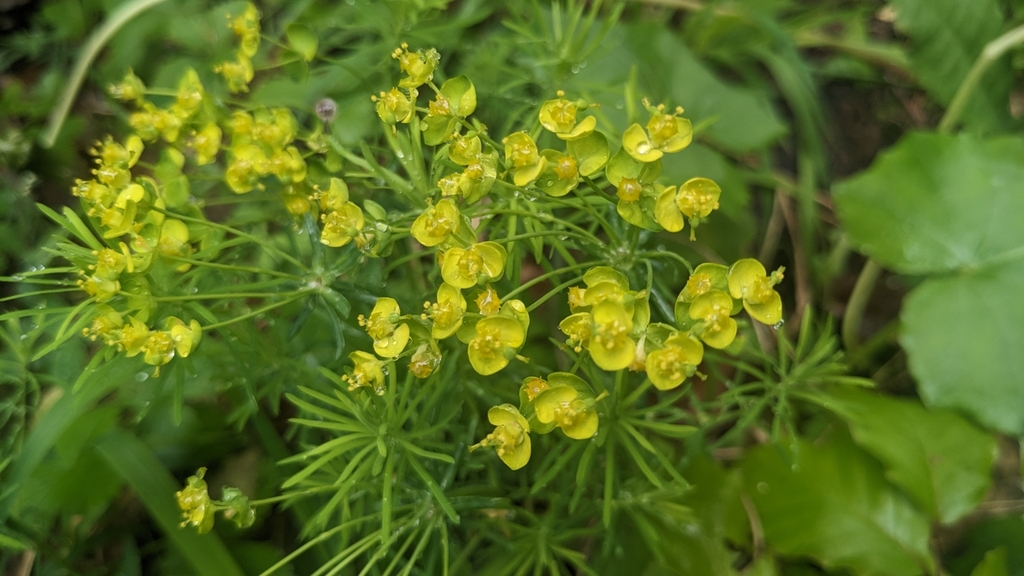
cypress spurge
Euphorbia cyparissias
Euphorbia cyparissias, the cypress spurge, is a species of plant in the genus Euphorbia. It is native to Europe and was introduced to North America in the 1860s as an ornamental plant.
Natural habitat types include dunes, pannes, coastal headlands and grasslands. In North America it is commonly found in the dry, gravelly soil of roadsides, pastures, and meadows. Cypress spurge thrives in open, disturbed areas.
From the article Euphorbia cyparissias on Wikipedia (CC BY-SA), quoted section by section
Description
The plant ranges from 8 inches (20 cm) to 16 inches (40 cm) in height. Its petal-like bracts are usually green-yellow, maturing to purple or red from May to August. The mature fruit explodes, spreading seeds up to 5 m (16 ft). The plant also reproduces through lateral root buds, which allow it to spread densely. It can be identified by its leaves, which are small and linear, measuring up to 4 cm (1.6 in) long by only 1 to 2 mm (1⁄32 to 3⁄32 in) wide.
What it does
This plant is considered a noxious weed in many places, including Colorado in the United States. Like some other non-native plants, it invades the habitat of native species. It is known to be harmful to cattle and horses, but not sheep. It can be difficult to control. Biological pest control methods have been attempted, involving the release of several European insect species in North America. Certain flea beetles have been effective, but there are concerns about the release of non-native insects into the region. Parasites of this species include Uromyces pisi-sativi, a fungus. Anthrenus scrophulariae may frequently be found on this plant. This plant is attractive as an ornamental but its invasive nature makes it necessary to control its spread; its root spread is more invasive than its ability to self-seed.
Wikipedia: “Ecology”
At the table
While the roots have sometimes been used as a purgative, it can be poisonous if taken in quantity, and animals can be poisoned by eating hay containing it. Contact with the sap can cause skin reactions.
Wikipedia: “Toxicity and uses”
Where it lives
Recorded sightings
—
geo-referenced records in GBIF, from museums, herbaria and field observers.
Drag the globe to turn it. Dots are where records exist, not a range map; darker means more records.
In the old herbals & bestiaries

Notable Commentaries on the History of Plants
Leonhart Fuchs · 1542 · p.846

Notable Commentaries on the History of Plants
Leonhart Fuchs · 1549 · p.844

On the Names of Plants
Hieronymus Bock (Tragus) · 1552 · p.369

Discourses on the Six Books of Dioscorides
Dioscorides; Pietro Andrea Mattioli (comm.) · 1568 · p.1497

A New Herbal, or History of Plants
Rembert Dodoens (trans. Henry Lyte) · 1578 · p.383

Herbarium Portatile, Oder Behendes Kräuter- und Gewächs-Buch: Darinn nicht allein 1363. so wol Einheimische als Außländndische Kräuter mit Lateinisch und Deutscher Benennung abgebildet, sondern auch die meisten, so in der Medicin gebräuchlich, kürtzlich erkläret werden
Panckow, Thomas · 1656 · p.285
In the stacks
Searching the stacks…
Every page naming Euphorbia cyparissias in the Biodiversity Heritage Library →
This page is assembled live from iNaturalist, GBIF, Wikipedia, the Source Library and the Internet Archive. It is not yet part of the hand-edited codex. iNaturalist taxon 55766.