- Plants
- ›Vascular Plants
- ›flowering plants
- ›Dicots
- ›Mints, Plantains, Olives, and Allies
- ›Plantain Family
- ›Toadflaxes and Allies
- ›Cymbalaria
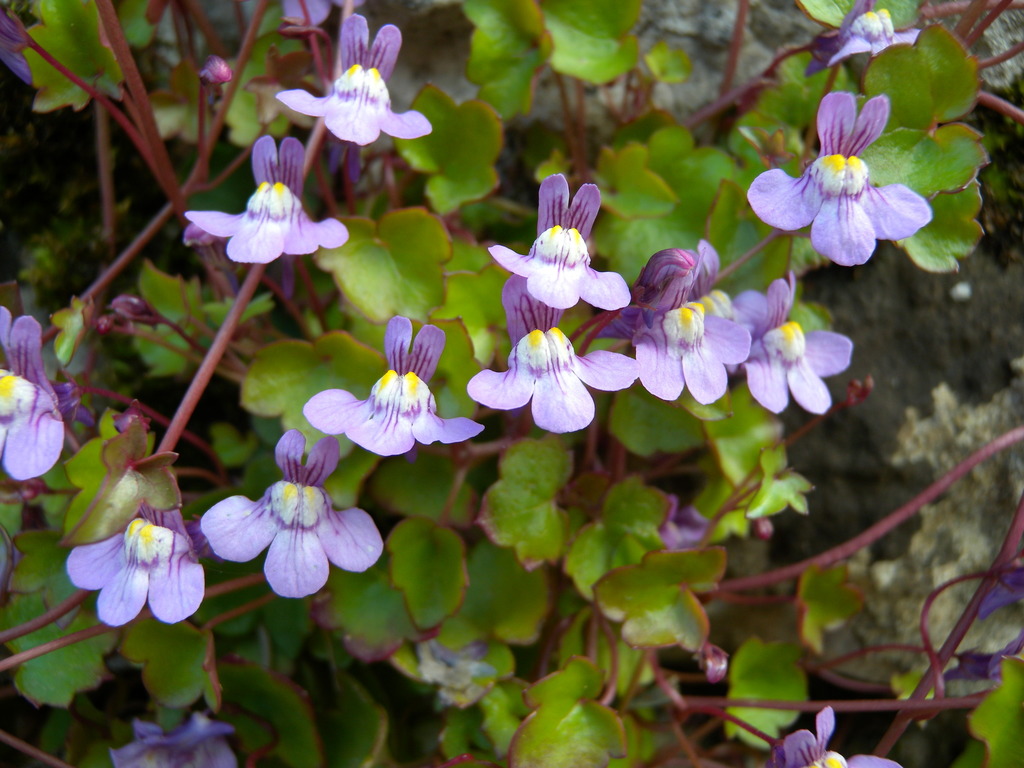
Ivy-leaved toadflax
Cymbalaria muralis
Cymbalaria muralis, commonly called ivy-leaved toadflax, is a low, spreading, trailing plant with small purple flowers, native to rocky habitats in southern Europe. It belongs to the plantain family (Plantaginaceae), and is introduced and naturalised in many other temperate locations. The flower stalk is unusual for seeking light until it is fertilized, after which it grows away from the light. Other names include coliseum ivy, Kenilworth ivy, mother of thousands, Oxford ivy, and wandering sailor.
From the article Cymbalaria muralis on Wikipedia (CC BY-SA), quoted section by section
Description
Cymbalaria muralis spreads quickly, growing 10–80 cm (3.9–31.5 in) tall. It is a biennial or short lived perennial plant. Its roots are thin and fibrous for reaching into cracks. Its rounded, heart-shaped, or kidney shaped leaves are 5–40 mm long, 6–60 mm wide, and are alternating, supported on thin petioles, usually purple, 10–22 mm long. The leaves are either smooth (glabrous) or with widely scattered hairs in the subspecies muralis, or pubescent (villous) in the subspecies visianii. They may have from three to seven lobes, but most often has five lobes. The leaves are relatively thick and often blushed with purple on their undersides.
Cymbalaria muralis has small flowers that strongly resemble those of a snapdragon. They have sepals at the base of the flower that have lobes 1.5–3 mm long and are sharply pointed. The petals form a closed tube 3–5 mm long. The lower lip of the flower expanded upwards to block the tube of the flower similarly to the well known snapdragon flowers (palate inflated). The two cushion shaped parts of the lip under the mouth have yellow spots. The lower lobes of the flower are spreading while the upper ones stand up, with rounded ends and 2–3 mm long. The majority of the flower is lilac with a yellow throat with darker lines on the upper lobes. Rarely the flowers may be all or nearly all white. …
Range & habitat
POWO regards the native range for this species to be limited to southern Europe, in Austria, France, Italy, Switzerland, and the former Yugoslavia, with the nominate subspecies Cymbalaria muralis subsp. muralis also occurring throughout this range. Similarly the World Plants database records it as native to the same areas, but more specifically to Slovenia, Croatia, Bosnia & Hercegovina, Serbia, and Kosovo in the former Yugoslavia and to the small state of San Marino on the Italian peninsula. It also shows it as native to additional areas north east of the Alps such as the Czech Republic, Slovakia and Liechtenstein, and many Atlantic Ocean islands such as the Azores, Madeira, the Canary Islands, and the Cape Verde Islands. Cymbalaria muralis subsp. visianii recorded by POWO as growing in the southeastern part of the species' range, only in Italy and the former Yugoslavia. The World Plants database largely agrees listing it as native to the central and southern parts of Italy and to Croatia, but also listing it as introduced in Germany; it has also been recorded as naturalised in Britain since 1970.
From this original range it spread to much of Europe and to the rest of the world as either an accidental introduction or because of its use as an ornamental plant. Its first record outside of cultivation in Great Britain is from 1640. …
Wikipedia: “Distribution”
What it does
Cymbalaria muralis is a generalist, attracting a wide range of pollinators, including bees, flies, and butterflies. Their roots are associated with arbuscular mycorrhiza, a group of fungi that partner with plants. At least three aphid species Myzus ornatus (violet aphid), Myzus persicae (green peach aphid), and Myzus cymbalariae are commonly found on Cymbalaria muralis. The last of these was first observed feeding on ivy-leaved toadflax and is named for the species. The plant is also a host for tomato ringspot virus.
Wikipedia: “Ecology”
At the table
Ivy-leaved toadflax is sometimes used as a salad green in Southern Europe. Its taste is described as like raw garden peas or bitter with a sharp numbing sensation, however it has also been noted as slightly toxic by researchers Marion Cooper and Anthony Johnson.
Wikipedia: “Edibility”
How it is grown
In gardens ivy-leaved toadflax is planted as a groundcover, particularly on rocky slopes, and planted in wall cracks. Once established it will reproduce on its own, both from seeding and stems rooting themselves. It is winter hardy in USDA zones 5 to 9. According to the garden author Carolyn Singer it is deer resistant.
Wikipedia: “Cultivation”
Where it lives
Recorded sightings
—
geo-referenced records in GBIF, from museums, herbaria and field observers.
Drag the globe to turn it. Dots are where records exist, not a range map; darker means more records.
In the old herbals & bestiaries

In the stacks
Searching the stacks…
Every page naming Cymbalaria muralis in the Biodiversity Heritage Library →
This page is assembled live from iNaturalist, GBIF, Wikipedia, the Source Library and the Internet Archive. It is not yet part of the hand-edited codex. iNaturalist taxon 55727.