- Plants
- ›Vascular Plants
- ›flowering plants
- ›Dicots
- ›pinks, cactuses, and allies
- ›pink family
- ›Caryophylloideae
- ›Sileneae
- ›Silene
- ›Behenantha
- ›Behenantha
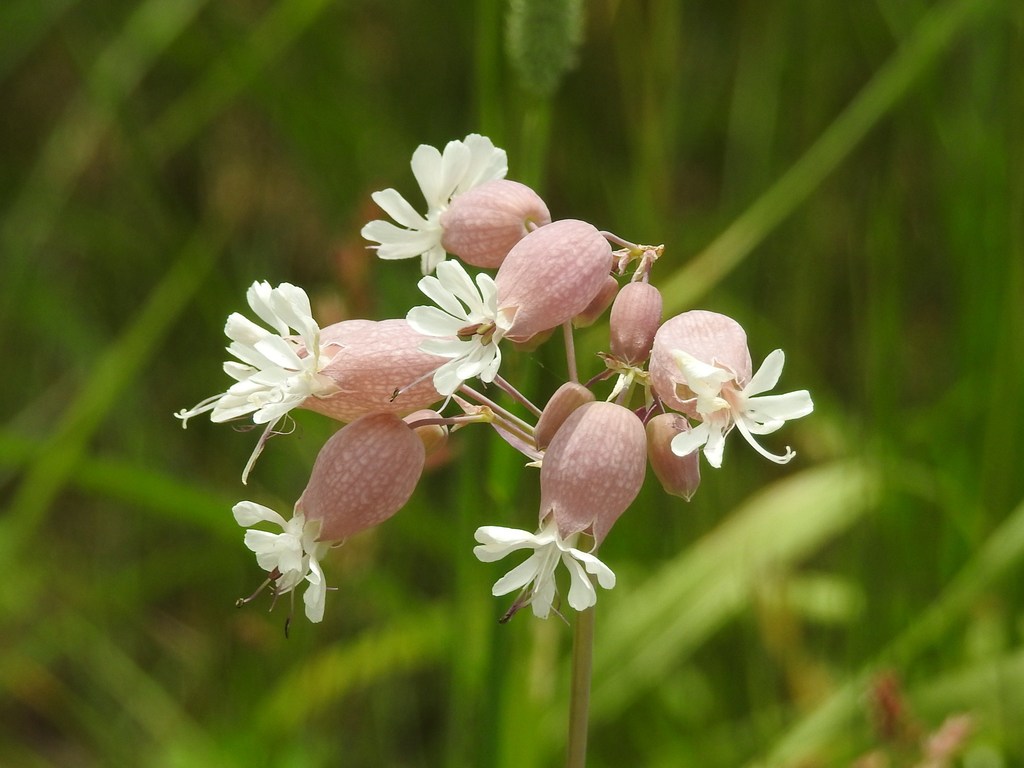
bladder campion
Silene vulgaris
Silene vulgaris, the bladder campion or maidenstears, is a plant species of the genus Silene within the family Caryophyllaceae. Native to the Old World, the plant has been naturalized elsewhere, including North America. The young shoots and leaves are edible.
From the article Silene vulgaris on Wikipedia (CC BY-SA), quoted section by section
Description
The plant can reach 60 centimetres (24 inches) in height, with white-petaled flowers up to 1.8 cm (1⁄2 in) wide. Similar species include S. noctiflora and S. latifolia.
Range & habitat
It is native to Europe, temperate Asia and northern Africa and has been introduced to other parts of the world, particularly North America, where it is now widespread and a common wild flower in meadows, open woods and fields.
Wikipedia: “Distribution and habitat”
At the table
The young shoots and the tender leaves are sometimes used as food in some countries of the Mediterranean region. These are considered edible raw before the plant flowers and can be used in salads. The older leaves are usually eaten boiled or fried, sauteed with garlic or in omelettes.
Crete and Cyprus. In Crete it is called agriopapoula (αγριοπάπουλα) and its leaves and tender shoots are eaten browned in olive oil. In Cyprus it is very widely eaten, so much so that in recent years it has once again been cultivated and sold in shops in bunches. Two of the common Cypriot names are strouthouthkia (στρουθούθκια; [stru'θuθca]) and tsakrithkia (τσακρίδκια; [t͡sa'kriðca]).
Italy. In Italy the leaves of this plant may be used as an ingredient in risotto. It is commonly known as sculpit, stridolo or by the obsolete scientific name Silene inflata, as well as s-ciopetin, grixol in Veneto and nenkuz or sclopit in Friuli and cojet in Piedmont.
Spain. In the La Mancha region of Spain, where S. vulgaris leaves are valued as a green vegetable, there used to be people known as collejeros who picked and sold these plants. …
Wikipedia: “Uses”
Where it lives
Recorded sightings
—
geo-referenced records in GBIF, from museums, herbaria and field observers.
Drag the globe to turn it. Dots are where records exist, not a range map; darker means more records.
In the stacks
Searching the stacks…
Every page naming Silene vulgaris in the Biodiversity Heritage Library →
This page is assembled live from iNaturalist, GBIF, Wikipedia, the Source Library and the Internet Archive. It is not yet part of the hand-edited codex. iNaturalist taxon 55721.