- Animals
- ›Arthropods
- ›Hexapods
- ›Insects
- ›Winged and Once-winged Insects
- ›Ants, Bees, Wasps, and Sawflies
- ›Narrow-waisted Wasps, Ants, and Bees
- ›Ants, Bees, and Stinging Wasps
- ›Bees and Apoid Wasps
- ›Bees
- ›Honey Bees, Bumble Bees, and Allies
- ›Carpenter Bees
- ›Large Carpenter Bees
- ›Xylocopa
- ›Cyaneoderes
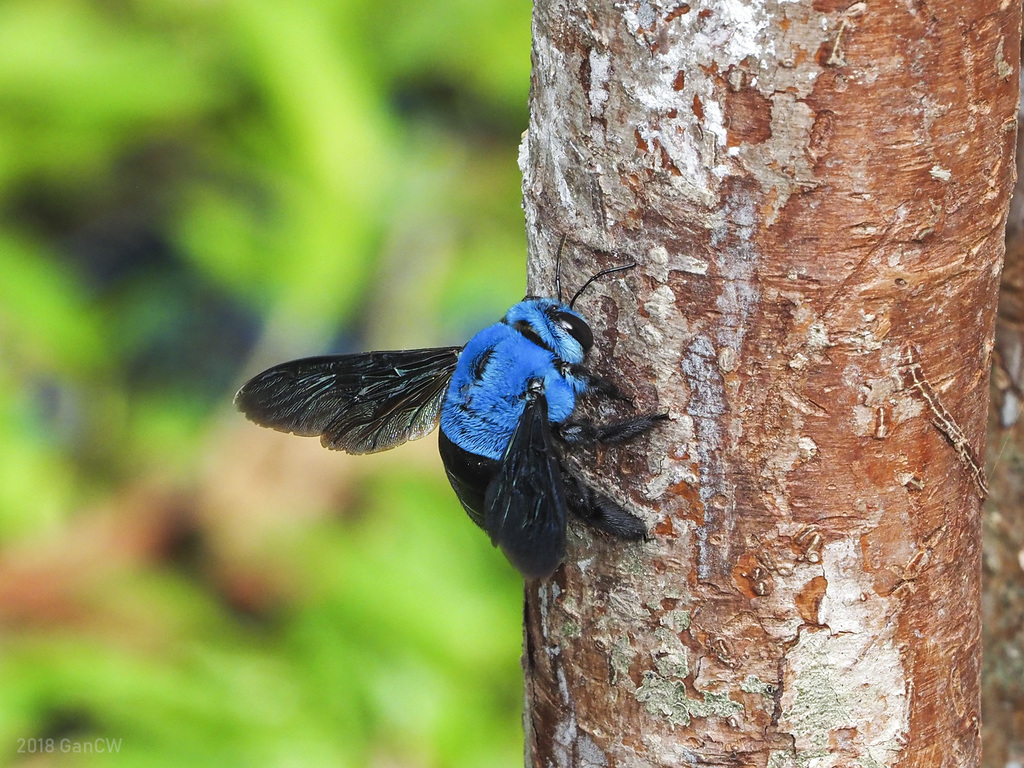
Blue Carpenter Bee
Xylocopa caerulea
Xylocopa caerulea, or the blue carpenter bee, is a species of carpenter bee.
From the article Xylocopa caerulea on Wikipedia (CC BY-SA), quoted section by section
Description
Xylocopa caerulea is a relatively large species, reaching an average size of 23 mm (0.91 in). The species is sexually dimorphic, with the thoraces of the females having striking blue color and the males' thoraces looking more brownish green. The sides of the abdomen and first abdominal segments are also covered by a similar, albeit finer and thinner, coat of blue hairs. The reflectance spectrum of the thorax of a female Xylocopa caerulea has a broad band in the blue wavelength range, with a trough around 600 nm, indicating the presence of a pigment that strongly reduces reflection in the red wavelength range.
What it does
Xylocopa caerulea will burrow into trees to make their nests. They usually are solitary, but sometimes multiple bees will share a common entry hole. They create honey which is mixed with pollen to create ambrosia or bee bread. This species will place the bee bread in a wooden chamber which they then lay their eggs on top of. The bee bread serves as a food source for their larvae.
Wikipedia: “Behavior”
Listen
Looking for field recordings…
Where it lives
Recorded sightings
—
geo-referenced records in GBIF, from museums, herbaria and field observers.
Drag the globe to turn it. Dots are where records exist, not a range map; darker means more records.
In the stacks
Searching the stacks…
Every page naming Xylocopa caerulea in the Biodiversity Heritage Library →
This page is assembled live from iNaturalist, GBIF, Wikipedia, the Source Library and the Internet Archive. It is not yet part of the hand-edited codex. iNaturalist taxon 557167.