- Plants
- ›Vascular Plants
- ›flowering plants
- ›Dicots
- ›Mints, Plantains, Olives, and Allies
- ›Plantain Family
- ›Veroniceae
- ›Veronica
- ›Pocilla
- ›Agrestes
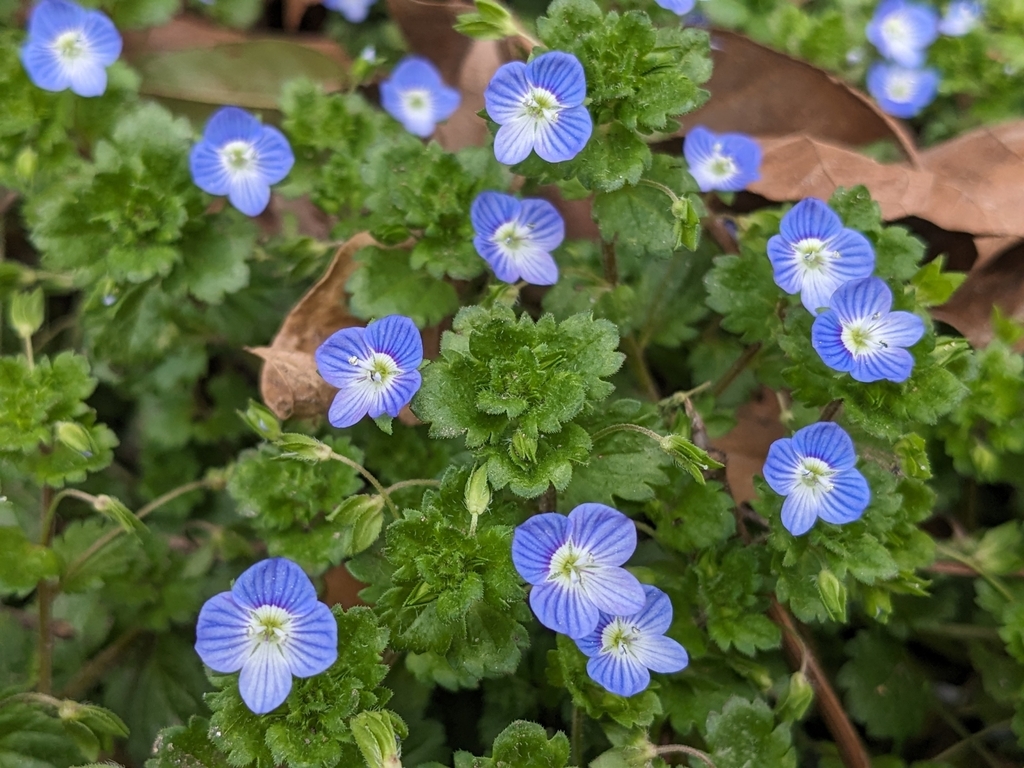
bird's-eye speedwell
Veronica persica
Veronica persica (common names: birdeye speedwell, common field-speedwell, Persian speedwell, large field speedwell, bird's-eye, or winter speedwell) (Persian: سیزاب ایرانی) is a flowering plant in the plantain family Plantaginaceae. It is native to Eurasia and is widespread as an introduced species in the British Isles (where it was first recorded in 1825), North America, and eastern Asia, including Japan and China.
From the article Veronica persica on Wikipedia (CC BY-SA), quoted section by section
Description
Veronica persica is an annual that reproduces from seed. Its cotyledons are triangular with truncated bases. The short-stalked leaves are broadly ovate with coarsely serrated margins, and measure one to two centimetres (0.4 to 0.8 in) long. The leaves are paired on the lower stem and are alternately arranged on the upper parts. The plant has weak stems that form a dense, prostrate groundcover. The tips of stems often grow upright. The flowers are roughly one centimetre (0.4 in) wide and are sky-blue with dark stripes and white centers. They are zygomorphic, having only one vertical plane of symmetry. They are solitary on long, slender, hairy stalks in the leaf axils. The seeds are transversely rugose and measure between one and two millimetres (0.04 and 0.08 in) long. There are five to 10 seeds per locule in the fruit. Similar species include Veronica persica fruit, which have lobes that widely diverge to form a spreading 'V', and solitary flowers emerging from the stem with the leaf stalks, whilst the flower stalks are regularly much longer than the leaves. …
Range & habitat
Veronica persica is native to the Caucasus and northern Iran, but it has become widely naturalised elsewhere. It now has a near cosmopolitan distribution, having been introduced to Europe, North Africa, the Americas, East Asia, Australia and New Zealand. The species was first recorded in Britain in 1825. It rapidly extended its range during the 1800s and was ubiquitous throughout lowland Britain and Ireland by 1960.
Wikipedia: “Distribution”
What it does
Veronica persica is a common ruderal and arable weed associated with disturbed habitats such as cultivated fields, gardens, lawns and roadsides. The plant prefers moist conditions and grows well in loamy, nutrient-rich soil. It is self-compatible and produces many seeds. It can germinate and flower throughout the year, and can spread vegetatively from stem fragments. These traits have contributed to the species' success outside its native range. Its seeds may be dispersed by ants.
Wikipedia: “Ecology”
At the table
Although many species in the genus are used in gardens (such as V. exalta, V. incana, V. gentianoides, V. longifolia, V. perfoliata, and V. spicata), this species is generally seen as a weed and has no known horticultural uses.
Wikipedia: “Horticultural uses”
In medicine
Afghani herbalist Mahomet Allum used the plant to treat patients with heart trouble, in Adelaide, Australia, in the mid-20th century. It is also used for snakebite treatment, hemorrhaging, rheumatoid arthritis, asthma, and as an expectorant.
Wikipedia: “Herbal medicine”
Where it lives
Recorded sightings
—
geo-referenced records in GBIF, from museums, herbaria and field observers.
Drag the globe to turn it. Dots are where records exist, not a range map; darker means more records.
In the stacks
Searching the stacks…
Every page naming Veronica persica in the Biodiversity Heritage Library →
This page is assembled live from iNaturalist, GBIF, Wikipedia, the Source Library and the Internet Archive. It is not yet part of the hand-edited codex. iNaturalist taxon 55666.